Ch. P - Fundamental Concepts of Algebra
Blitzer - College Algebra 8th Edition
Blitzer8th EditionCollege AlgebraISBN: 9780136970514Non è quello che usi tu?Cambia libro di testo
Capitolo 1, Problema 8

Evaluate each expression in Exercises 1–12, or indicate that the root is not a real number. √144+25

Guida verificata passo dopo passo
1
Step 1: Begin by identifying the components of the expression. The given expression is √144 + 25, which involves a square root and an addition operation.
Step 2: Evaluate the square root of 144. Recall that the square root of a number is a value that, when multiplied by itself, equals the original number. For example, √144 means finding a number x such that x² = 144.
Step 3: Once the square root of 144 is determined, substitute its value back into the expression. The expression will now be in the form of a simple addition problem.
Step 4: Add the result of the square root to 25. Perform the addition operation to simplify the expression further.
Step 5: Verify that the result is a real number. Since the square root of 144 is a real number and addition does not introduce any imaginary components, the final result will also be a real number.

Risposta video verificata per un problema simile:

Questa soluzione video è stata consigliata dai nostri tutor come utile per risolvere questo problema.
Durata del video:
2m

Concetti chiave

Ecco i concetti essenziali che devi comprendere per rispondere correttamente alla domanda.

Square Roots

A square root of a number is a value that, when multiplied by itself, gives the original number. For example, the square root of 144 is 12, since 12 × 12 = 144. Understanding how to calculate square roots is essential for evaluating expressions that involve them.
Video consigliato:
02:20
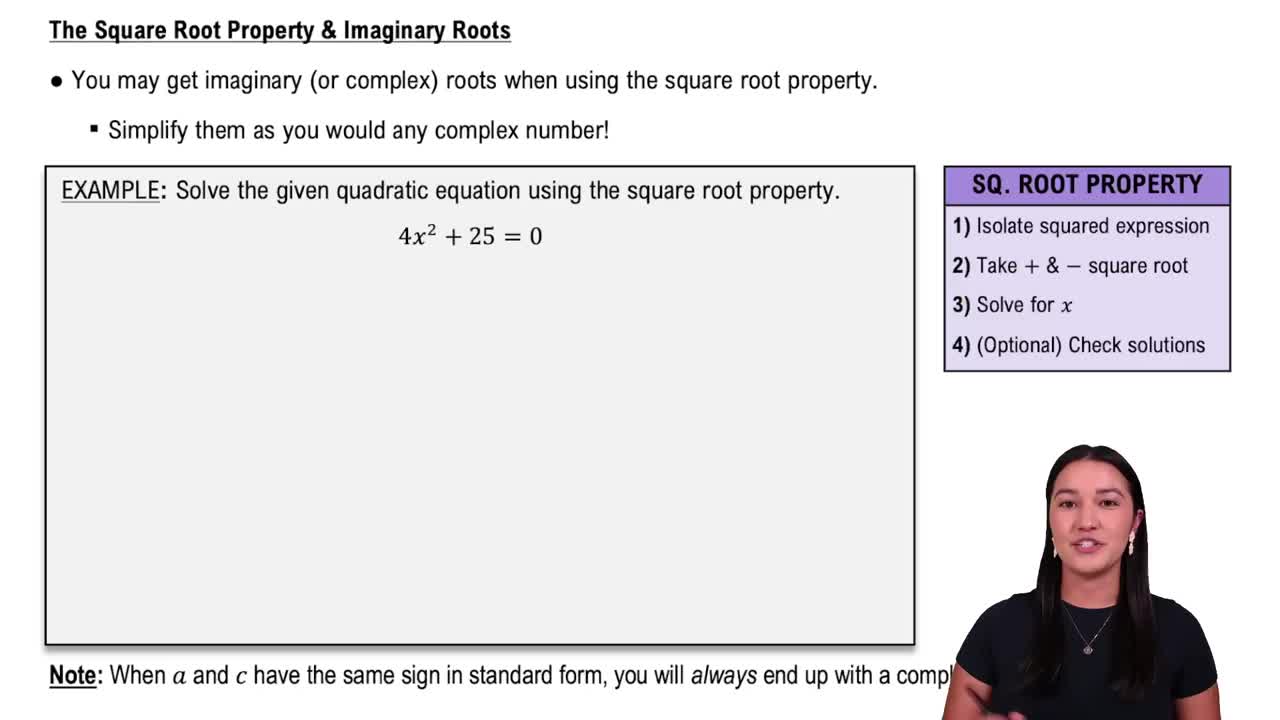
Imaginary Roots with the Square Root Property

Real Numbers

Real numbers include all the rational and irrational numbers that can be found on the number line. This concept is crucial when determining whether the result of an expression, such as a square root, is a real number or not. For instance, the square root of a negative number is not a real number.
Video consigliato:
03:31
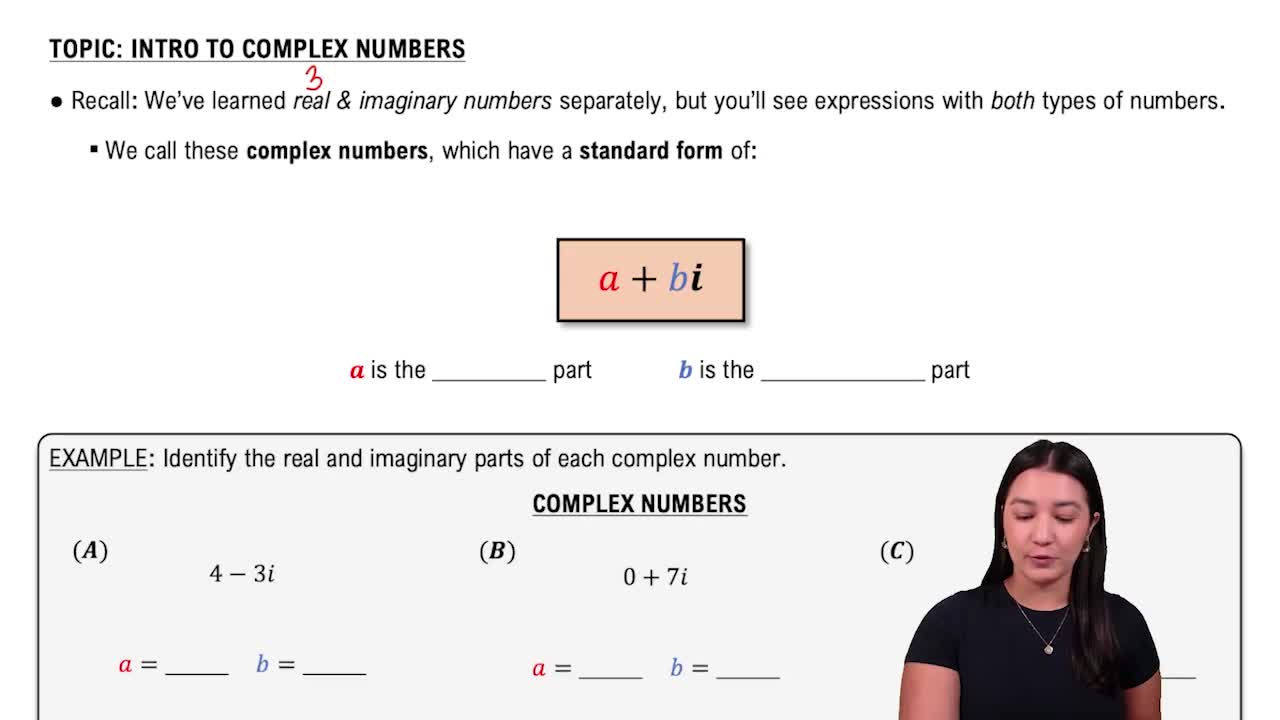
Introduction to Complex Numbers

Order of Operations

The order of operations is a set of rules that dictates the sequence in which different mathematical operations should be performed to ensure consistent results. The acronym PEMDAS (Parentheses, Exponents, Multiplication and Division, Addition and Subtraction) helps remember this order. Applying these rules correctly is vital when evaluating complex expressions.
Video consigliato:
8:38
Performing Row Operations on Matrices