Ch. P - Fundamental Concepts of Algebra
Blitzer - College Algebra 8th Edition
Blitzer8th EditionCollege AlgebraISBN: 9780136970514Non è quello che usi tu?Cambia libro di testo
Capitolo 1, Problema 88

Find each product. (a−b)(a2+ab+b2)(a-b)(a^2+ab+b^2)

Guida verificata passo dopo passo
1
Recognize that the expression \((a - b)(a^2 + ab + b^2)\) matches the form of the difference of cubes factorization, where \(a^3 - b^3 = (a - b)(a^2 + ab + b^2)\).
Understand that multiplying \((a - b)\) by \((a^2 + ab + b^2)\) will give you the expanded form of \(a^3 - b^3\).
To verify, apply the distributive property (also known as FOIL for binomials) by multiplying each term in the first parenthesis by each term in the second parenthesis:
Calculate \(a \times a^2 = a^3\), \(a \times ab = a^2b\), \(a \times b^2 = ab^2\), \(-b \times a^2 = -a^2b\), \(-b \times ab = -ab^2\), and \(-b \times b^2 = -b^3\).
Combine like terms: notice that \(a^2b\) and \(-a^2b\) cancel out, as do \(ab^2\) and \(-ab^2\), leaving you with \(a^3 - b^3\).

Risposta video verificata per un problema simile:

Questa soluzione video è stata consigliata dai nostri tutor come utile per risolvere questo problema.
Durata del video:
2m

Concetti chiave

Ecco i concetti essenziali che devi comprendere per rispondere correttamente alla domanda.

Polynomial Multiplication

Polynomial multiplication involves multiplying each term in one polynomial by every term in the other polynomial. This process requires applying the distributive property to combine like terms and simplify the expression.
Video consigliato:
03:42
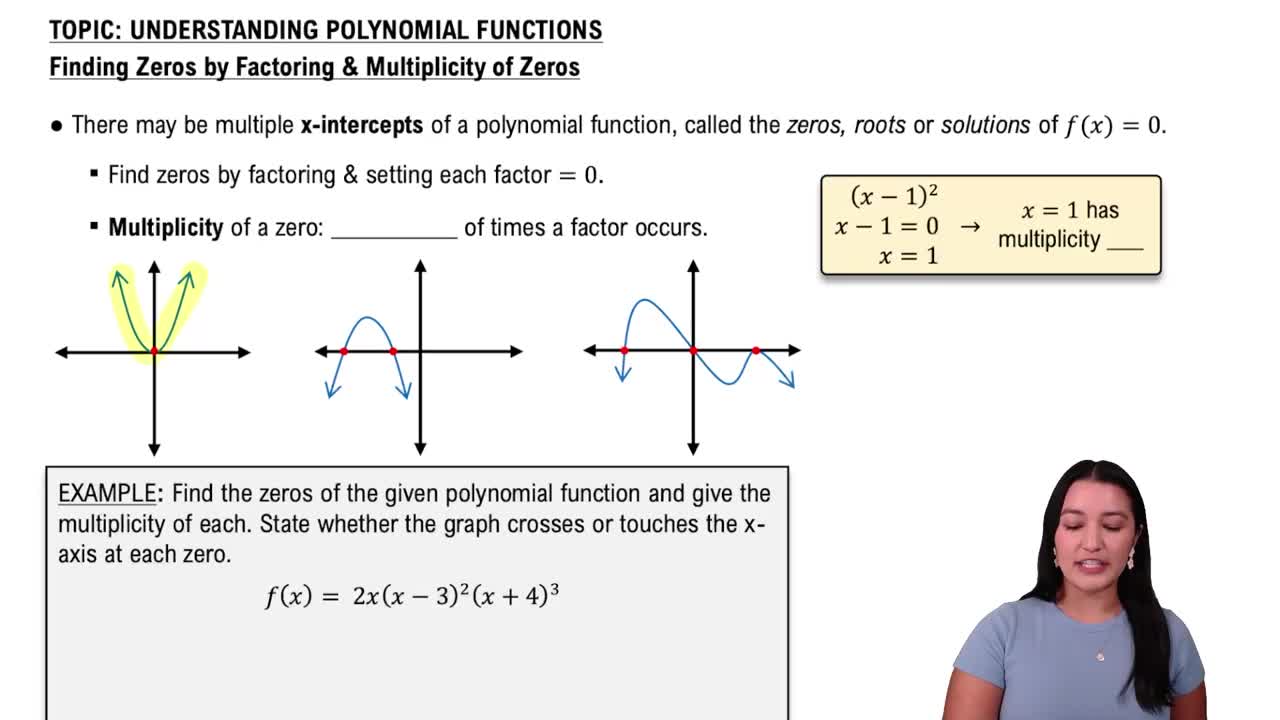
Finding Zeros & Their Multiplicity

Difference of Cubes Formula

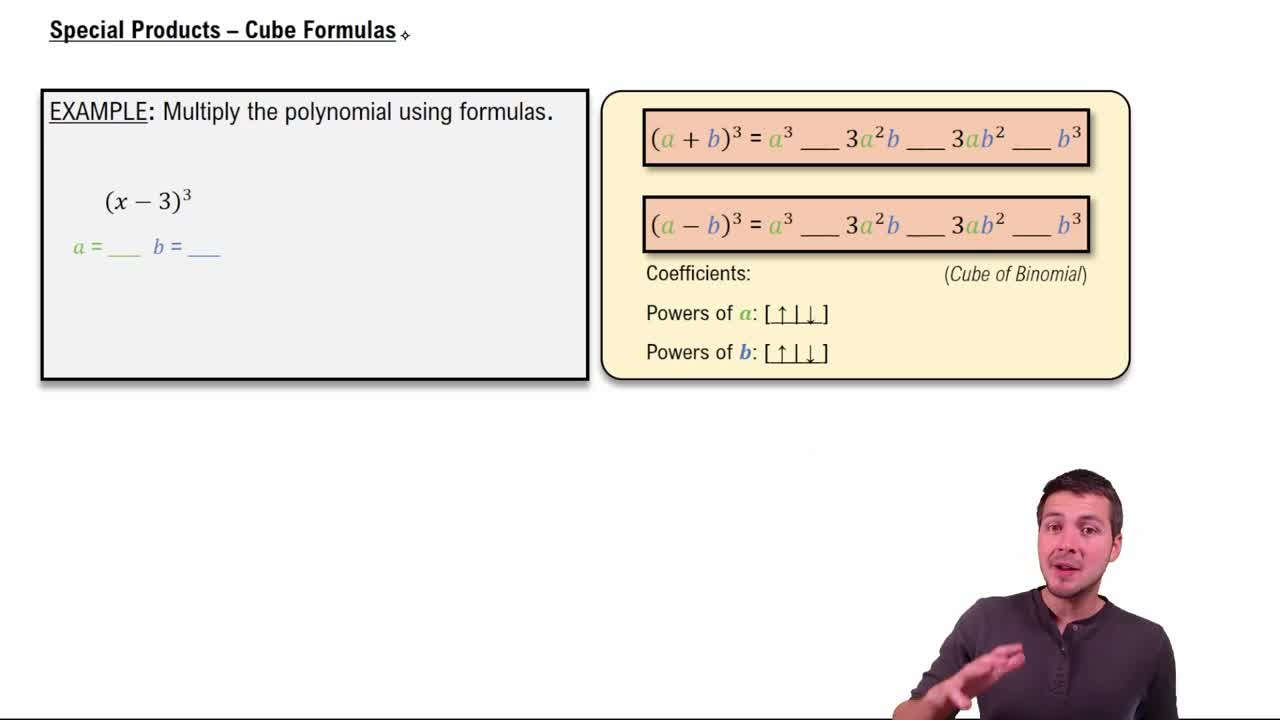
The difference of cubes formula states that (a - b)(a^2 + ab + b^2) equals a^3 - b^3. Recognizing this pattern allows for quick simplification of expressions matching this form without performing full multiplication.
Video consigliato:
03:41
Special Products - Cube Formulas

Exponents and Like Terms

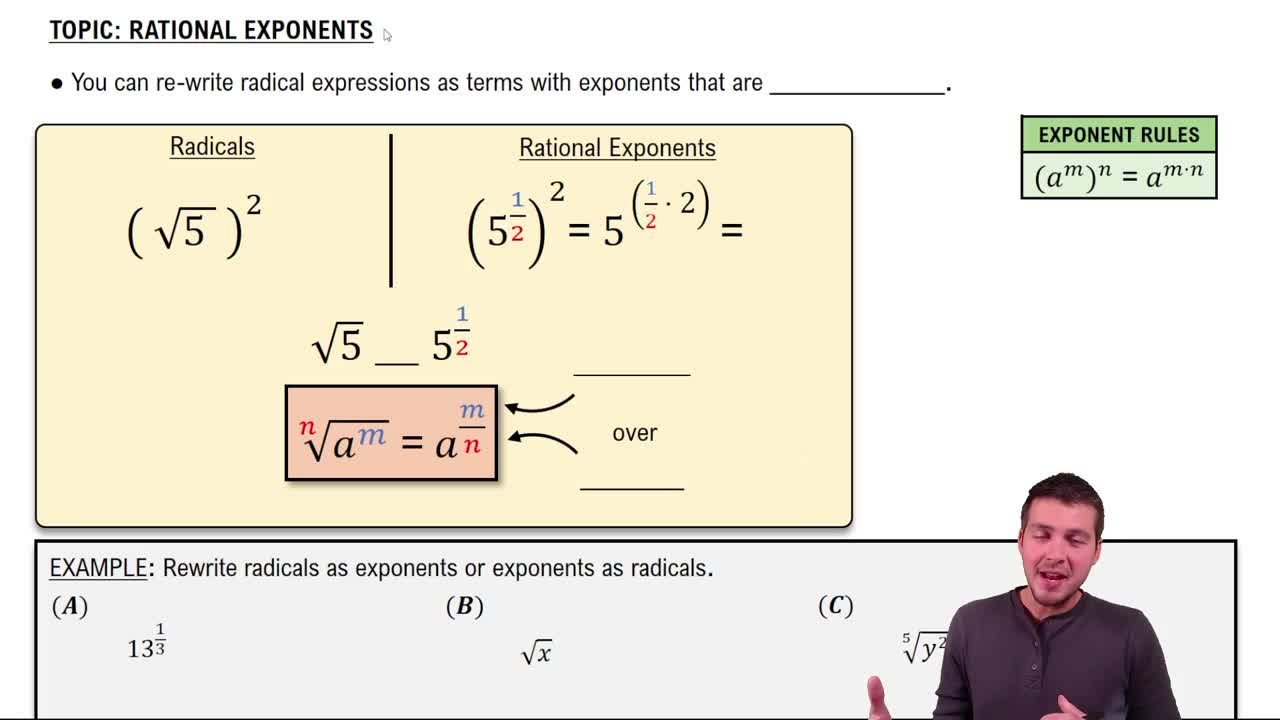
Understanding exponents is essential for correctly interpreting terms like a^2 and b^2. Combining like terms involves adding or subtracting coefficients of terms with the same variables and exponents to simplify the final expression.
Video consigliato:
04:06
Rational Exponents