Ch. P - Fundamental Concepts of Algebra
Blitzer - College Algebra 8th Edition
Blitzer8th EditionCollege AlgebraISBN: 9780136970514Non è quello che usi tu?Cambia libro di testo
Capitolo 1, Problema 13

In Exercises 1–16, evaluate each algebraic expression for the given value or values of the variable(s). 5(x+2)/(2x-14), for x=10

Guida verificata passo dopo passo
1
Step 1: Start by substituting the given value of x (x = 10) into the algebraic expression 5(x + 2) / (2x - 14). This gives 5(10 + 2) / (2(10) - 14).
Step 2: Simplify the numerator. Add the terms inside the parentheses: 10 + 2 = 12. The numerator becomes 5 * 12.
Step 3: Simplify the denominator. Multiply 2 by 10 to get 20, then subtract 14: 20 - 14 = 6. The denominator becomes 6.
Step 4: Rewrite the expression with the simplified numerator and denominator: (5 * 12) / 6.
Step 5: Simplify the fraction by performing the multiplication in the numerator (5 * 12) and then dividing the result by the denominator (6).

Risposta video verificata per un problema simile:

Questa soluzione video è stata consigliata dai nostri tutor come utile per risolvere questo problema.
Durata del video:
2m

Concetti chiave

Ecco i concetti essenziali che devi comprendere per rispondere correttamente alla domanda.

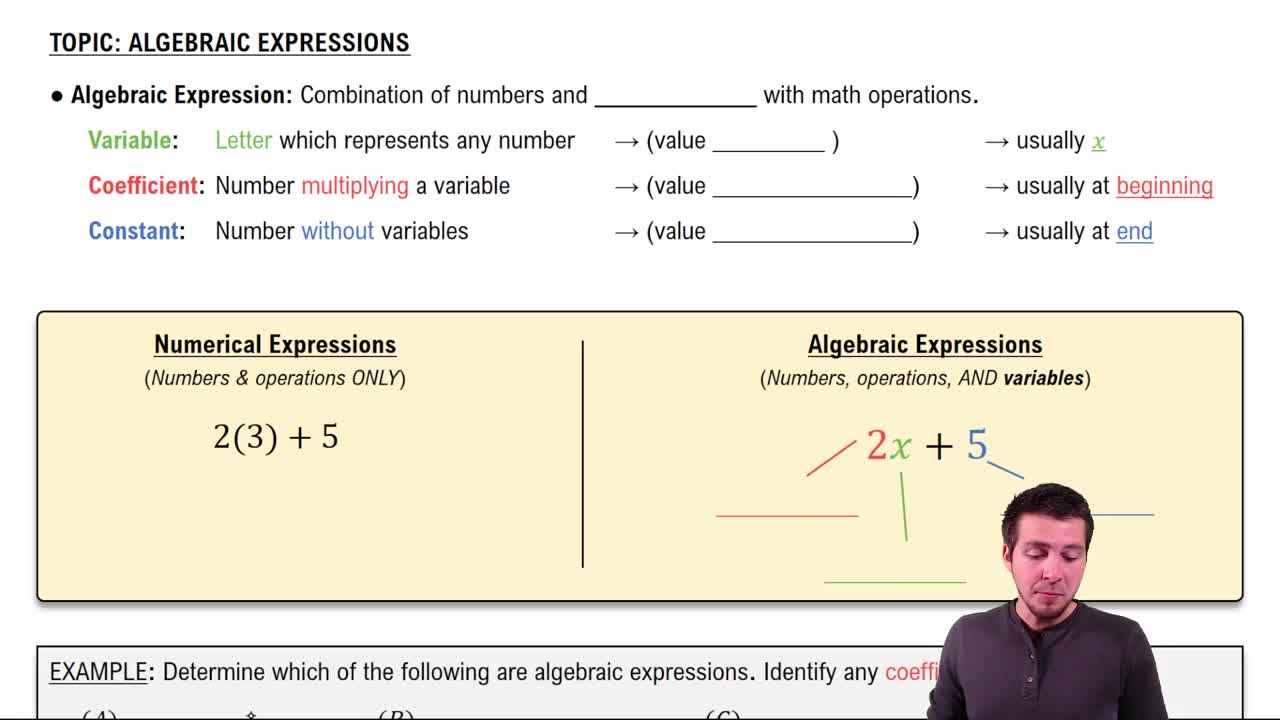
Algebraic Expressions

An algebraic expression is a mathematical phrase that can include numbers, variables, and operation symbols. In this case, the expression 5(x+2)/(2x-14) consists of a numerator and a denominator, where 'x' is a variable that can take on different values. Understanding how to manipulate and evaluate these expressions is fundamental in algebra.
Video consigliato:
05:09
Introduction to Algebraic Expressions

Substitution

Substitution is the process of replacing a variable in an expression with a specific value. For the expression given, substituting x=10 means replacing every instance of 'x' with 10, allowing us to simplify and evaluate the expression. This step is crucial for finding the numerical value of the expression.
Video consigliato:
5:48
Solving Systems of Equations - Substitution

Order of Operations

The order of operations is a set of rules that dictates the sequence in which calculations should be performed to ensure consistent results. Commonly remembered by the acronym PEMDAS (Parentheses, Exponents, Multiplication and Division, Addition and Subtraction), applying these rules correctly is essential when evaluating expressions to avoid errors in calculations.
Video consigliato:
8:38
Performing Row Operations on Matrices