Ch. P - Fundamental Concepts of Algebra
Blitzer - College Algebra 8th Edition
Blitzer8th EditionCollege AlgebraISBN: 9780136970514Non è quello che usi tu?Cambia libro di testo
Capitolo 1, Problema 118

In Exercises 111–120, use the order of operations to simplify each expression. 6(−4)−5(−3)/(9−10)

Guida verificata passo dopo passo
1
Identify the order of operations: Parentheses, Exponents, Multiplication and Division (from left to right), and Addition and Subtraction (from left to right). This is often remembered as PEMDAS.
Simplify the parentheses first. In this case, calculate \( 9 - 10 \), which simplifies to \( -1 \).
Next, handle the multiplication in the terms \( 6(-4) \) and \( -5(-3) \). Multiply \( 6 \) by \( -4 \) and \( -5 \) by \( -3 \).
Divide the result of \( -5(-3) \) by \( -1 \). Perform this division to simplify the fraction.
Finally, combine the results of \( 6(-4) \) and the simplified division from the previous step by performing the subtraction.

Risposta video verificata per un problema simile:

Questa soluzione video è stata consigliata dai nostri tutor come utile per risolvere questo problema.
Durata del video:
5m

Concetti chiave

Ecco i concetti essenziali che devi comprendere per rispondere correttamente alla domanda.

Order of Operations

The order of operations is a set of rules that dictates the sequence in which mathematical operations should be performed to ensure consistent results. The acronym PEMDAS (Parentheses, Exponents, Multiplication and Division, Addition and Subtraction) helps remember this order. Following these rules is crucial for simplifying expressions correctly.
Video consigliato:
8:38
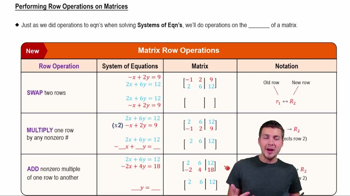
Performing Row Operations on Matrices

Multiplication and Division

Multiplication and division are operations that are performed from left to right after addressing any parentheses or exponents in an expression. In the given problem, the multiplication of 6 and -4, as well as -5 and -3, must be calculated before any addition or subtraction occurs. Understanding how to handle these operations is essential for simplifying the expression accurately.
Video consigliato:
03:42
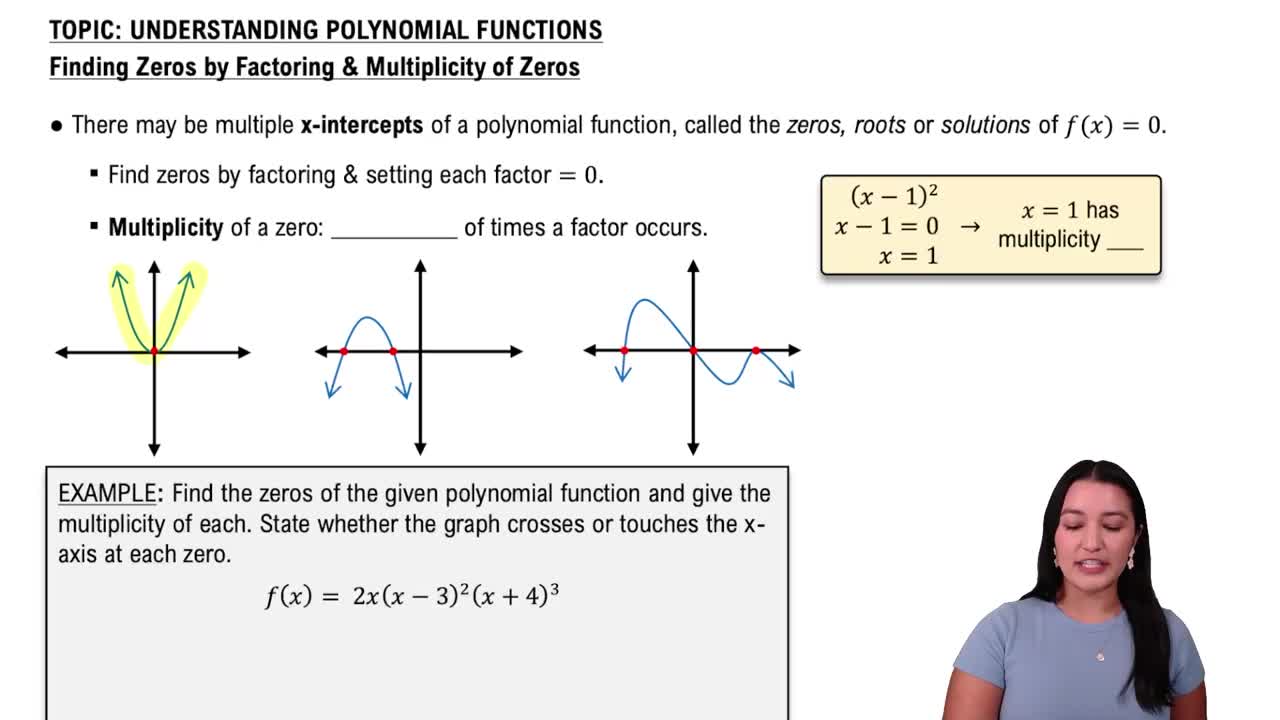
Finding Zeros & Their Multiplicity

Negative Numbers

Negative numbers are values less than zero and can affect the outcome of arithmetic operations. In this expression, the presence of negative numbers requires careful attention, especially when multiplying or dividing, as the rules for signs (positive times negative equals negative) must be applied. Recognizing how to work with negative values is vital for achieving the correct simplification.
Video consigliato:
05:02
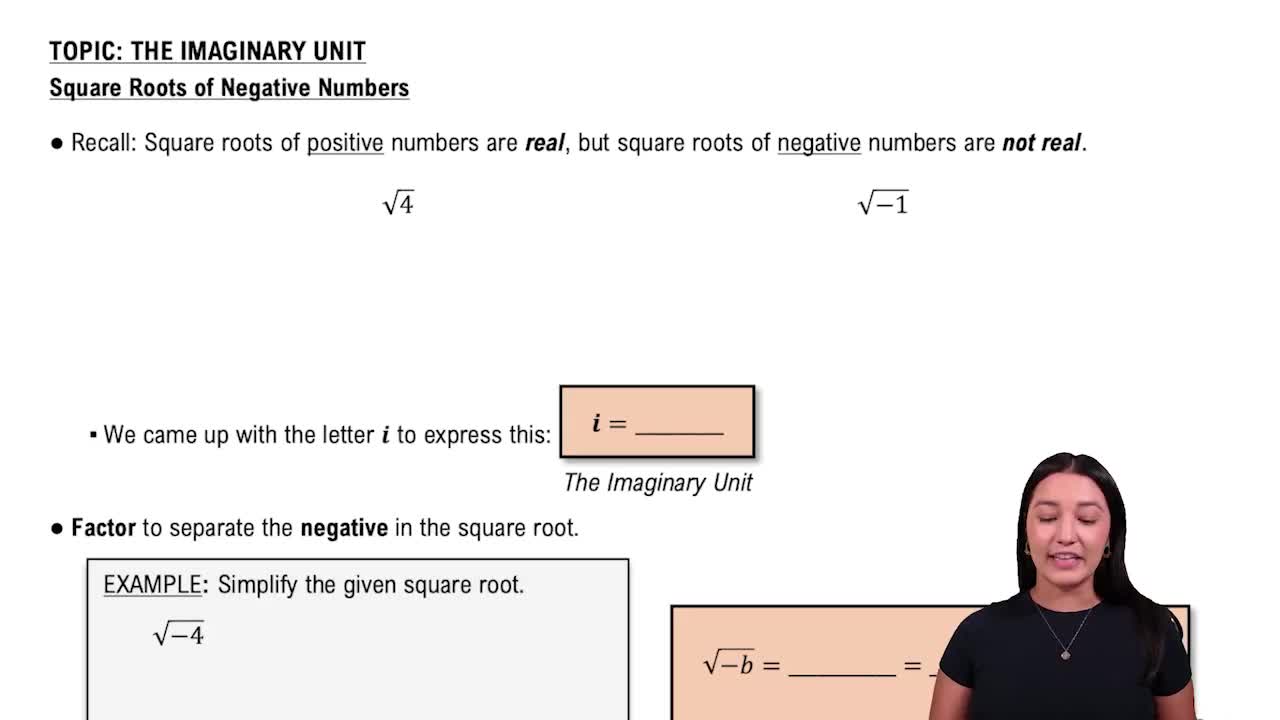
Square Roots of Negative Numbers