Ch. P - Fundamental Concepts of Algebra
Blitzer - College Algebra 8th Edition
Blitzer8th EditionCollege AlgebraISBN: 9780136970514Non è quello che usi tu?Cambia libro di testo
Capitolo 1, Problema 35

List all numbers from the given set that are a. natural numbers, b. whole numbers, c. integers, d. rational numbers, e. irrational numbers, f. real numbers. {-9, -4/5, 0, 0.25, √3, 9.2, √100}

Guida verificata passo dopo passo
1
Step 1: Understand the definitions of each type of number: - Natural numbers: positive integers starting from 1 (1, 2, 3, ...). - Whole numbers: natural numbers including zero (0, 1, 2, 3, ...). - Integers: all whole numbers and their negatives (..., -3, -2, -1, 0, 1, 2, 3, ...). - Rational numbers: numbers that can be expressed as a fraction \( \frac{a}{b} \) where \(a\) and \(b\) are integers and \(b \neq 0\). - Irrational numbers: numbers that cannot be expressed as a simple fraction, their decimal expansions are non-terminating and non-repeating. - Real numbers: all rational and irrational numbers combined.
Step 2: Evaluate each element in the set \( \{-9, -\frac{4}{5}, 0, 0.25, \sqrt{3}, 9.2, \sqrt{100} \} \): - \(-9\) is an integer. - \(-\frac{4}{5}\) is a rational number (fraction). - \(0\) is a whole number. - \(0.25\) is a rational number (can be written as \(\frac{1}{4}\)). - \(\sqrt{3}\) is an irrational number. - \(9.2\) is a rational number (can be written as \(\frac{92}{10}\)). - \(\sqrt{100}\) simplifies to \(10\), which is a natural number.
Step 3: List all natural numbers from the set: - Identify numbers that are positive integers starting from 1. - From the set, \(10\) (from \(\sqrt{100}\)) is a natural number.
Step 4: List all whole numbers from the set: - Include all natural numbers and zero. - From the set, \(0\) and \(10\) (from \(\sqrt{100}\)) are whole numbers.
Step 5: List all integers, rational numbers, irrational numbers, and real numbers: - Integers: numbers without fractional parts, including negatives and zero (\(-9, 0, 10\)). - Rational numbers: all numbers that can be expressed as fractions (\(-9, -\frac{4}{5}, 0, 0.25, 9.2, 10\)). - Irrational numbers: numbers that cannot be expressed as fractions (\(\sqrt{3}\)). - Real numbers: all numbers in the set since they are either rational or irrational.

Risposta video verificata per un problema simile:

Questa soluzione video è stata consigliata dai nostri tutor come utile per risolvere questo problema.
Durata del video:
4m

Concetti chiave

Ecco i concetti essenziali che devi comprendere per rispondere correttamente alla domanda.

Number Sets and Their Definitions

Understanding different types of numbers is essential. Natural numbers are positive counting numbers starting from 1. Whole numbers include all natural numbers plus zero. Integers extend whole numbers to include negative numbers as well.
Video consigliato:
4:47
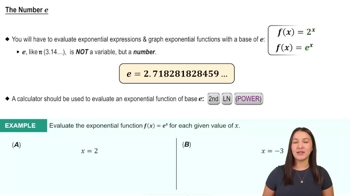
The Number e

Rational and Irrational Numbers

Rational numbers can be expressed as a fraction of two integers, including decimals that terminate or repeat. Irrational numbers cannot be written as simple fractions and have non-repeating, non-terminating decimals, such as √3.
Video consigliato:
4:47
The Number e

Real Numbers

Real numbers include all rational and irrational numbers, encompassing every point on the number line. This set covers natural numbers, whole numbers, integers, rational numbers, and irrational numbers, making it the broadest category in this context.
Video consigliato:
03:31
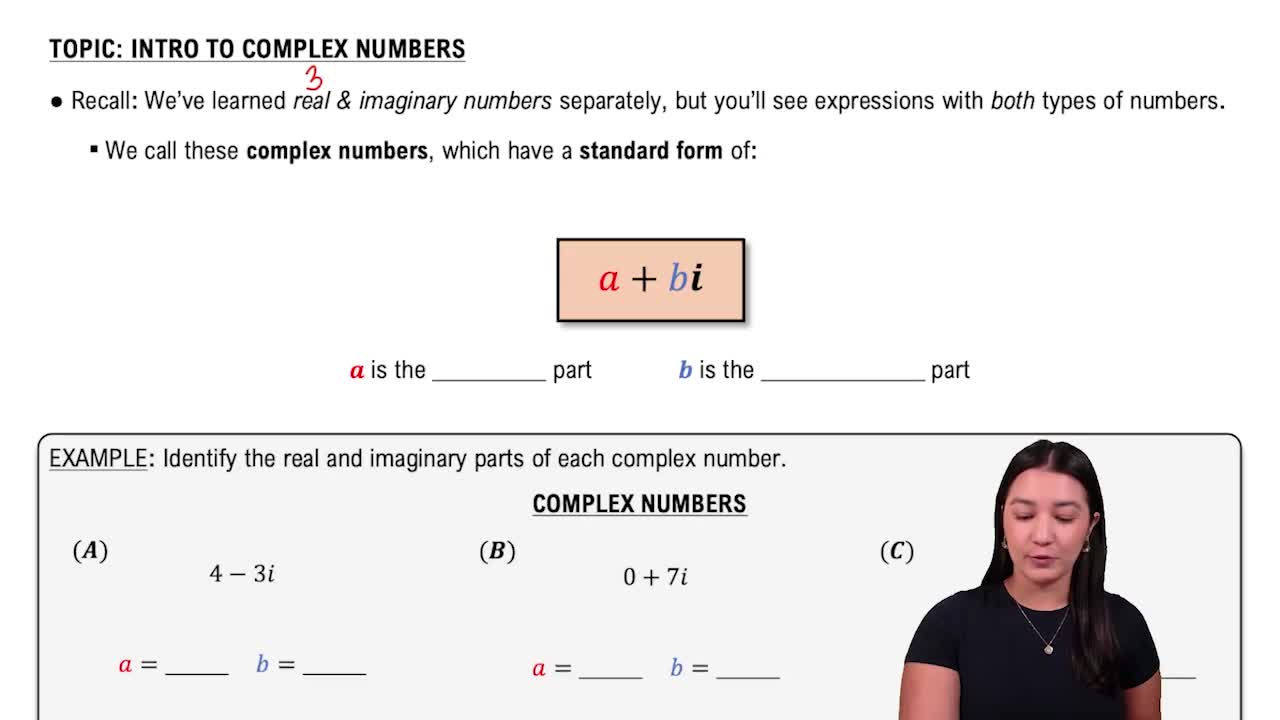
Introduction to Complex Numbers