Ch. P - Fundamental Concepts of Algebra
Blitzer - College Algebra 8th Edition
Blitzer8th EditionCollege AlgebraISBN: 9780136970514Non è quello che usi tu?Cambia libro di testo
Capitolo 1, Problema 55

Simplify each exponential expression in Exercises 23–64. (4x^3)^−2

Guida verificata passo dopo passo
1
Start by recalling the rule of exponents: \((a^m)^n = a^{m \cdot n}\). This rule will help simplify the expression \((4x^3)^{-2}\).
Apply the rule of exponents to distribute the \(-2\) exponent to both the base \(4\) and \(x^3\). This gives \(4^{-2} \cdot (x^3)^{-2}\).
Simplify \(4^{-2}\) using the property \(a^{-n} = \frac{1}{a^n}\). This results in \(\frac{1}{4^2}\).
Simplify \((x^3)^{-2}\) using the same property \(a^{-n} = \frac{1}{a^n}\). This results in \(\frac{1}{x^{3 \cdot 2}}\), which simplifies further to \(\frac{1}{x^6}\).
Combine the simplified terms \(\frac{1}{4^2}\) and \(\frac{1}{x^6}\) into a single fraction: \(\frac{1}{4^2 \cdot x^6}\). Finally, simplify \(4^2\) to \(16\), resulting in \(\frac{1}{16x^6}\).

Risposta video verificata per un problema simile:

Questa soluzione video è stata consigliata dai nostri tutor come utile per risolvere questo problema.
Durata del video:
2m

Concetti chiave

Ecco i concetti essenziali che devi comprendere per rispondere correttamente alla domanda.

Exponential Rules

Exponential rules are fundamental properties that govern the manipulation of expressions involving exponents. Key rules include the product of powers, power of a power, and negative exponents. For instance, a negative exponent indicates the reciprocal of the base raised to the absolute value of the exponent, which is crucial for simplifying expressions like (4x^3)^{-2}.
Video consigliato:
6:54
Cramer's Rule - 2 Equations with 2 Unknowns

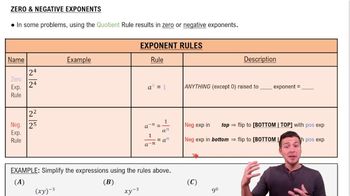
Negative Exponents

Negative exponents represent the reciprocal of the base raised to the positive exponent. For example, a term like a^{-n} can be rewritten as 1/a^n. This concept is essential for simplifying expressions with negative exponents, as it allows us to convert them into a more manageable form, facilitating further simplification.
Video consigliato:
6:37
Zero and Negative Rules

Power of a Product

The power of a product rule states that when raising a product to an exponent, you can distribute the exponent to each factor in the product. For example, (ab)^n = a^n * b^n. This rule is particularly useful in simplifying expressions like (4x^3)^{-2}, as it allows us to separately handle the constant and the variable components.
Video consigliato:
04:10
Powers of i