Ch. P - Fundamental Concepts of Algebra
Blitzer - College Algebra 8th Edition
Blitzer8th EditionCollege AlgebraISBN: 9780136970514Non è quello che usi tu?Cambia libro di testo
Capitolo 1, Problema 62

Simplify the radical expressions in Exercises 58 - 62. ∜(32x5)/∜(16x) (Assume that x > 0.)

Guida verificata passo dopo passo
1
Rewrite the expression by combining the fourth roots into a single fourth root: \(\frac{\sqrt[4]{32x^5}}{\sqrt[4]{16x}} = \sqrt[4]{\frac{32x^5}{16x}}\).
Simplify the fraction inside the radical: \(\frac{32x^5}{16x} = 2x^{5-1} = 2x^4\).
Now the expression is \(\sqrt[4]{2x^4}\). Recognize that \(\sqrt[4]{x^4} = x\) since \(x > 0\).
Separate the fourth root into the product of two fourth roots: \(\sqrt[4]{2x^4} = \sqrt[4]{2} \times \sqrt[4]{x^4} = \sqrt[4]{2} \times x\).
Write the simplified expression as \(x \sqrt[4]{2}\), which is the simplified form of the original expression.

Risposta video verificata per un problema simile:

Questa soluzione video è stata consigliata dai nostri tutor come utile per risolvere questo problema.
Durata del video:
3m

Concetti chiave

Ecco i concetti essenziali che devi comprendere per rispondere correttamente alla domanda.

Properties of Radicals

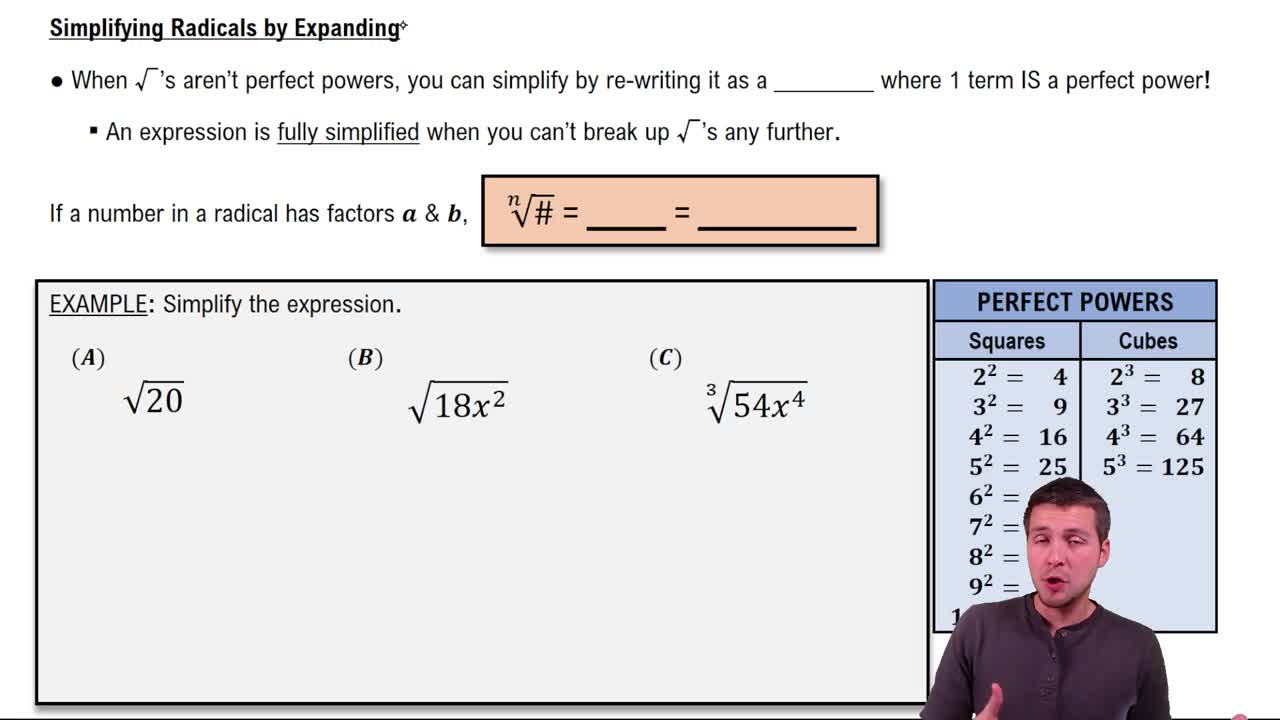
Radicals represent roots, such as square roots or fourth roots. Key properties include the ability to separate radicals over multiplication and division, for example, ⁿ√(a/b) = ⁿ√a / ⁿ√b. Understanding these properties allows simplification of complex radical expressions.
Video consigliato:
05:20
Expanding Radicals

Simplifying Radicals with Variables

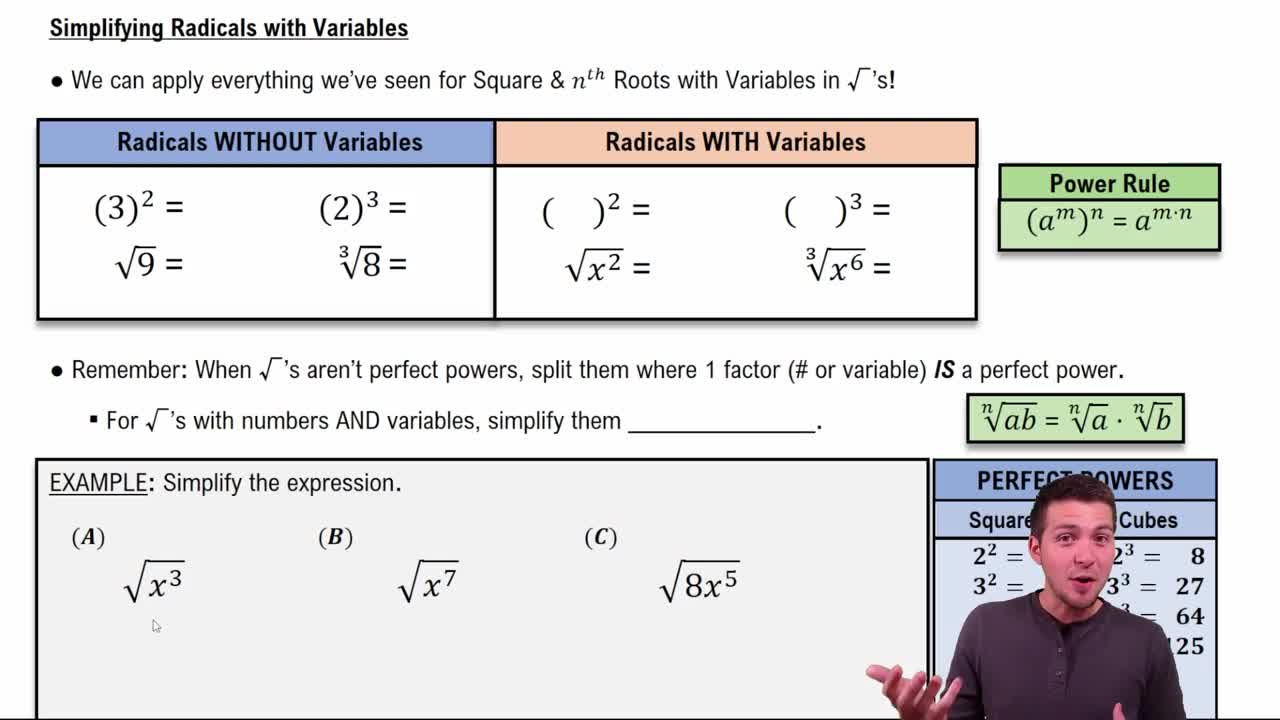
When simplifying radicals containing variables, apply the root to both the coefficient and the variable separately. For variables with exponents, divide the exponent by the root's index, extracting whole powers outside the radical and leaving the remainder inside.
Video consigliato:
06:44
Radical Expressions with Variables

Fourth Roots and Exponent Rules

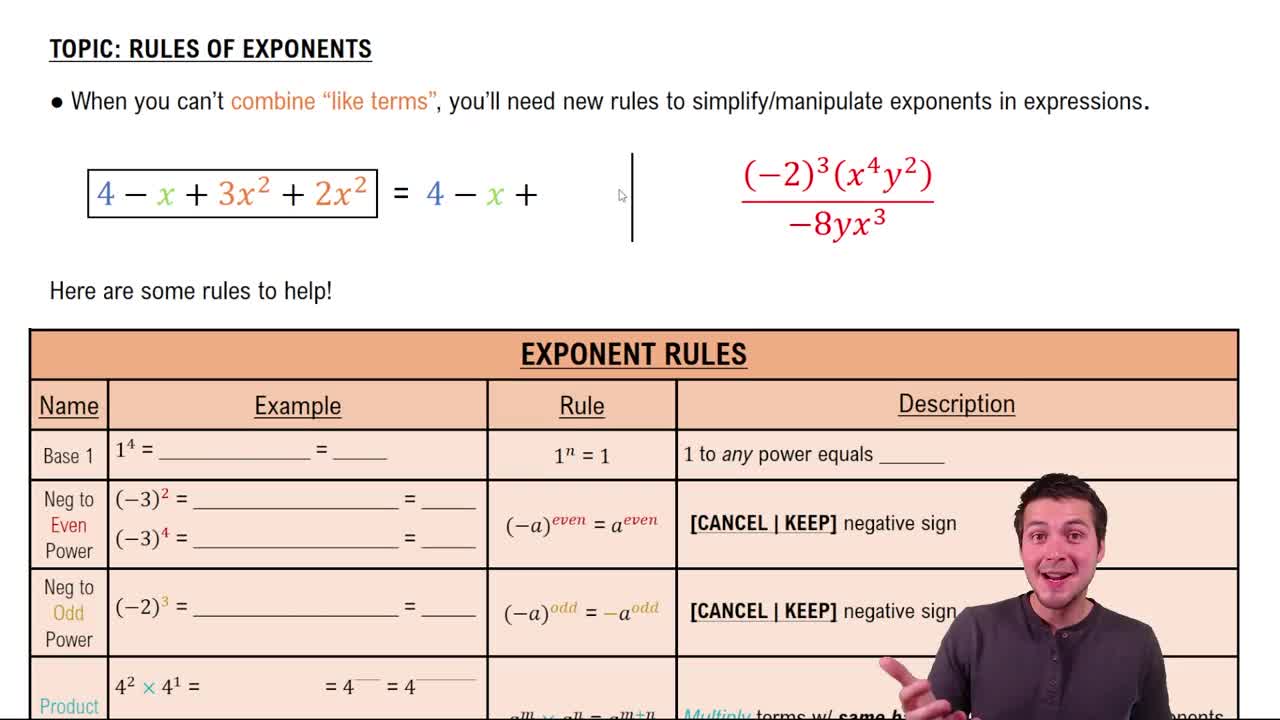
The fourth root (⁴√) of a number is the value that, when raised to the fourth power, returns the original number. Using exponent rules, ⁿ√(a^m) = a^(m/n), helps convert radicals into fractional exponents, simplifying calculations and expressions.
Video consigliato:
7:39
Introduction to Exponent Rules