Evaluate each exponential expression in Exercises 1–22.
Ch. P - Fundamental Concepts of Algebra

Capitolo 1, Problema 18
State the name of the property illustrated: (3 • 7) + (4 • 7) = (4 • 7) + (3 •7)
Guida verificata passo dopo passo1
Observe the given expression: \( (3 \cdot 7) + (4 \cdot 7) = (4 \cdot 7) + (3 \cdot 7) \). Notice that the two products are being added together on both sides.
Identify that the terms on the left side are \(3 \cdot 7\) and \(4 \cdot 7\), and on the right side, the same terms appear but in reversed order: \(4 \cdot 7\) and \(3 \cdot 7\).
Recall the Commutative Property of Addition, which states that changing the order of addends does not change the sum. In symbolic form, this is \(a + b = b + a\).
Since the expression shows the sum of two products with their order switched but the sum remains the same, this illustrates the Commutative Property of Addition.
Therefore, the property illustrated by the equation is the Commutative Property of Addition.

Risposta video verificata per un problema simile:
Questa soluzione video è stata consigliata dai nostri tutor come utile per risolvere questo problema.
Durata del video:
1mConcetti chiave
Ecco i concetti essenziali che devi comprendere per rispondere correttamente alla domanda.
Commutative Property of Addition
The commutative property of addition states that changing the order of addends does not change the sum. For example, a + b = b + a. In the given expression, the sums on both sides have the same terms added in different orders, illustrating this property.
Video consigliato:
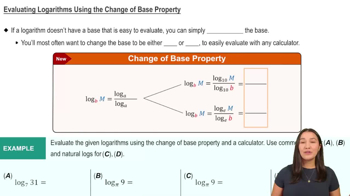
Change of Base Property
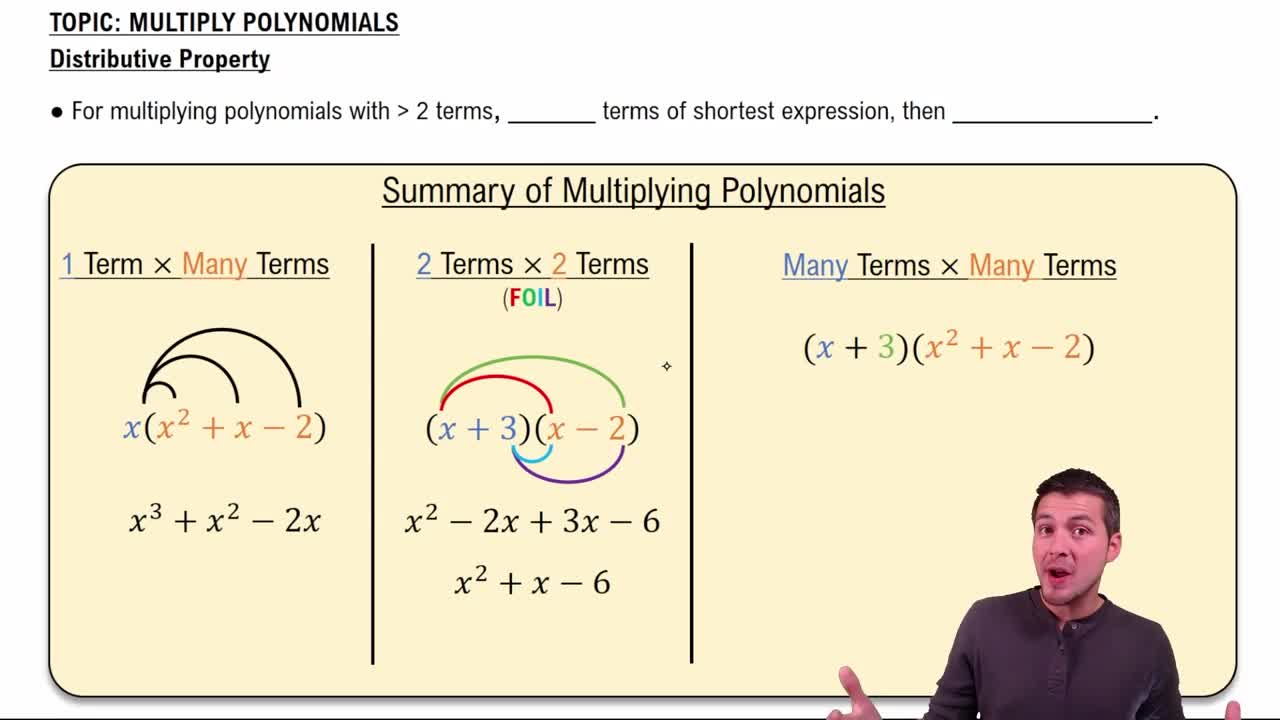
Distributive Property
The distributive property connects multiplication and addition, stating that a(b + c) = ab + ac. Although the given expression resembles terms from distribution, it primarily shows rearrangement of terms rather than distribution itself.
Video consigliato:
Multiply Polynomials Using the Distributive Property
Multiplication of Real Numbers
Multiplication of real numbers is commutative, meaning a × b = b × a. This allows factors to be reordered without changing the product, which is essential in understanding why (3 • 7) and (7 • 3) are equivalent in the expression.
Video consigliato:
Introduction to Complex Numbers
Pratica correlata
Domanda del libro di testo
924
views
Domanda del libro di testo
In Exercises 17–38, factor each trinomial, or state that the trinomial is prime. x2+8x+15
1114
views
Domanda del libro di testo
Use the product rule to simplify the expressions in Exercises 13–22. In Exercises 17–22, assume that variables represent nonnegative real numbers.
1048
views
Domanda del libro di testo
In Exercises 15–58, find each product. (2x−3)(x2−3x+5)
1006
views
Domanda del libro di testo
In Exercises 15–32, multiply or divide as indicated. (x2−4)/(x2−4x+4) ⋅ (2x−4)/(x+2)
899
views
Domanda del libro di testo
A football was kicked vertically upward from a height of 4 feet with an initial speed of 60 feet per second. The formula h=4+60t-16t2 describes the ball's height above the ground, h, in feet, t seconds after it was kicked. Use this formula to solve Exercises 19–20. What was the ball's height 2 seconds after it was kicked?
2418
views