 Indietro
Building Blocks of Managerial Accounting: Core Concepts and Applications
Guida di studio - Note intelligenti
 Appunti personalizzati basati sui tuoi materiali, ampliati con definizioni chiave, esempi e contesto.
Building Blocks of Managerial Accounting
Introduction
Managerial accounting provides essential information for internal decision-making within organizations. This chapter introduces the foundational concepts, types of businesses, cost classifications, and the preparation of income statements for various business models.
Types of Companies
Service, Merchandising, and Manufacturing Companies
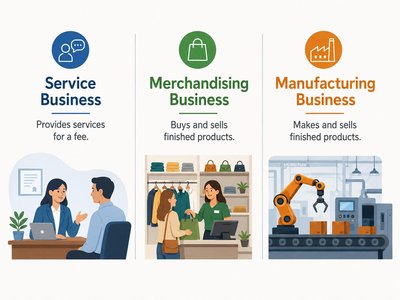
Businesses are commonly classified into three sectors based on their primary activities: service, merchandising, and manufacturing. Understanding these distinctions is crucial for analyzing cost structures and financial statements.
Service Companies: Sell intangible services (e.g., consulting, banking, healthcare). They typically do not hold inventory.
Merchandising Companies: Buy and resell tangible products (e.g., Walmart, Amazon). They maintain inventory for resale.
Manufacturing Companies: Use labor, plant, and equipment to convert raw materials into finished goods (e.g., Ford Motor Company). They manage three types of inventory: raw materials, work in process, and finished goods.
Inventory Types in Manufacturing
Raw Materials Inventory: Basic materials awaiting use in production.
Work in Process Inventory: Goods in the process of being manufactured but not yet complete.
Finished Goods Inventory: Completed products ready for sale.

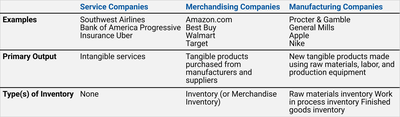
Comparison Table: Business Sectors
Service Companies | Merchandising Companies | Manufacturing Companies |
|---|---|---|
Intangible services | Tangible products purchased for resale | Products made from raw materials |
No inventory | Inventory (merchandise) | Raw materials, work in process, finished goods |
The Value Chain
Definition and Elements
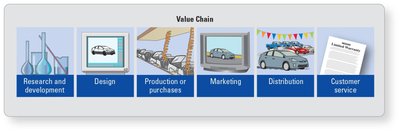
The value chain encompasses all activities that add value to a company's products and services, from initial research to customer service.
Research and Development (R&D): Creating new or improved products and processes.
Design: Engineering products and processes.
Production or Purchases: Manufacturing or acquiring goods for resale.
Marketing: Promoting and advertising products or services.
Distribution: Delivering products to customers.
Customer Service: Supporting customers after the sale.
Cost Classifications
Direct and Indirect Costs
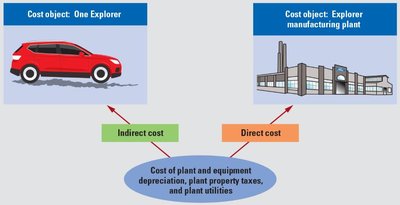
Costs are classified based on their traceability to a cost object (anything for which a manager wants to know the cost).
Direct Costs: Can be directly traced to a cost object (e.g., direct materials, direct labor).
Indirect Costs: Cannot be directly traced to a single cost object; shared among multiple objects (e.g., factory utilities).

Assigning Costs
Trace: Assign direct costs precisely to cost objects.
Allocate: Assign indirect costs less precisely, using allocation methods.
Product Costs vs. Period Costs
For external reporting, costs are classified as either product or period costs:
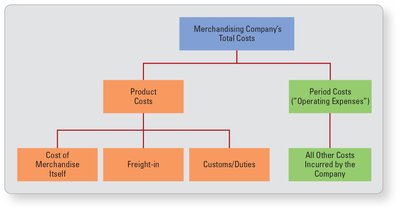
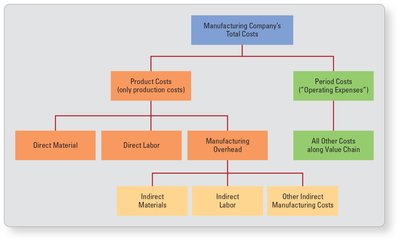
Product Costs: Incurred to produce or purchase inventory; treated as inventory until sold (e.g., direct materials, direct labor, manufacturing overhead).
Period Costs: Not tied to inventory; expensed in the period incurred (e.g., selling, general, and administrative expenses).
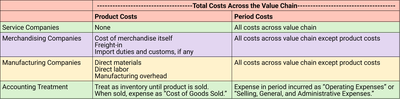
Summary Table: Product vs. Period Costs
Company Type | Product Costs | Period Costs |
|---|---|---|
Service | None | All costs across value chain |
Merchandising | Cost of merchandise, freight-in, duties | All other costs |
Manufacturing | Direct materials, direct labor, manufacturing overhead | All other costs |
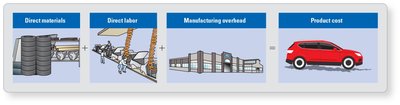
Manufacturing Costs: DM, DL, MOH
Direct Materials (DM): Primary materials in the finished product.
Direct Labor (DL): Wages for employees converting materials into products.
Manufacturing Overhead (MOH): All other manufacturing costs (indirect materials, indirect labor, plant utilities, etc.).
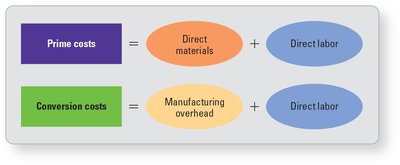
Formula:
Prime and Conversion Costs
Prime Costs: Direct materials + Direct labor
Conversion Costs: Direct labor + Manufacturing overhead
Income Statements for Different Companies
Service Company Income Statement
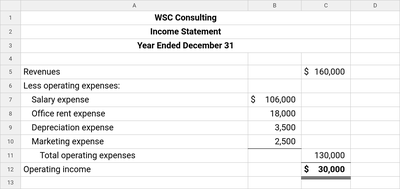
Service companies report revenues and deduct operating expenses to determine operating income. They do not report cost of goods sold.
Merchandising Company Income Statement
Merchandisers calculate cost of goods sold (COGS) and subtract it from sales revenue to find gross profit, then deduct operating expenses.
COGS Formula:
Manufacturing Company Income Statement
Manufacturers calculate COGS by tracking the flow of costs through raw materials, work in process, and finished goods inventories.
Direct Materials Used:
Cost of Goods Manufactured:
COGS:
Cost Behavior and Decision Making
Relevant and Irrelevant Costs
Relevant Costs: Differ between alternatives (differential costs).
Irrelevant Costs: Do not differ among alternatives (e.g., sunk costs).
Controllable Costs: Can be influenced by management.
Uncontrollable Costs: Cannot be changed in the short run.
Fixed and Variable Costs
Fixed Costs: Remain constant in total over a wide range of activity levels.
Variable Costs: Change in total in direct proportion to changes in volume.
Total Cost Formula:
Average Cost Formula:
Marginal Cost: The cost of producing one additional unit. Fixed costs typically do not change with one more unit unless at full capacity.
Summary
Managerial accounting provides tools for internal decision-making by classifying costs, analyzing cost behavior, and preparing financial statements tailored to different business models.
Understanding the value chain and cost classifications is essential for accurate product costing and profitability analysis.
