 Indietro
Chapter 1: Accounting and the Business Environment – Study Notes
Guida di studio - Note intelligenti
 Appunti personalizzati basati sui tuoi materiali, ampliati con definizioni chiave, esempi e contesto.
Accounting and the Business Environment
Introduction to Accounting
Accounting is a vital information system that measures, processes, and communicates financial information about business activities. It is essential for decision-making by various stakeholders, both internal and external to the organization.
Definition: Accounting is the process of identifying, measuring, and communicating economic information to permit informed judgments and decisions by users of the information.
Purpose: To provide useful financial information to users for decision-making.
Users of Accounting Information: Includes investors, creditors, managers, employees, and government agencies.
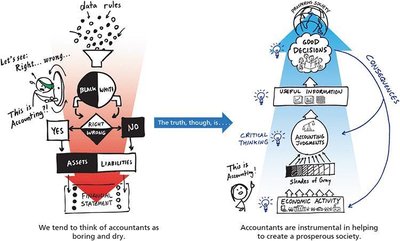
Types of Accountants and Accounting Positions
Accountants can specialize in various fields and hold different positions within organizations, each with distinct responsibilities and required qualifications.
Certified Public Accountants (CPAs): Licensed professionals serving the public.
Chartered Global Management Accountants (CGMAs): Experts in finance, operations, and management.
Certified Management Accountants (CMAs): Specialists in management accounting, often working within a single company.
Certified Financial Planners (CFPs): Professionals assisting individuals with financial planning.
Common Positions: CFO, Controller, Treasurer, Tax Accountant, Auditor, Cost Accountant, General Accountant.
Position | Job Description | Salary Range |
|---|---|---|
Chief Financial Officer (CFO) | Oversees company finances, planning, and reporting | $194,250–$321,750 |
Controller | Compiles financial statements, interacts with auditors | $151,000–$213,250 |
Treasurer | Manages financing and debt arrangements | $139,750–$245,000 |
Tax Accountant | Helps companies navigate tax laws | $63,750–$213,250 |
Auditor | Ensures compliance with rules and regulations | $51,250–$217,250 |
Cost Accountant | Analyzes accounting data in manufacturing | $66,500–$125,750 |
General Accountant | Records transactions, prepares records | $53,500–$125,750 |
Data Analytics in Accounting
Modern accountants must understand how technology and data analytics are used to process and interpret financial information.
Data Analytics: The process of examining data, identifying trends, and drawing conclusions to answer business questions.
Data Visualization: Presenting data and trends graphically to communicate insights effectively.
Organizations and Rules Governing Accounting
Governing Organizations
Several organizations establish and enforce accounting standards and regulations:
Financial Accounting Standards Board (FASB): Oversees creation and governance of U.S. accounting standards.
Securities and Exchange Commission (SEC): Regulates U.S. financial markets.
International Accounting Standards Board (IASB): Issues International Financial Reporting Standards (IFRS), used globally.
Generally Accepted Accounting Principles (GAAP)
GAAP are the guidelines for financial accounting in the U.S. They ensure information is relevant and faithfully represented (complete, neutral, and free from error).
Key Accounting Assumptions and Principles
Economic Entity Assumption: Each business is a separate economic unit.
Cost Principle: Assets and services are recorded at their actual (historical) cost.
Going Concern Assumption: The business will continue operating in the foreseeable future.
Monetary Unit Assumption: Financial statements are measured in a stable monetary unit.
Business Organization Types
Businesses can be organized in several forms, each with unique characteristics:
Type | Definition | Owners | Liability | Taxation |
|---|---|---|---|---|
Sole Proprietorship | Single owner | One | Personal liability | Owner pays tax |
Partnership | Two or more owners | Two or more | Personal liability | Partners pay tax |
Corporation | Separate legal entity | One or more (stockholders) | Limited liability | Corporation pays tax |
LLC | Members only liable for own actions | One or more | Limited liability | Members pay tax |
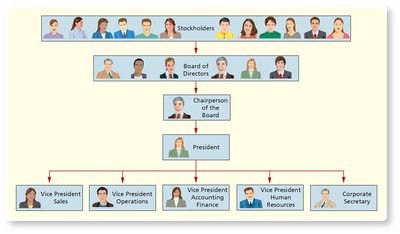
Structure of a Corporation
Corporations are structured to separate ownership and management, providing limited liability to stockholders and continuity of existence.
Ethics in Accounting and Business
Ethical conduct is crucial in accounting. Audits and regulations such as the Sarbanes-Oxley Act (SOX) and the Public Company Accounting Oversight Board (PCAOB) help ensure integrity and transparency in financial reporting.
The Accounting Equation and Key Elements
The Accounting Equation
The accounting equation is the foundation of double-entry accounting, representing the relationship between a company's assets, liabilities, and equity:
Equation:
Assets: Economic resources expected to benefit the business (e.g., cash, inventory, land).
Liabilities: Debts owed to creditors (e.g., accounts payable, notes payable).
Equity: Owners' claims to the assets, including contributed capital and retained earnings.
Components of Equity
Contributed Capital: Investments by owners (stockholders), often in the form of common stock.
Retained Earnings: Profits kept in the business after dividends are paid. Affected by revenues (increase), expenses (decrease), and dividends (decrease).
Net Income: Occurs when revenues exceed expenses.
Net Loss: Occurs when expenses exceed revenues.
Transaction Analysis Using the Accounting Equation
Steps in Transaction Analysis
Each business transaction affects the accounting equation. The analysis involves:
Identifying the accounts and their types (asset, liability, equity).
Determining if each account increases or decreases.
Ensuring the equation remains balanced after each transaction.
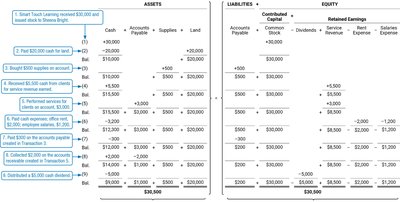
Example: Smart Touch Learning Transactions
Below is a summary of how various transactions affect the accounting equation for a sample company:
Owner investment increases cash (asset) and common stock (equity).
Purchasing land for cash decreases cash but increases land (both assets).
Buying supplies on account increases supplies (asset) and accounts payable (liability).
Earning revenue increases cash or accounts receivable (asset) and service revenue (equity).
Paying expenses decreases cash (asset) and increases expenses (reducing equity).
Paying on account reduces both cash (asset) and accounts payable (liability).
Collecting on account increases cash (asset) and decreases accounts receivable (asset).
Paying dividends decreases cash (asset) and retained earnings (equity).
Preparation of Financial Statements
Types of Financial Statements
Financial statements communicate a company's financial performance and position. The main statements are:
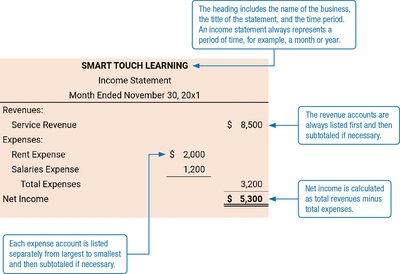
Income Statement: Reports revenues and expenses to show net income or loss for a period.
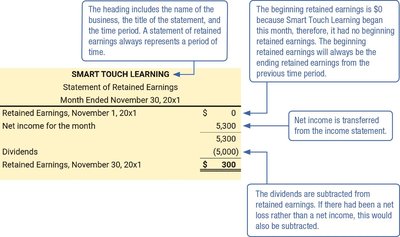
Statement of Retained Earnings: Shows changes in retained earnings over a period.
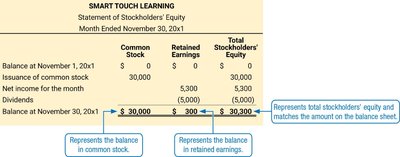
Statement of Stockholders' Equity: Reports changes in equity, including contributed capital and retained earnings.
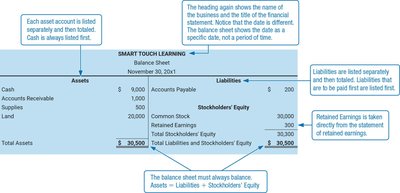
Balance Sheet: Presents assets, liabilities, and equity at a specific date.
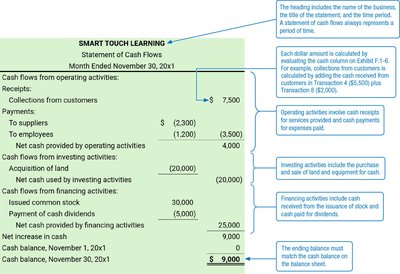
Statement of Cash Flows: Details cash inflows and outflows from operating, investing, and financing activities.
Income Statement Example
Statement of Retained Earnings Example
Statement of Stockholders' Equity Example
Balance Sheet Example
Statement of Cash Flows Example
Evaluating Business Performance: Return on Assets (ROA)
Return on Assets (ROA)
ROA is a key metric for evaluating how efficiently a company uses its assets to generate profit.
Formula:
Average Total Assets:
Interpretation: A higher ROA indicates more efficient use of assets.
Example: If a company has net income of $9,578 million, beginning assets of $100,495 million, and ending assets of $99,467 million:
million
Additional info: These notes cover the foundational concepts in financial accounting, including the accounting equation, transaction analysis, and preparation of basic financial statements, as well as the evaluation of business performance using ROA.
