 Indietro
Chapter 1: Accounting and the Business Environment – Study Notes
Guida di studio - Note intelligenti
 Appunti personalizzati basati sui tuoi materiali, ampliati con definizioni chiave, esempi e contesto.
Accounting and the Business Environment
Introduction to Accounting
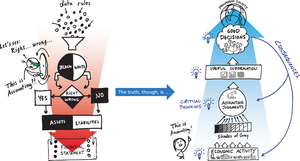
Accounting is a critical information system in business that measures, processes, and communicates financial information to support decision-making. It is foundational for both internal and external stakeholders to evaluate and guide business activities.
Why Is Accounting Important?
Measures Business Activities: Accounting identifies and quantifies economic events relevant to a business.
Processes Information: Data is organized and summarized into meaningful reports.
Communicates Results: Reports are shared with decision makers to inform choices.
Users of Accounting Information
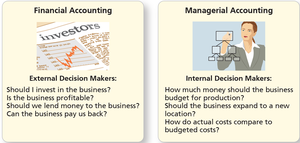
Accounting information is used by both external and internal decision makers:
External Users (Financial Accounting): Investors, creditors, and taxing authorities use financial statements to assess the business’s financial health and performance.
Internal Users (Managerial Accounting): Managers and employees use accounting data for planning, controlling, and decision-making within the organization.
Types of Accountants
Certified Public Accountants (CPAs): Serve the general public, often through auditing and tax services.
Chartered Global Management Accountants (CGMAs): Specialize in global finance and management.
Certified Management Accountants (CMAs): Focus on financial management within organizations.
Certified Financial Planners (CFPs): Advise individuals on personal financial planning.
Data Analytics in Accounting
Modern accountants must understand technology such as artificial intelligence, cloud-based systems, and robotic process automation.
Collaboration with IT professionals is essential for developing and maintaining accounting information systems.
Organizations and Rules That Govern Accounting
Governing Organizations
Financial Accounting Standards Board (FASB): Oversees the creation and governance of accounting standards in the U.S.
Securities and Exchange Commission (SEC): Regulates U.S. financial markets and enforces accounting standards for public companies.
Generally Accepted Accounting Principles (GAAP)
GAAP are the guidelines for preparing financial statements, ensuring information is relevant and faithfully represented (complete, neutral, and free from error).
International Financial Reporting Standards (IFRS)
IFRS are global accounting guidelines published by the International Accounting Standards Board (IASB), used in over 166 jurisdictions.
Key Accounting Principles and Assumptions
Economic Entity Assumption: Each business is a separate economic unit, distinct from its owners.
Cost Principle: Assets and services are recorded at their actual cost.
Going Concern Assumption: The business will continue operating into the foreseeable future.
Monetary Unit Assumption: Financial statements are measured in a stable currency.
Business Organizations
Sole Proprietorship: Owned by one individual.
Partnership: Owned by two or more individuals.
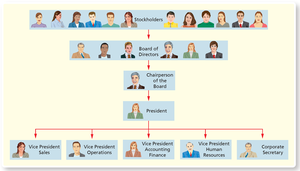
Corporation: Separate legal entity, ownership via stock, limited liability for owners.
Limited-Liability Company (LLC): Hybrid structure offering limited liability and flexible management.
Ethics in Accounting and Business
Audit: Independent examination of financial statements.
Sarbanes-Oxley Act (SOX): Requires companies to review internal controls.
Public Company Accounting Oversight Board (PCAOB): Oversees audits of public companies.
The Accounting Equation
Definition and Components
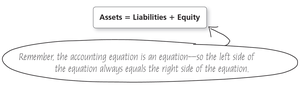
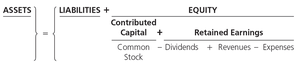
The accounting equation is the foundation of double-entry accounting, representing the relationship between a company’s resources and the claims on those resources:
Accounting Equation:
Assets
Economic resources expected to benefit the business in the future.
Examples: Cash, inventory, furniture, land.
Liabilities
Debts owed to creditors, often identified by the term "payable" (e.g., accounts payable, notes payable).
Equity
Owners’ claims to the assets of the business.
Composed of contributed capital (e.g., common stock) and retained earnings (profits not distributed as dividends).
Increases with owner contributions and revenues; decreases with dividends and expenses.
Analyzing Transactions Using the Accounting Equation
What Is a Transaction?
A transaction is any event that affects the financial position of the business and can be measured reliably. Not all business events are transactions (e.g., hiring an employee is not a transaction until payment occurs).

Steps in Transaction Analysis
Identify the accounts and their types (asset, liability, equity).
Determine if each account increases or decreases.
Ensure the accounting equation remains in balance after each transaction.
Examples of Transaction Analysis
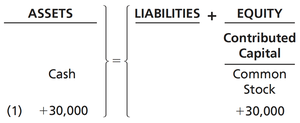
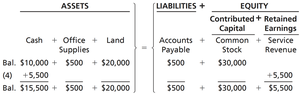
Transaction 1: Owner invests $30,000 cash in exchange for stock.
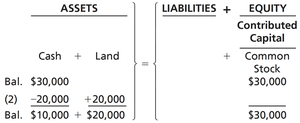
Transaction 2: Purchase of land for $20,000 cash.
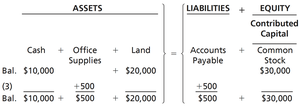
Transaction 3: Purchase of office supplies on account ($500).
Transaction 4: Earned $5,500 service revenue in cash.
Preparation of Financial Statements
Types of Financial Statements
Income Statement: Reports revenues and expenses to show net income or net loss for a period.
Statement of Retained Earnings: Shows changes in retained earnings from the beginning to the end of the period.
Balance Sheet: Presents assets, liabilities, and equity as of a specific date.
Statement of Cash Flows: Summarizes cash receipts and payments for a period.
Evaluating Business Performance
Return on Assets (ROA)
Return on Assets measures how efficiently a company uses its assets to generate profit. It is calculated as:
Net Income: Found on the income statement.
Average Total Assets: Calculated as (Beginning Assets + Ending Assets) / 2.
Example: If a company has net income of $7,618 million, beginning assets of $92,918 million, and ending assets of $92,377 million, then:
million
Additional info: These foundational concepts are essential for understanding all subsequent topics in financial accounting, including transaction recording, adjusting entries, and financial statement analysis.
