 Indietro
Chapter 1: Financial Statements – Structured Study Notes for Financial Accounting
Guida di studio - Note intelligenti
 Appunti personalizzati basati sui tuoi materiali, ampliati con definizioni chiave, esempi e contesto.
Financial Statements
Introduction to Accounting
Accounting is a critical information system for businesses, enabling the measurement, processing, and communication of financial data. The preparation of financial statements follows a systematic process known as the accounting cycle.
Accounting Cycle: The sequence of steps to record, process, and report financial transactions.
Purpose: To provide useful information for decision makers.
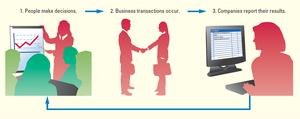
Decision Makers in Accounting
Various stakeholders rely on accounting information to make informed decisions:
Individuals: Personal financial planning.
Investors and Creditors: Assessing profitability and risk.
Regulatory Bodies: Ensuring compliance with laws.
Nonprofit Organizations: Managing resources and accountability.
Types of Accounting
Accounting is divided into two main types, each serving different users:
Financial Accounting: For external users (investors, creditors, government agencies, public).
Managerial Accounting: For internal users (managers), focusing on budgets, forecasts, and projections.
Business Organization Structures
Proprietorship
A proprietorship is a business owned by a single individual, typically small in scale. The owner is personally liable for all debts, but the business is treated as a distinct entity for accounting purposes.
Single owner
Personal liability
Small retail or professional services
Partnership
A partnership involves two or more co-owners. Income and losses flow through to partners, and liability depends on the partnership type.
General Partnership: Mutual agency and unlimited liability.
Limited-Liability Partnership: Liability limited to investment.
Limited-Liability Company (LLC)
An LLC is a flexible business structure where the company, not the owners, is liable for debts. Members have limited liability, and income flows through to them.
Limited liability for members
Flexible ownership
Corporation
A corporation is a legal entity distinct from its owners (stockholders). It can raise capital by issuing stock and offers limited liability to stockholders.
Double taxation: Corporation pays income tax; shareholders taxed on dividends.
Board of directors: Elected by stockholders to set policy and appoint officers.
Accounting Concepts, Assumptions, and Principles
Professional Frameworks
Accounting standards are established by professional bodies:
GAAP: Generally Accepted Accounting Principles (FASB).
IFRS: International Financial Reporting Standards (IASB).
Conceptual Foundation of Accounting
The conceptual framework guides the preparation of financial statements, emphasizing relevance, faithful representation, and other qualitative characteristics.
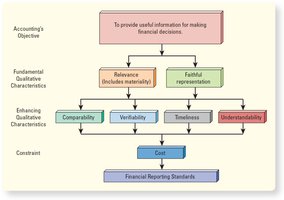
Relevance: Information must be pertinent to decision making.
Faithful Representation: Information must be complete, neutral, and free from error.
Enhancing Characteristics: Comparability, verifiability, timeliness, understandability.
Constraint: Cost-benefit consideration.
Key Assumptions and Principles
Entity Assumption: Each organization is a separate economic unit.
Continuity (Going-Concern) Assumption: Entity will continue operating in the foreseeable future.
Historical Cost Principle: Assets recorded at actual cost.
Stable-Monetary-Unit Assumption: Dollar’s purchasing power is stable over time.
The Accounting Equation
Definition and Application
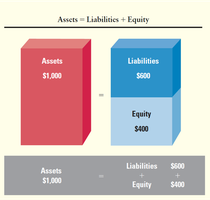
The accounting equation is the foundation of financial accounting, showing the relationship among assets, liabilities, and equity. Both sides must always be equal.
Assets: Economic resources expected to provide future benefits.
Liabilities: Debts owed to outsiders (creditors).
Equity: Owners’ claims on assets.
Formula:
Components of Equity
Paid-in Capital: Investments by stockholders (common stock).
Retained Earnings: Income kept for use in the business.
Components of Retained Earnings
Revenues: Inflows from delivering goods/services; increase retained earnings.
Expenses: Outflows from operations; decrease retained earnings.
Dividends: Distribution to stockholders; decrease retained earnings.
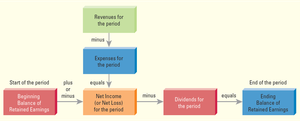
Financial Statements and Their Relationships
The Income Statement
The income statement reports revenues and expenses for a period, resulting in net income or net loss. It is also known as the statement of operations.
Net Income: Revenues minus expenses.
Net Loss: Expenses exceed revenues.
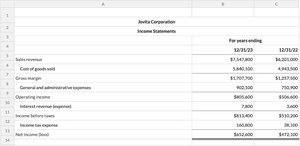
Item | 12/31/23 | 12/31/22 |
|---|---|---|
Sales revenue | $3,547,500 | $4,261,000 |
Cost of goods sold | $1,248,100 | $1,315,000 |
Gross margin | $1,299,400 | $2,946,000 |
General and administrative expenses | $903,300 | $712,900 |
Operating income | $895,000 | $2,234,000 |
Interest revenue (expense) | $16,000 | $18,000 |
Income before taxes | $911,000 | $2,252,000 |
Income tax expense | $160,000 | $413,000 |
Net income (loss) | $652,000 | $473,000 |
The Statement of Retained Earnings
This statement shows changes in retained earnings over a period, including net income and dividends.
Beginning retained earnings
Add: Net income (loss)
Less: Dividends declared
Ending retained earnings
The Balance Sheet
The balance sheet (statement of financial position) reports assets, liabilities, and stockholders’ equity at a specific point in time.
Current assets: Used or converted to cash within one business cycle (e.g., cash, receivables, inventories).
Long-term assets: Benefit the company beyond the next fiscal year (e.g., property, plant, equipment).
Current liabilities: Debts due within one year (e.g., accounts payable).
Long-term liabilities: Debts payable after one year (e.g., bonds payable).
Equity: Stockholders’ ownership (e.g., common stock, retained earnings).
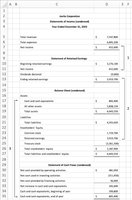
Item | Amount |
|---|---|
Cash and cash equivalents | $862,000 |
Accounts receivable | $1,200,000 |
Inventories | $1,248,100 |
Property, plant, equipment | $2,000,000 |
Accounts payable | $500,000 |
Long-term debt | $1,000,000 |
Common stock | $1,500,000 |
Retained earnings | $1,200,000 |
Relationships Among Financial Statements
Data flows from one financial statement to the next. Net income from the income statement increases retained earnings, which appears in the balance sheet.
Ethical Evaluation of Business Decisions
Ethics in Accounting
Ethical considerations are essential in accounting to ensure integrity, transparency, and trust in financial reporting. Accountants must evaluate business decisions ethically, adhering to professional standards and legal requirements.
Integrity: Honest and accurate reporting.
Transparency: Clear disclosure of financial information.
Compliance: Following laws and regulations.
