 Indietro
Chapter 1: Financial Statements – Structured Study Notes for Financial Accounting
Guida di studio - Note intelligenti
 Appunti personalizzati basati sui tuoi materiali, ampliati con definizioni chiave, esempi e contesto.
Financial Statements
Why Accounting Is Critical to Business
Accounting serves as an essential information system for businesses, enabling the measurement, processing, and communication of financial data. The accounting cycle is the process by which financial statements are prepared, supporting decision-making for various stakeholders.
Measures business activities: Tracks and records all financial transactions.
Processes data: Converts raw data into structured financial statements and reports.
Communicates results: Shares financial outcomes with decision makers such as investors, creditors, and regulatory bodies.
Accounting cycle: The systematic process of preparing financial statements.
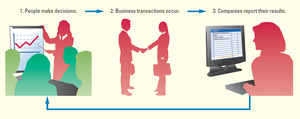
Additional info: The accounting cycle begins with business decisions, followed by transactions, and ends with reporting results.
Decision Makers Who Use Accounting
Accounting information is used by a variety of stakeholders, both internal and external to the business.
Individuals: Personal financial decisions.
Investors and creditors: Assessing profitability and creditworthiness.
Regulatory bodies: Ensuring compliance with laws and regulations.
Nonprofit organizations: Managing resources and reporting to donors.
Types of Accounting
There are two primary types of accounting, each serving different users and purposes.
Financial Accounting: For external users (investors, creditors, government agencies, public).
Managerial Accounting: For internal users (managers), focusing on budgets, forecasts, and projections.
Forms of Business Organization
Businesses can be organized in several ways, each with distinct characteristics and implications for accounting.
Proprietorship: Single owner, personally liable for debts, distinct entity for accounting.
Partnership: Two or more co-owners, income/losses flow through to partners, mutual agency and unlimited liability (general), limited liability for investment (LLP).
Limited-Liability Company (LLC): Business liable for debts, members have limited liability, income flows through to members.
Corporation: Owned by stockholders, can raise capital by issuing stock, legally distinct, limited liability, double taxation (corporation and shareholders).
Accounting Concepts, Assumptions, and Principles
Professional Frameworks
Accounting standards are established by professional bodies to ensure consistency and reliability in financial reporting.
Generally Accepted Accounting Principles (GAAP): Formulated by the Financial Accounting Standards Board (FASB).
International Financial Reporting Standards (IFRS): Formulated by the International Accounting Standards Board (IASB).
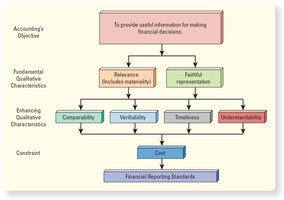
Additional info: The conceptual framework emphasizes relevance, faithful representation, comparability, verifiability, timeliness, and understandability, with cost as a constraint.
Key Assumptions and Principles
Entity Assumption: Each organization is a separate economic unit.
Continuity (Going-Concern) Assumption: The entity will continue to operate in the foreseeable future.
Historical Cost Principle: Assets are recorded at their actual cost at purchase.
Stable-Monetary-Unit Assumption: The dollar’s purchasing power is assumed stable over time.
Global View: IFRS is increasingly important as global markets allow cross-border investment and trading.
The Accounting Equation
Definition and Application
The accounting equation is the foundation of financial accounting, showing the relationship among assets, liabilities, and equity. Both sides of the equation must always be equal.
Assets: Economic resources expected to provide future benefits (e.g., cash, inventory, property).
Liabilities: Debts owed to external parties (e.g., accounts payable, loans).
Equity: Owners’ claims on the business (e.g., paid-in capital, retained earnings).
Accounting Equation:
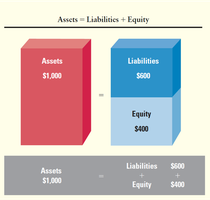
Additional info: The equation can be rearranged to highlight equity: .
Components of Equity
Paid-in Capital: Investments made by stockholders, primarily through common stock.
Retained Earnings: Income earned and retained for use in the business.
Components of Retained Earnings
Retained earnings are affected by revenues, expenses, and dividends.
Revenues: Inflows from delivering goods or services; increase retained earnings.
Expenses: Outflows due to operational costs; decrease retained earnings.
Dividends: Distribution to stockholders; decrease retained earnings.
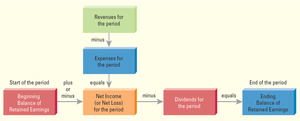
Additional info: The flowchart illustrates how net income and dividends affect the beginning and ending balances of retained earnings.
Financial Statements and Their Relationships
Constructing Financial Statements
Financial statements are interconnected, with data flowing from one to another. The main statements include the income statement, statement of retained earnings, and balance sheet.
Income Statement: Reports revenues and expenses for a period, resulting in net income or loss.
Statement of Retained Earnings: Shows changes in retained earnings, including net income and dividends.
Balance Sheet: Reports assets, liabilities, and equity at a specific point in time.
The Income Statement
The income statement (statement of operations) summarizes revenues and expenses, leading to net income or loss.
Revenues: Sales and other income.
Expenses: Costs of goods sold, administrative expenses, interest, taxes.
Net Income (Loss): The bottom line, calculated as revenues minus expenses.
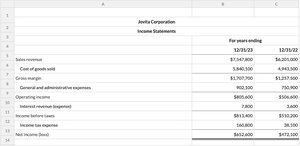
Item | 12/31/23 | 12/31/22 |
|---|---|---|
Sales revenue | $3,547,500 | $4,261,000 |
Cost of goods sold | $1,248,100 | $1,315,000 |
Gross margin | $1,299,400 | $2,946,000 |
General and administrative expenses | $903,300 | $712,900 |
Operating income | $895,000 | $1,204,000 |
Interest revenue (expense) | $16,000 | $20,000 |
Income before taxes | $161,000 | $180,000 |
Income tax expense | $84,000 | $91,000 |
Net income (loss) | $62,000 | $473,000 |
The Statement of Retained Earnings
This statement tracks the portion of net income reinvested in the business and the impact of dividends.
Beginning retained earnings
Add: Net income (loss)
Less: Dividends declared
Ending retained earnings
The Balance Sheet
The balance sheet (statement of financial position) presents assets, liabilities, and stockholders’ equity at a specific date.
Assets: Current (cash, receivables, inventory, prepaid expenses) and long-term (property, investments, intangibles).
Liabilities: Current (accounts payable, salaries payable, short-term notes) and long-term (bonds, long-term notes).
Equity: Common stock, additional paid-in capital, retained earnings, treasury stock, accumulated other comprehensive income (loss).
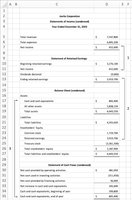
Item | Amount |
|---|---|
Cash and cash equivalents | $862,000 |
Accounts receivable | $1,400,000 |
Inventory | $1,248,100 |
Property, plant, equipment | $2,000,000 |
Accounts payable | $600,000 |
Long-term debt | $1,000,000 |
Common stock | $1,000,000 |
Retained earnings | $910,000 |
Additional info: The balance sheet reflects the company’s financial position at a single point in time.
Relationships Among Financial Statements
Financial statements are interrelated. Net income from the income statement flows into retained earnings, which appears on the balance sheet. The balance sheet summarizes the company’s assets, liabilities, and equity.
Ethical Evaluation of Business Decisions
Ethics in Accounting
Ethical considerations are fundamental in accounting. Accountants must ensure honesty, integrity, and transparency in reporting financial information, as these principles underpin trust in financial markets and business operations.
Honesty: Accurate and truthful reporting.
Integrity: Adherence to ethical standards and professional codes.
Transparency: Clear and open communication of financial results.
Additional info: Ethical lapses can lead to legal consequences and loss of stakeholder trust.
