 Indietro
Internal Control and Cash: Study Notes for Financial Accounting
Guida di studio - Note intelligenti
 Appunti personalizzati basati sui tuoi materiali, ampliati con definizioni chiave, esempi e contesto.
Internal Control and Cash
Introduction
This chapter explores the importance of internal controls in financial accounting, focusing on fraud prevention, the structure and objectives of internal control systems, and the management of cash. It also covers the preparation of bank reconciliations, reporting cash on the balance sheet, and the application of unsupervised machine learning in detecting expense reimbursement fraud.
Fraud and Its Impact
Definition and Consequences of Fraud
Fraud is the intentional misrepresentation of facts to persuade another party to act in a certain way, resulting in injury or damage.
Fraud is a growing global problem, especially with the expansion of e-commerce.
Common examples include insurance fraud, check forgery, Medicare fraud, credit card fraud, and identity theft.
Types of Fraud
Misappropriation of assets: Theft of money or inventory, bribery, kickbacks, and overstated expense reimbursements. Usually committed by employees.
Fraudulent financial reporting: False or misleading journal entries to deceive investors and creditors. Usually committed by managers under pressure to meet or exceed results (e.g., Enron, MCI/WorldCom).
The Fraud Triangle
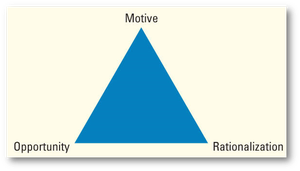
The fraud triangle illustrates the three elements necessary for fraud to occur: motive, opportunity, and rationalization. Weak internal controls often create the opportunity for fraud.
Fraud and Ethics
Fraud has economic, legal, and ethical implications.
Perpetrators gain short-term benefits, but overall losses are greater for others.
Fraud is illegal and unethical, leading to penalties such as imprisonment, fines, and damages.
Objectives and Components of Internal Control
Objectives of Internal Control
Internal control is a plan of organization and procedures implemented to achieve the following objectives:
Safeguard assets
Encourage employees to follow company policy
Ensure accurate, reliable accounting records
Comply with legal requirements
Promote operational efficiency (secondary objective)
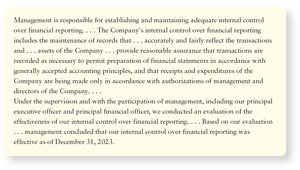
Management Report on Internal Controls
Public companies are required to report on the effectiveness of their internal controls over financial reporting.
Function of an Internal Control System
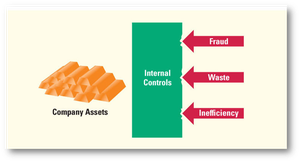
Internal controls act as a barrier to prevent fraud, waste, and inefficiency, thereby protecting company assets.
Components of Internal Control
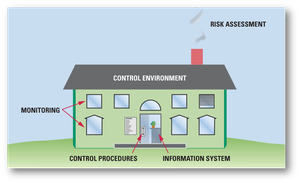
Control Environment: The overall attitude, awareness, and actions of management regarding the internal control system and its importance.
Risk Assessment: Identifying and analyzing relevant risks to achieving objectives and determining how to manage them.
Information System: The methods and records used to identify, assemble, analyze, classify, and report a company's transactions.
Control Procedures: Policies and procedures that help ensure management directives are carried out.
Monitoring of Controls: Ongoing evaluations to ensure controls are operating as intended.
Internal Control Procedures
Types of Controls
Preventative Controls: Designed to prevent errors or fraud before they occur (e.g., smart hiring, separation of duties, limited access, proper approvals).
Monitoring (Detective) Controls: Designed to detect errors or fraud after they have occurred (e.g., audits, reconciliations, exception reporting).
Key Internal Control Procedures
Smart Hiring Practices: Background checks, training, supervision, competitive salaries, and clear responsibilities.
Separation of Duties: No one person should handle asset handling, record keeping, and transaction approval.
Comparison and Compliance Monitoring: Use of budgets, exception reporting, audits, and reconciliations to monitor activities.
Adequate Records: Maintain detailed, prenumbered documents (e.g., Positive Pay service for checks).
Limited Access: Restrict access to assets using physical controls, passwords, and encryption.
Proper Approvals: Require management or delegated approval for transactions, especially purchases.
Information Technology and Safeguard Controls
Accounting systems increasingly rely on IT for accuracy and speed (e.g., electronic sensors, bar codes).
Safeguard controls include fireproof vaults, alarms, security cameras, loss prevention specialists, fidelity bonds, mandatory vacations, and job rotation.
Internal Controls for E-Commerce
E-commerce introduces risks such as stolen credit card numbers, malware, and phishing.
Security measures include encryption and firewalls.
Malware and Phishing
Malware: Malicious software that can destroy or alter data, infect files, or steal information.
Phishing: Fraudulent attempts to obtain sensitive information by disguising as trustworthy entities online.
Encryption and Firewalls
Encryption: Rearranging messages mathematically so only authorized parties can read them (e.g., check-sum digits for account numbers).
Firewalls: Limit unauthorized access to computer networks using passwords, PINs, and multiple layers of security.
Internal Controls Over Cash Receipts and Payments
Cash Receipts Over the Counter
Point-of-sale terminals record sales, cost of goods sold, and inventory reduction.
Cashiers turn in cash drawers at the end of shifts; accounting reconciles sales to cash in drawer.
Cash Receipts by Mail
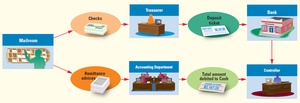
Mailroom staff process checks and remittance advices, which are then recorded and deposited. The accounting department ensures all cash is properly credited.
Controls Over Payment by Check or EFT
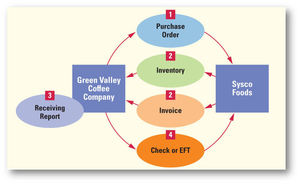
Payments by check or EFT provide a record, require authorization, and must be supported by evidence.
Duties are separated among purchasing, receiving, preparing payments, and approving payments.
Payment Packet
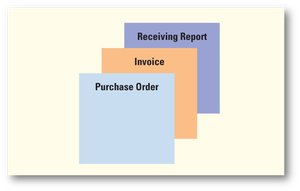
A payment packet typically includes a purchase order, invoice, and receiving report, ensuring all steps in the purchasing process are verified before payment.
Petty Cash
Used for minor expenses, managed by a custodian using an imprest system (fund plus vouchers equals specified balance).
Debit cards have reduced the need for petty cash funds.
Limitations of Internal Control
Collusion, management override, and human error can circumvent controls.
Cost-benefit analysis is essential; controls should not cost more than the benefits they provide.
Bank Reconciliation
Purpose and Documents
Bank reconciliation explains differences between the company’s cash records (books) and the bank statement.
Key documents: signature card, deposit ticket, check, bank statement, and bank reconciliation.
Check Structure
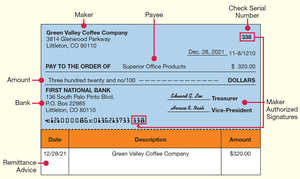
A check involves three parties: the maker (signs the check), the payee (receives payment), and the bank (on which the check is drawn).
Bank Statement
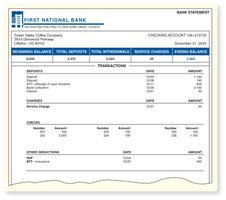
The bank statement reports all cash activity, including beginning and ending balances, deposits, and withdrawals.
Bank Reconciliation Process
Identify timing differences and errors between the bank and book balances.
Adjust the bank balance for deposits in transit, outstanding checks, and bank errors.
Adjust the book balance for bank collections, EFTs, service charges, interest, NSF checks, and book errors.
Example: Cash Records and Bank Reconciliation
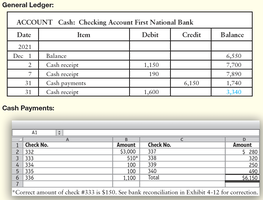
The following table summarizes the cash records and payments for Green Valley Coffee Company:
Date | Item | Debit | Credit | Balance |
|---|---|---|---|---|
Dec 1 | Balance | 6,500 | ||
Dec 2 | Cash receipt | 1,150 | 7,700 | |
Dec 3 | Cash receipt | 190 | 7,890 | |
Dec 31 | Cash payments | 6,510 | 1,380 | |
Dec 31 | Cash receipt | 1,600 | 2,980 |
Outstanding Checks Example
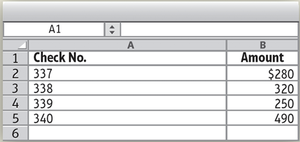
Check No. | Amount |
|---|---|
337 | $280 |
338 | $320 |
339 | $250 |
340 | $490 |
Bank Reconciliation Table
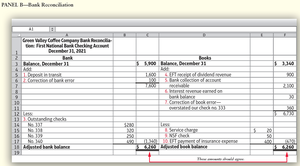
Bank | Books | |
|---|---|---|
Balance, December 31 | $5,900 | $3,140 |
Add: Deposit in transit | 1,600 | |
Add: Correction of bank error | 100 | |
Add: EFT receipt of dividend revenue | 900 | |
Add: Bank collection of account receivable | 2,100 | |
Add: Interest revenue | 30 | |
Add: Correction of book error | 360 | |
Less: Outstanding checks | 1,340 | |
Less: Service charge | 20 | |
Less: NSF check | 50 | |
Less: EFT payment of insurance expense | 400 | |
Adjusted balance | $6,260 | $6,260 |
Journalizing Transactions from the Bank Reconciliation
All reconciling items on the book side require journal entries, as these transactions have not yet been recorded by the company.
Reporting Cash on the Balance Sheet
Cash and Cash Equivalents
Cash: Includes currency, checking and savings accounts, and money market accounts.
Cash equivalents: Short-term, highly liquid investments with maturities of three months or less (e.g., time deposits, certificates of deposit, U.S. Treasury bills).
Equity securities like Apple stock are not cash equivalents due to lack of maturity and higher risk.
Disclosure
Public companies typically include a footnote stating that all highly liquid investments with maturities of three months or less are classified as cash equivalents.
Unsupervised Machine Learning in Expense Reimbursement Fraud Detection
Expense Reimbursement Fraud
Occurs when employees claim reimbursement for non-legitimate expenses.
The Association of Certified Fraud Examiners (ACFE) classifies schemes as mischaracterized, fictitious, overstated, or multiple reimbursements.
Machine Learning for Fraud Detection
Unsupervised machine learning models flag unusual receipts for human investigation.
Helps identify patterns of fraud and improves future detection.
Advantages: Examines every transaction, combines structured and unstructured data, reduces human error and bias, and responds to sophisticated fraudsters.
Practice Problems
Bank Reconciliation Practice
Identify whether each item is a bank side or book side adjustment.
Determine the impact on cash balances (+ or -).
Record journal entries for book side adjustments.
Summary
Internal controls are essential for safeguarding assets, ensuring reliable financial reporting, and preventing fraud. Effective cash management and reconciliation procedures are critical for accurate financial statements. Advances in technology, including machine learning, are increasingly important in detecting and preventing fraud in modern organizations.
