 Indietro
Introduction to Managerial Accounting: Key Concepts and Cost Classifications
Guida di studio - Note intelligenti
 Appunti personalizzati basati sui tuoi materiali, ampliati con definizioni chiave, esempi e contesto.
Introduction to Managerial Accounting
Definition and Purpose
Managerial accounting is the process of identifying, measuring, analyzing, interpreting, and communicating information for the pursuit of an organization’s goals. Unlike financial accounting, which provides information to external users, managerial accounting is focused on internal decision makers such as managers and employees. It supports planning, directing, and controlling business operations to achieve organizational objectives.
Internal focus: Managerial accounting provides data for internal users to aid in decision-making.
External focus (Financial Accounting): Financial accounting provides information for external users such as investors, creditors, and regulatory agencies.
Examples of managerial accounting uses: Budgeting, performance evaluation, cost management, and asset management.
Additional info: Managerial accounting is not governed by GAAP (Generally Accepted Accounting Principles), allowing for more flexibility in reporting formats and frequency.
Managers’ Role in the Organization
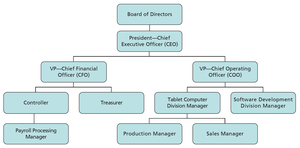
Managers operate at various levels within an organization, often structured by departments or divisions. The organizational chart visually represents the hierarchy and reporting relationships among managers and departments.
Board of Directors: Elected by shareholders, responsible for strategic goals.
Chief Executive Officer (CEO): Implements short- and long-term plans.
Line positions: Directly involved in providing goods or services.
Staff positions: Support line positions with specialized services.
Managerial Accounting Functions
Managerial accounting supports three primary management functions:
Planning: Setting goals and determining how to achieve them (strategic and operational planning).
Directing: Overseeing day-to-day operations.
Controlling: Monitoring operations and ensuring goals are met.
Ethical Standards of Managers
Managerial accountants are expected to uphold high ethical standards as outlined by the Institute of Management Accountants (IMA). The IMA’s Statement of Ethical Professional Practice includes principles such as honesty, fairness, objectivity, and responsibility.
Competence: Maintain professional expertise and perform duties in accordance with laws and standards.
Confidentiality: Protect sensitive information and use it appropriately.
Integrity: Avoid conflicts of interest and act ethically.
Credibility: Communicate information fairly and disclose relevant facts.
Example: If pressured to manipulate financial results, an accountant should follow organizational policies and escalate concerns if necessary, adhering to ethical guidelines.
Cost Classifications in Managerial Accounting
Types of Companies and Inventory
Companies are classified based on their primary activities:
Service companies: Sell time, skill, and knowledge; do not carry inventory.
Merchandising companies: Resell products purchased from suppliers; carry merchandise inventory.
Manufacturing companies: Convert raw materials into finished products; maintain three types of inventory:
Raw Materials Inventory (RM): Materials awaiting use in production.
Work-in-Process Inventory (WIP): Goods in production but not yet complete.
Finished Goods Inventory (FG): Completed products ready for sale.
Direct and Indirect Costs
Costs are classified based on their traceability to a cost object (anything for which a separate measurement of cost is desired):
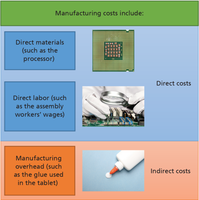
Direct costs: Easily traced to a cost object (e.g., direct materials, direct labor).
Indirect costs: Cannot be easily traced to a cost object (e.g., manufacturing overhead).
Manufacturing Costs
Manufacturing costs are divided into three categories:
Direct materials (DM): Raw materials used in production.
Direct labor (DL): Wages of employees directly involved in production.
Manufacturing overhead (MOH): Indirect costs related to production (e.g., indirect materials, indirect labor, factory utilities).
Prime and Conversion Costs
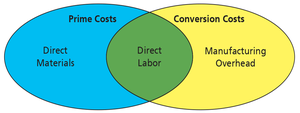
Manufacturing costs can also be grouped as:
Prime costs: Direct materials + Direct labor
Conversion costs: Direct labor + Manufacturing overhead
Product and Period Costs
Costs are also classified based on their relation to production:
Product costs: Costs incurred to create a product (DM, DL, MOH); recorded as inventory until sold.
Period costs: Non-manufacturing costs (selling, administrative, taxes, interest); expensed when incurred.
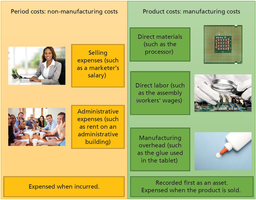
Additional info: Product costs are matched with revenues in the period in which the product is sold, while period costs are expensed in the period incurred.
Summary Table: Cost Classifications
Cost Type | Definition | Examples |
|---|---|---|
Direct Costs | Traced directly to a cost object | Direct materials, direct labor |
Indirect Costs | Not easily traced to a cost object | Manufacturing overhead |
Product Costs | Incurred to create a product | DM, DL, MOH |
Period Costs | Non-manufacturing costs | Selling, administrative expenses |
Key Formulas
Prime Costs: \text{Prime Costs} = \text{Direct Materials} + \text{Direct Labor}$
Conversion Costs: \text{Conversion Costs} = \text{Direct Labor} + \text{Manufacturing Overhead}$
