 Indietro
Merchandise Inventory: Principles, Methods, and Financial Impacts
Guida di studio - Note intelligenti
 Appunti personalizzati basati sui tuoi materiali, ampliati con definizioni chiave, esempi e contesto.
Merchandise Inventory
Accounting Principles and Controls Related to Merchandise Inventory
Merchandise inventory is a key asset for merchandising and manufacturing companies. Proper accounting principles and internal controls are essential for accurate reporting and safeguarding inventory.
Consistency Principle: Requires businesses to use the same accounting methods and procedures from period to period, enabling comparability of financial statements. Changes must be disclosed in the financial statement notes.
Disclosure Principle: Financial statements must provide sufficient information for external users to make informed decisions. Information should be relevant and faithfully represented.
Materiality Concept: Only items significant to the business’s financial situation require strict accounting. Materiality depends on the size and impact of the item relative to the business.
Conservatism: When faced with options, businesses should report the least favorable figures. This means anticipating losses, recording assets at the lowest reasonable amount, and liabilities at the highest.
Inventory Controls: Include proper authorization for purchases, tracking receipts, recording damaged inventory, annual physical counts, and accurate recording/removal of sold inventory.
Data Analytics: Modern businesses use real-time data analytics to monitor inventory, reduce waste, and optimize sales.
Accounting for Merchandise Inventory Costs Under a Perpetual Inventory System
In a perpetual inventory system, inventory records are updated continuously. At period end, units in ending inventory and units sold are counted and valued.
Inventory Costing Methods: Four methods are allowed by GAAP: Specific Identification, FIFO, LIFO, and Weighted-Average.
Specific Identification: Assigns actual cost to each unit, used for high-value, unique items (e.g., automobiles, jewels).
FIFO (First-In, First-Out): Assumes earliest purchases are sold first. Cost of Goods Sold (COGS) is based on oldest costs; ending inventory reflects recent costs.
LIFO (Last-In, First-Out): Assumes latest purchases are sold first. COGS is based on newest costs; ending inventory reflects oldest costs.
Weighted-Average: Computes a new average cost per unit after each purchase. Both COGS and ending inventory are valued at this average.
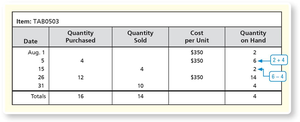
Perpetual Inventory Record Example
The perpetual inventory record tracks purchases, sales, unit costs, and quantities on hand.
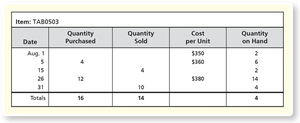
Changes in Cost per Unit Example
When inventory costs change, the record must reflect these changes for accurate valuation.
Specific Identification Method Example
Each unit is tracked individually, and its specific cost is recorded.
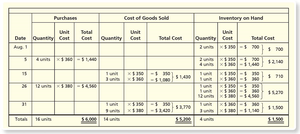
FIFO Method Example
FIFO records show oldest costs assigned to COGS and recent costs to ending inventory.
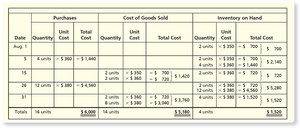
LIFO Method Example
LIFO records show newest costs assigned to COGS and oldest costs to ending inventory.
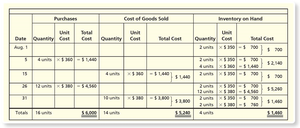
Weighted-Average Method Example
Weighted-average cost per unit is recalculated after each purchase.
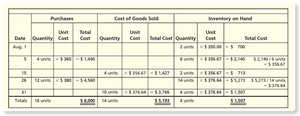
Weighted-Average Calculation Example
Weighted-average cost is calculated as:
Formula:
Example: (rounded)
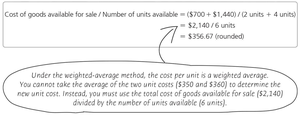
Effects of Inventory Costing Methods on Financial Statements
Different inventory costing methods impact the income statement and balance sheet, especially during periods of rising or declining costs.
Income Statement: COGS is higher under LIFO than FIFO when costs are rising, resulting in lower net income under LIFO.
Balance Sheet: FIFO inventory values are highest when costs are rising; LIFO values are lowest.
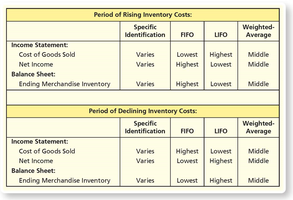
Comparative Results Table
This table summarizes the effects of each method during rising and declining inventory costs.
Period | Method | COGS | Net Income | Ending Inventory |
|---|---|---|---|---|
Rising Costs | FIFO | Lowest | Highest | Highest |
Rising Costs | LIFO | Highest | Lowest | Lowest |
Rising Costs | Weighted-Average | Middle | Middle | Middle |
Declining Costs | FIFO | Highest | Lowest | Lowest |
Declining Costs | LIFO | Lowest | Highest | Highest |
Declining Costs | Weighted-Average | Middle | Middle | Middle |
Lower-of-Cost-or-Market Rule
The lower-of-cost-or-market (LCM) rule requires inventory to be reported at the lower of its historical cost or market value (current replacement cost).
If market value falls below cost, inventory is written down to market value.
Adjusting journal entries are required to reflect this change.
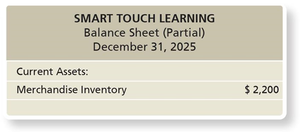
Balance Sheet Example
Inventory is reported at $2,200, reflecting the LCM rule.
Effects of Merchandise Inventory Errors on Financial Statements
Inventory errors affect related accounts such as COGS, gross profit, and net income. Because ending inventory is used in these calculations, errors propagate through the financial statements.
Overstatement of Ending Inventory: COGS is understated, gross profit and net income are overstated.
Understatement of Ending Inventory: COGS is overstated, gross profit and net income are understated.
Inventory errors self-correct after two periods, as the error reverses in the following period.
Inventory Turnover and Days’ Sales in Inventory
These ratios are used to evaluate business performance and inventory management efficiency.
Inventory Turnover Ratio: Measures how quickly inventory is sold. Formula:
Days’ Sales in Inventory: Measures the average number of days inventory is held. Formula:
High turnover indicates efficient selling; low turnover suggests slow-moving inventory.
For perishable inventory, days’ sales in inventory is critical for avoiding losses.
Example: Pepsico
Inventory turnover: 8.70 times per year
Days’ sales in inventory: 42 days
Additional info: These ratios should be compared to industry averages for meaningful evaluation.
