 Indietro
Recording Business Transactions: Financial Accounting Study Notes
Guida di studio - Note intelligenti
 Appunti personalizzati basati sui tuoi materiali, ampliati con definizioni chiave, esempi e contesto.
Recording Business Transactions
Accounts and the Accounting Equation
The accounting equation forms the foundation of financial accounting: Assets = Liabilities + Equity. Each category contains multiple accounts, which are detailed records of all increases and decreases in a specific item during a period.
Asset Accounts: Represent resources owned by the business (e.g., Cash, Accounts Receivable, Land).
Liability Accounts: Represent obligations owed to outsiders (e.g., Accounts Payable, Notes Payable).
Equity Accounts: Represent the owner's interest in the business (e.g., Common Stock, Retained Earnings).
Chart of Accounts: A systematic listing of all accounts used by a company.
Ledger: The complete record of all accounts and their balances.
Double-Entry Accounting and T-Accounts
Double-entry accounting ensures that every transaction affects at least two accounts, maintaining the balance of the accounting equation. The T-account is a visual tool used to represent accounts, with debits on the left and credits on the right.
Debit (DR): Left side of the T-account.
Credit (CR): Right side of the T-account.
Normal Balance: The side (debit or credit) where increases are recorded for each account type.

Rules of Debits and Credits
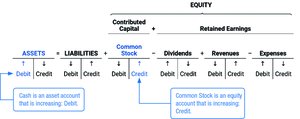
Assets increase with debits and decrease with credits.
Liabilities and equity increase with credits and decrease with debits.
Each account has a normal balance on its increase side.


Determining T-Account Balances
To find the balance of a T-account, add the debits and credits separately, then subtract the smaller total from the larger. The balance is reported on the side with the larger total.
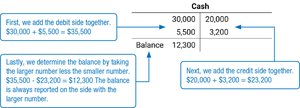
Journalizing and Posting Transactions
Transactions are first recorded in a journal using source documents as evidence. The journal lists transactions in chronological order. Posting transfers these entries to the ledger.
Source Documents: Include invoices, checks, and receipts.
Journal: The chronological record of transactions.
Posting: The process of transferring journal entries to the ledger.
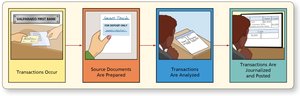
Steps in Journalizing and Posting
Identify the accounts and their types.
Determine whether each account increases or decreases, applying debit and credit rules.
Record the transaction in the journal.
Post the journal entry to the ledger.
Check if the accounting equation remains balanced.
Example: Stockholder Contribution
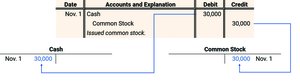
On November 1, Smart Touch Learning received $30,000 cash from a stockholder and issued common stock.
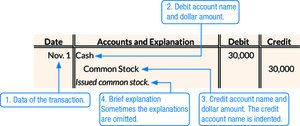
Example: Purchase of Land for Cash
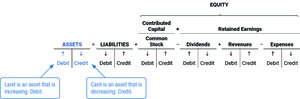
On November 2, Smart Touch Learning paid $20,000 cash for land. The land account increases (debit), and the cash account decreases (credit).
Example: Payment of Expenses with Cash
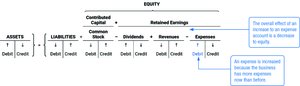
Expenses are recorded as debits, reducing equity. Cash is credited, reflecting the outflow.
Alternative Account Formats
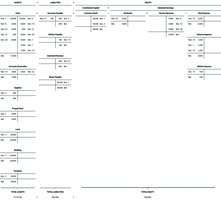
Besides T-accounts, businesses may use four-column accounts, which provide columns for debits, credits, and running balances.
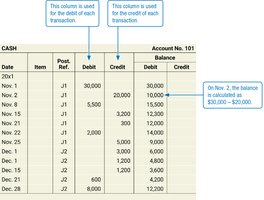
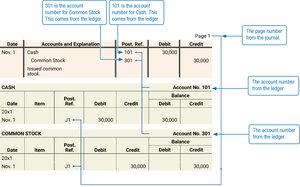
Posting References
Posting references link journal entries to ledger accounts, ensuring traceability and accuracy.
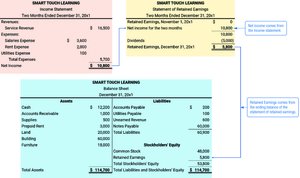
Unadjusted Trial Balance
The unadjusted trial balance lists all ledger accounts and their balances at a specific point in time. It is used to verify that total debits equal total credits.
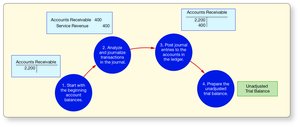
The Accounting Cycle
The accounting cycle is the process by which companies produce financial statements for a period. It includes analyzing transactions, journalizing, posting, and preparing trial balances.
Debt Ratio and Business Performance
The debt ratio measures the proportion of assets financed by debt, indicating a company's financial leverage and risk.
Formula:
Interpretation: A higher debt ratio suggests greater financial risk.
Example: PepsiCo, Inc. had a debt ratio of 81.7% as of December 28, 2024, meaning most assets were financed by liabilities.
Key Takeaways: Understanding accounts, double-entry accounting, journalizing, posting, and the accounting cycle is essential for accurate financial reporting and analysis.
