 Indietro
Step-by-Step Guidance for Financial Accounting Exam Questions
Guida di studio - Note intelligenti
 Appunti personalizzati basati sui tuoi materiali, ampliati con definizioni chiave, esempi e contesto.
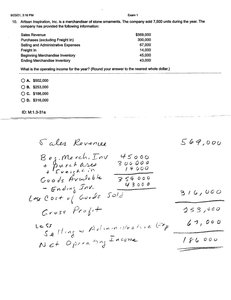
Q1. What is the operating income for the year? (Round your answer to the nearest whole dollar.)
Background
Topic: Income Statement Preparation
This question tests your ability to calculate operating income by preparing a partial income statement, including sales revenue, cost of goods sold, and selling/administrative expenses.
Key Terms and Formulas
Sales Revenue: Total income from sales.
Cost of Goods Sold (COGS):
Gross Profit:
Operating Income:
Step-by-Step Guidance
Identify the sales revenue and all inventory and expense values provided.
Calculate the cost of goods sold using the formula: .
Subtract COGS from sales revenue to find gross profit.
Subtract selling and administrative expenses from gross profit to determine operating income.
Set up the final calculation for operating income, but do not compute the final value yet.
Try solving on your own before revealing the answer!
Final Answer: $186,000
Operating income is calculated as follows: . This represents the profit after accounting for cost of goods sold and selling/administrative expenses.
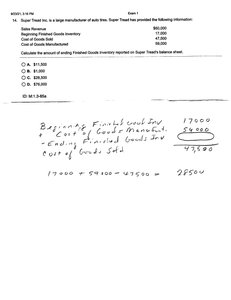
Q2. Calculate the amount of ending Finished Goods Inventory reported on Super Treat's balance sheet.
Background
Topic: Inventory Accounting
This question tests your understanding of how to calculate ending finished goods inventory using the cost of goods sold formula.
Key Terms and Formulas
Beginning Finished Goods Inventory
Cost of Goods Manufactured
Cost of Goods Sold
Ending Finished Goods Inventory:
Step-by-Step Guidance
Write down the values for beginning finished goods inventory, cost of goods manufactured, and cost of goods sold.
Plug these values into the formula for ending finished goods inventory.
Set up the calculation, but stop before computing the final numeric result.
Try solving on your own before revealing the answer!
Final Answer: $29,500
Using the formula: . This is the ending finished goods inventory reported on the balance sheet.
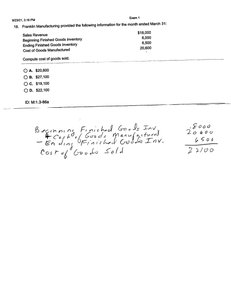
Q3. Compute cost of goods sold for the month ended March 31.
Background
Topic: Cost of Goods Sold Calculation
This question tests your ability to calculate cost of goods sold for a manufacturing company using inventory and production data.
Key Terms and Formulas
Beginning Finished Goods Inventory
Cost of Goods Manufactured
Ending Finished Goods Inventory
Cost of Goods Sold:
Step-by-Step Guidance
List the values for beginning finished goods inventory, cost of goods manufactured, and ending finished goods inventory.
Apply the formula for cost of goods sold.
Set up the calculation, but do not compute the final answer yet.
Try solving on your own before revealing the answer!
Final Answer: $7,100
COGS is calculated as . This represents the total cost of goods sold for the month.
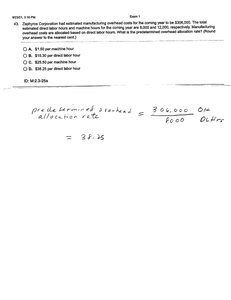
Q4. What is the predetermined overhead allocation rate? (Round your answer to the nearest cent.)
Background
Topic: Overhead Allocation in Cost Accounting
This question tests your ability to calculate the predetermined overhead rate, which is used to allocate manufacturing overhead costs to products based on direct labor hours.
Key Terms and Formulas
Estimated Manufacturing Overhead
Estimated Direct Labor Hours
Predetermined Overhead Rate:
Step-by-Step Guidance
Identify the estimated manufacturing overhead and estimated direct labor hours.
Set up the formula for the predetermined overhead rate.
Prepare to divide the overhead by the labor hours, but do not compute the final value yet.
Try solving on your own before revealing the answer!
Final Answer: $38.25 per direct labor hour
The predetermined overhead rate is . This rate is used to allocate overhead costs to products based on labor hours.
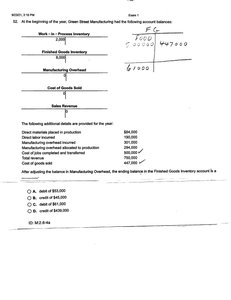
Q5. After adjusting the balance in Manufacturing Overhead, what is the ending balance in the Finished Goods Inventory account?
Background
Topic: Inventory and Overhead Adjustment
This question tests your understanding of how to adjust inventory balances after accounting for manufacturing overhead and other production costs.
Key Terms and Formulas
Work-in-Process Inventory
Finished Goods Inventory
Manufacturing Overhead
Cost of Goods Sold
Ending Finished Goods Inventory:
Step-by-Step Guidance
Review the account balances and additional details provided.
Calculate the cost of goods manufactured and cost of goods sold.
Adjust for manufacturing overhead as instructed.
Set up the formula for ending finished goods inventory, but do not compute the final value yet.
Try solving on your own before revealing the answer!
Final Answer: $84,000
After adjusting for manufacturing overhead, the ending balance in Finished Goods Inventory is $84,000. This reflects the correct inventory value after all production and overhead costs are considered.
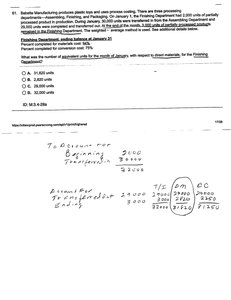
Q6. What was the number of equivalent units for the month of January, with respect to direct materials, for the Finishing Department?
Background
Topic: Process Costing and Equivalent Units
This question tests your ability to calculate equivalent units in a process costing system, specifically for direct materials in a manufacturing department.
Key Terms and Formulas
Equivalent Units: The number of units that could have been completed given the amount of materials used.
Formula:
Step-by-Step Guidance
Identify the units transferred out and the ending inventory.
Determine the percentage completion for direct materials in the ending inventory.
Set up the calculation for equivalent units, but do not compute the final value yet.
Try solving on your own before revealing the answer!
Final Answer: 37,250 units
Equivalent units for direct materials are calculated as . This represents the total equivalent units for the month.
