 Indietro
Time Value of Money: Streams of Cash Flows, Perpetuities, Annuities, and Variable Solving
Guida di studio - Note intelligenti
 Appunti personalizzati basati sui tuoi materiali, ampliati con definizioni chiave, esempi e contesto.
Time Value of Money
Valuing a Stream of Cash Flows
The time value of money is a fundamental concept in financial accounting, reflecting the idea that a dollar today is worth more than a dollar in the future due to its earning potential. When analyzing streams of cash flows, it is essential to apply rules for compounding and discounting to determine present and future values.
Rule 1: Only values at the same point in time can be compared or combined.
Rule 2: To calculate a cash flow’s future value, compound it forward.
Rule 3: To calculate the present value of a future cash flow, discount it back.
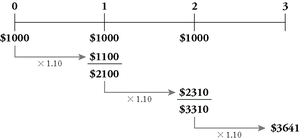
Example: Saving $1,000 today and at the end of each of the next two years at a 10% interest rate. The future value after three years can be calculated by compounding each deposit forward.
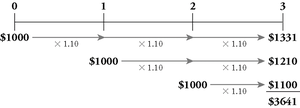
Alternatively, compute the future value of each cash flow separately and sum them:
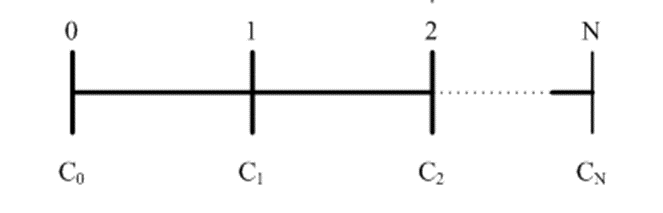
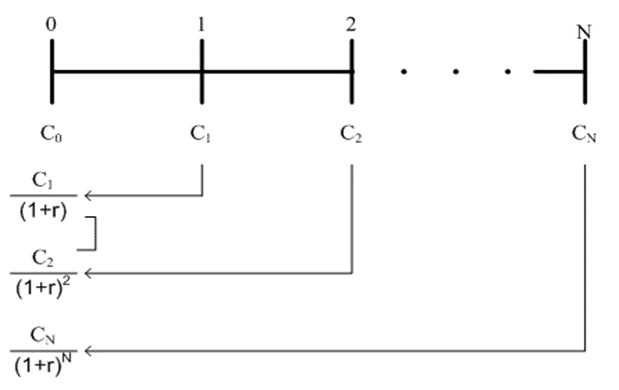
For a general stream of cash flows, the present value is calculated by discounting each cash flow to the present:
Example: Present Value of a Stream of Cash Flows
Suppose you promise to pay $5,000 in one year and $8,000 each year for the next three years at a 6% interest rate. The present value is the sum of the discounted cash flows.

Using Financial Calculators and Excel
Financial calculators and spreadsheets simplify the process of solving for present and future values. The five key variables are:
N: Number of periods
PV: Present value
PMT: Payment
FV: Future value
I/Y: Interest rate
Example: Investing $20,000 at 8% for 15 years. Enter the known variables and solve for FV.

Example: Computing the Future Value
Saving $1,000 today and at the end of each of the next two years at 10% interest. The timeline illustrates the cash flows:

Perpetuities
Definition and Present Value
A perpetuity is a stream of equal cash flows that occur at regular intervals and last forever. The first cash flow occurs at the end of the first period.

The present value of a perpetuity is:
where C is the payment and r is the interest rate.
Example: Creating a Perpetuity
Investing $100 at 5% allows you to withdraw $5 every year forever.
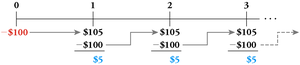
Example: Endowing a Perpetuity
To fund a $30,000 annual graduation party forever at 8% interest, the required donation is:

Annuities
Definition and Present Value
An annuity is a stream of equal cash flows paid at regular intervals for a fixed number of periods. The first payment occurs one period from today.

Example: Creating an Annuity
Investing $100 at 5% creates a 20-year annuity of $5 per year, plus $100 at the end.
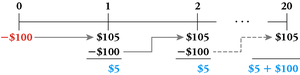
The present value of an annuity is:
Example: Present Value of a Lottery Prize Annuity
Winning $30 million as 30 payments of $1 million per year (starting today) or $15 million paid today. The timeline for option (a):

The present value of the 29 payments (excluding the first) is $11.16 million, plus the first payment:
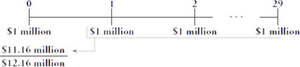

Future Value of an Annuity
Example: Retirement Savings Plan Annuity
Ellen saves $10,000 per year for 30 years at 10%. The future value is calculated using a financial calculator or Excel.

Growing Cash Flows
Growing Perpetuity
A growing perpetuity is a stream of cash flows that grow at a constant rate forever. The present value is:

Example: Endowing a Growing Perpetuity
Funding a graduation party with costs rising 4% per year, starting at $30,000, at 8% interest.

Growing Annuity
A growing annuity is a stream of N growing cash flows, paid at regular intervals, ending after N periods.
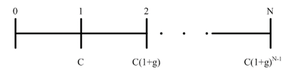
Example: Retirement Savings with a Growing Annuity
Ellen increases her savings by 5% per year for 30 years at 10%. The present value and future value are calculated using the growing annuity formula.
Solving for Variables Other Than Present Value or Future Value
Solving for Cash Flows in an Annuity (Loan Payment)
To compute the payment for a loan, use the annuity formula with known PV, N, and r.

Solving for Rate of Return
The rate of return is the interest rate that equates the present value of benefits and costs. For example, to make two lottery payout options equivalent, solve for r.


Solving for Number of Periods
To determine how long it takes for a sum to grow to a known value, solve for N given PV, PMT, FV, and r.

Key Formulas:
Future Value:
Present Value:
Present Value of a Perpetuity:
Present Value of an Annuity:
Present Value of a Growing Perpetuity:
Present Value of a Growing Annuity:
Additional info: These notes expand on the original content by providing definitions, formulas, and examples for each type of cash flow stream, as well as guidance on using financial calculators and Excel for computations. All images included directly reinforce the explanation of the adjacent paragraph.
