 Indietro
Valuation Principle and Time Value of Money in Financial Accounting
Guida di studio - Note intelligenti
 Appunti personalizzati basati sui tuoi materiali, ampliati con definizioni chiave, esempi e contesto.
The Valuation Principle
Cost-Benefit Analysis
The valuation principle is central to financial decision-making, ensuring that the value of benefits exceeds the value of costs. Financial managers use this principle to make decisions that increase the value of the firm for its investors.
Cost-Benefit Analysis: Any decision where the value of benefits exceeds the costs will increase firm value.
Quantification: Benefits and costs must be quantified in equivalent terms, usually cash today.
Example: Trading 200 ounces of silver for 10 ounces of gold, with market prices used to determine net value.
Role of Competitive Market Prices
Competitive market prices are used to determine the value of goods and assets, regardless of personal opinions or face values.
Law of One Price: In competitive markets, identical goods must have the same price.
Arbitrage: Buying and selling equivalent goods to profit from price differences without risk.
Valuation Principle: The value of a commodity or asset is determined by its competitive market price.
The Time Value of Money and Interest Rates
Time Value of Money
The time value of money reflects the principle that a dollar today is worth more than a dollar in the future due to its earning potential.
Interest Rate (r): The rate at which money can be borrowed or lent over a period.
Opportunity Cost: The cost of spending money today is the future value it could have earned.
Example: Investing $100,000 today at 10% interest yields $110,000 in one year. If an investment returns only $105,000, it is less valuable than simply depositing the money in the bank.

Present and Future Value
Present value (PV) and future value (FV) are fundamental concepts for comparing cash flows at different points in time.
Present Value: The value of a future cash flow discounted to today.
Future Value: The value of a cash flow moved forward in time.

Discount Factors and Rates
Discounting is used to determine the value today of a dollar received in the future. The discount factor is calculated as:
Discount Factor: for one year.
Discount Rate: The rate used to discount future cash flows.
Valuing Cash Flows at Different Points in Time
Timelines
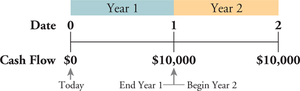
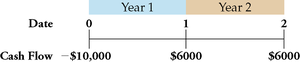
Timelines are visual representations of cash flows, helping to identify the timing of inflows and outflows.
Rules for Valuing Cash Flows
Three rules guide the valuation of cash flows:
Rule 1: Comparing and Combining Values - Only compare or combine values at the same point in time.
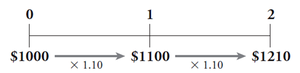
Rule 2: Compounding - To calculate a cash flow’s future value, compound it using the interest rate.
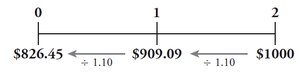
Rule 3: Discounting - To calculate the value of a future cash flow at an earlier point in time, discount it.

Compound Interest
Compound interest is the effect of earning interest on prior interest payments, leading to exponential growth over time.
Formula:
Example: $1000 grows to $1210$ in two years.
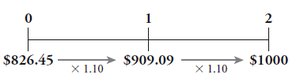
Discounting Cash Flows
Discounting is the process of determining the present value of future cash flows.
Formula:
Example: $1000 today at interest.


Present Value of a Single Future Cash Flow
Example 1: Savings Bond
Calculating the present value of a bond that pays $15,000 in 10 years at a 6% interest rate:
Formula:
Result: The bond is worth much less today than its final payoff due to the time value of money.
Example 2: Loan Repayment
XYZ Company expects to receive $2 million in five years. At a 4% interest rate, the present value is calculated to determine how much can be borrowed today.


Excel Formula: = PV(0.04, 5, 0, 2000000)
Result: The loan amount is less than $2 million due to discounting.
Summary Table: Key Formulas
Concept | Formula (LaTeX) |
|---|---|
Future Value | |
Present Value | |
Discount Factor |
Conclusion
The valuation principle and the time value of money are foundational concepts in financial accounting. They guide decision-making by ensuring that costs and benefits are properly quantified and compared using market prices and appropriate discounting or compounding techniques.
