 Indietro
Acid-Base Equilibria: Concepts, Calculations, and Applications
Guida di studio - Note intelligenti
 Appunti personalizzati basati sui tuoi materiali, ampliati con definizioni chiave, esempi e contesto.
Ch.15 - Acid-Base Equilibria
Introduction to Acids
Acids are a distinct class of covalent compounds characterized by their ability to donate hydrogen ions (H+) when dissolved in water. They typically have a hydrogen atom bonded to a nonmetal or a polyatomic ion. The hydrogen ion is usually at the beginning of the formula, except in certain cases such as acetic acid and some amines.
Common Acids: HCl, H2S, HCN, H3PO4, CH3COOH, NH4+, CH3NH3+
Characteristics in Aqueous Solution:
Ionize to produce H+ (or H3O+) and an anion
Have a sour taste due to the presence of H+ ions
React with metals to produce H2 gas
Turn blue litmus paper red

Introduction to Bases
Bases are substances that can accept hydrogen ions (protons) from acids in chemical reactions. They are classified as ionic or covalent (neutral amines) bases.
Ionic Bases: Contain a metal cation and a basic anion (e.g., hydroxide, hydride, amide, oxide).
Covalent Bases (Neutral Amines): Contain nitrogen atoms bonded to hydrogen and/or carbon atoms.
Characteristics in Aqueous Solution:
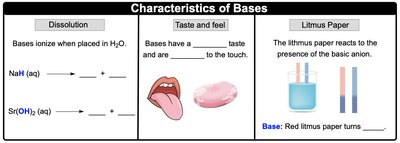
Ionize to produce OH- ions
Have a bitter taste and slippery feel
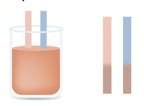
Turn red litmus paper blue
Auto-Ionization of Water and the Ion Product Constant (Kw)
Auto-Ionization
Water can undergo auto-ionization, where two water molecules react to form hydronium and hydroxide ions:
Water is amphoteric, meaning it can act as both an acid and a base.
Ion Product Constant (Kw)
The equilibrium constant for the auto-ionization of water is called Kw. Its value depends on temperature:
T (°C) | Kw |
|---|---|
0 | 1.14 × 10⁻¹⁵ |
10 | 2.93 × 10⁻¹⁵ |
20 | 6.81 × 10⁻¹⁵ |
30 | 1.471 × 10⁻¹⁴ |
50 | 5.476 × 10⁻¹⁴ |
100 | 51.3 × 10⁻¹⁴ |
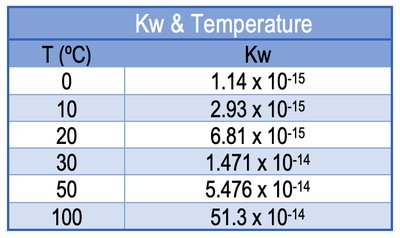
As temperature increases, Kw increases, meaning water ionizes more at higher temperatures.
Mathematical Operations in Acid-Base Equilibria
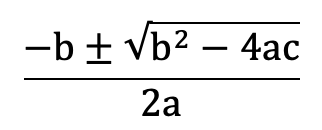
Quadratic Formula in Equilibrium Calculations
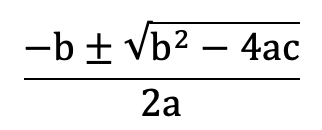
When solving for equilibrium concentrations, the quadratic formula is often required if the approximation method is not valid:
Quadratic Formula:
Percent Ionization/Dissociation
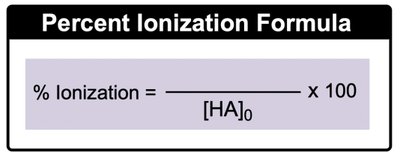
Percent Ionization Formula
The percent ionization of a weak acid or base is calculated as:
For acids:
For bases:
ICE Chart Shortcut and Approximations
When the initial concentration divided by the equilibrium constant (K) is greater than 500, the change in concentration (x) can be neglected in the denominator for simplification:
Approximation Method: If , then
Otherwise, use the quadratic formula.
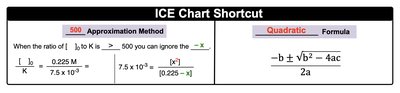
Additional info: The ICE chart (Initial, Change, Equilibrium) is a systematic way to organize and solve equilibrium problems in acid-base chemistry. The quadratic formula is used when the approximation method is not valid, ensuring accurate calculation of equilibrium concentrations.
