 Indietro
Chapter 3: Molecules and Compounds – Comprehensive Study Notes
Guida di studio - Note intelligenti
 Appunti personalizzati basati sui tuoi materiali, ampliati con definizioni chiave, esempi e contesto.
Molecules and Compounds
Introduction to Molecules and Compounds
Elements combine to form compounds, which are substances with properties distinct from their constituent elements. The transformation from elements to compounds involves chemical bonding, resulting in new chemical and physical characteristics.
Compound: A substance formed when two or more elements chemically bond together.
Example: Hydrogen (H2) and Oxygen (O2) are elements, but when combined, they form water (H2O), a compound with unique properties.
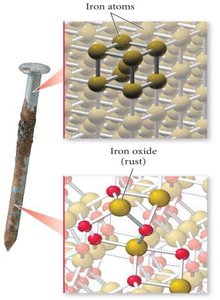
Types of Chemical Bonds
Chemical bonds are strong attractions between atoms that hold compounds together. There are three primary types of bonds:
Ionic Bonds: Occur between metals and nonmetals; involve the transfer of electrons, forming cations (positive ions) and anions (negative ions).
Covalent Bonds: Occur between nonmetals or metalloid + nonmetal; involve the sharing of electrons, resulting in molecules.
Metallic Bonds: Occur between metal atoms; involve a 'sea' of shared electrons.
Atoms bound covalently form molecules. If the atoms are identical, the substance is a molecular element; if different, it is a molecular compound.
Chemical Formulas and Molecular Models
Representing Compounds
Chemical formulas and models are used to represent the composition and structure of compounds:
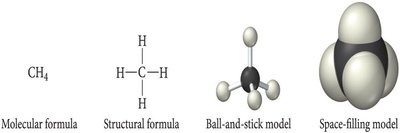
Chemical Formula: Indicates the elements and the number of atoms (e.g., H2O, CO2, NaCl).
Structural Formula: Uses lines to represent covalent bonds between atoms.
Ball-and-Stick Model: Shows atoms as balls and bonds as sticks.
Space-Filling Model: Closely represents the actual shape and size of a molecule.
Organic Compounds
Structure and Functional Groups
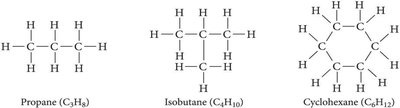
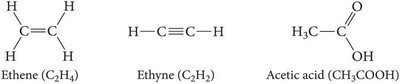
Organic compounds are primarily composed of carbon and hydrogen, often with other elements such as oxygen, nitrogen, phosphorus, sulfur, and chlorine. Carbon's versatility allows for the formation of straight chains, branched chains, and rings.
Hydrocarbons: Compounds containing only carbon and hydrogen; found in fuels like gasoline, oil, propane, and natural gas.
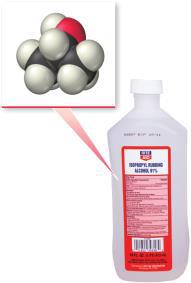
Functional Groups: Specific atoms or bonds that impart characteristic chemical properties to organic molecules (e.g., alcohol, carboxylic acid, amine).
Counting Atoms: The Mole Concept
The Mole and Avogadro's Number
Chemists use the mole as a counting unit for atoms, molecules, or ions. One mole contains 6.022 × 10²³ particles, known as Avogadro's number. This allows chemists to relate mass to the number of particles in a sample.
Definition: 1 mole = 6.022 × 10²³ particles
Example: 12 g of carbon-12 contains 1 mole of carbon atoms.
Converting Between Moles, Mass, and Particles
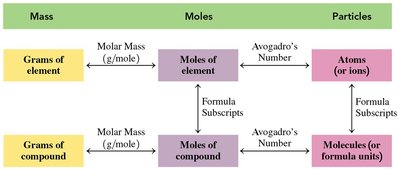
Conversions between mass, moles, and number of particles are fundamental in chemistry. The relationships are established using molar mass and Avogadro's number.
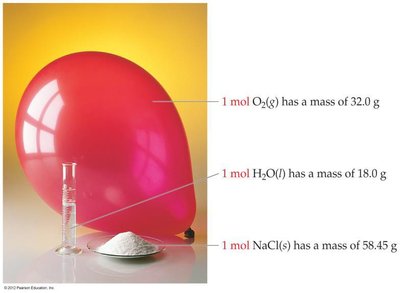
Molar Mass: The mass in grams of one mole of a substance (g/mol).
Conversion Factors: Used to convert between grams, moles, and number of particles.
Moles of Elements in a Compound
Interpreting Chemical Formulas
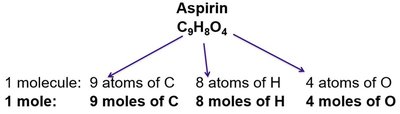
The subscripts in a chemical formula indicate the ratio of atoms and moles of each element in a compound. For example, in aspirin (C9H8O4):
1 molecule contains 9 C, 8 H, and 4 O atoms.
1 mole contains 9 moles C, 8 moles H, and 4 moles O.
Formula Mass and Molar Mass
Calculating Formula Mass
The formula mass (or molecular mass/weight) is the sum of the atomic masses of all atoms in a molecule or formula unit. It is calculated as follows:
Formula mass = Sum of (number of atoms × atomic mass) for each element
Example: For H2O:

Molar Mass as a Conversion Factor
The molar mass is numerically equal to the formula mass but expressed in grams per mole (g/mol). It is used to convert between mass and moles:
1 mole H2O = 18.02 g
1 mole NaCl = 58.45 g
Percent Composition of Compounds
Calculating Mass Percent
The percent composition of a compound is the mass percentage of each element in one mole of the compound. It is calculated using:
Percent composition can be determined from the chemical formula and molar masses or from experimental mass analysis.
Empirical and Molecular Formulas
Types of Chemical Formulas
Chemical formulas can be categorized as:
Empirical Formula: Shows the simplest whole-number ratio of atoms in a compound.
Molecular Formula: Shows the actual number of atoms of each element in a molecule.
Example: For H2O2, the empirical formula is HO; for CCl4, the empirical and molecular formulas are identical.
Determining Empirical Formulas
Steps to determine the empirical formula:
Convert percentages to grams (assume 100 g sample).
Convert grams to moles using molar mass.
Write a pseudoformula with calculated moles as subscripts.
Divide all subscripts by the smallest number of moles.
If subscripts are not whole numbers, multiply by a factor to obtain whole numbers.
Determining Molecular Formulas
The molecular formula is determined using the empirical formula and the molar mass:
Dimensional Analysis in Chemistry
Converting Between Mass, Moles, and Particles
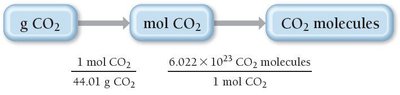
Dimensional analysis is used to convert between grams, moles, and number of particles using conversion factors:
Summary Table: Common Organic Compounds
The following table summarizes the names, formulas, functional groups, and main uses of several common organic compounds:
Name | Formula | Group | Main Use |
|---|---|---|---|
Methane | CH4 | Hydrocarbon | Natural gas |
Propane | C3H8 | Hydrocarbon | Fuel |
Octane | C8H18 | Hydrocarbon | Fuel (gasoline) |
Methanol | CH3OH | Alcohol | Fuel |
Ethanol | CH3CH2OH | Alcohol | Fuel |
Acetic Acid | CH3COOH | Carboxylic acid | Vinegar |
Acetone | CH3COCH3 | Ketone | Nail polish remover |
Methyl Amine | CH3NH2 | Amine | Part of amino acids |
Additional info:
These notes expand on the original content by providing academic context, definitions, and examples for each topic. All images included are directly relevant to the adjacent explanations, reinforcing key concepts in molecular structure, chemical bonding, and quantitative analysis in chemistry.
