Indietro
Chemical Kinetics: Principles, Rate Laws, and Mechanisms
Guida di studio - Note intelligenti
 Appunti personalizzati basati sui tuoi materiali, ampliati con definizioni chiave, esempi e contesto.
Chemical Kinetics
Introduction to Reaction Rates
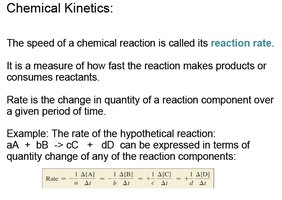
Chemical kinetics is the study of the speed, or rate, at which chemical reactions occur. The reaction rate measures how quickly reactants are converted into products or how fast products are formed. It is defined as the change in concentration of a reactant or product per unit time.
Reaction Rate: The change in quantity of a reaction component over a given period of time.
General Rate Expression: For a reaction aA + bB → cC + dD, the rate can be expressed as:
Reaction Rate Changes Over Time
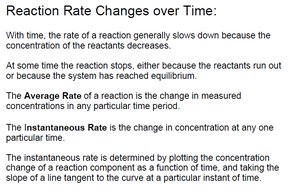
The rate of a reaction typically decreases as the concentration of reactants decreases. Eventually, the reaction may stop when reactants are depleted or equilibrium is reached.
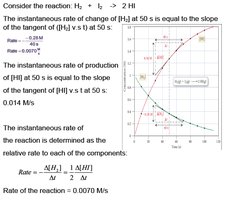
Average Rate: Change in measured concentrations over a time period.
Instantaneous Rate: Change in concentration at a specific instant, determined by the slope of the tangent to a concentration vs. time curve.
Worked Examples: Calculating Reaction Rates
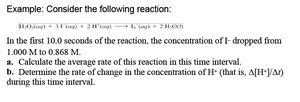
Examples often involve calculating the average or instantaneous rate from concentration data over time.
Example: For the reaction 2HI(aq) → H2(aq) + I2(aq), if [I-] drops from 1.000 M to 0.868 M in 10.0 s, calculate the average rate and the rate of change of [H+].
Factors Affecting Reaction Rates
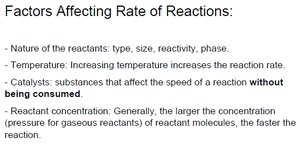
Several factors influence how fast a reaction proceeds:
Nature of Reactants: Type, size, reactivity, and phase affect rate.
Temperature: Higher temperature generally increases reaction rate.
Catalysts: Substances that increase reaction rate without being consumed.
Reactant Concentration: Higher concentration (or pressure for gases) increases rate.
The Rate Law
Definition and Formulation
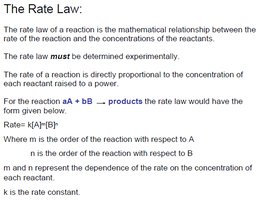
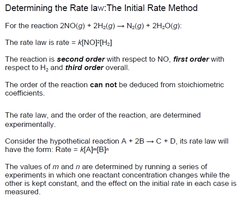
The rate law expresses the relationship between the reaction rate and the concentrations of reactants. It must be determined experimentally and cannot be deduced from the balanced equation alone.
General form:
k: Rate constant (depends on temperature and reaction).
m, n: Reaction orders with respect to A and B, respectively.
Reaction Order
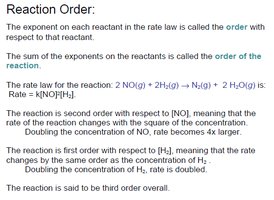
The order of a reaction with respect to a reactant is the exponent of its concentration in the rate law. The overall order is the sum of the exponents.
Example: For ,
Second order in NO, first order in H2, third order overall.
Experimental Determination of Rate Laws
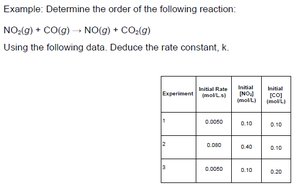
Rate laws are determined by measuring how the initial rate changes as the concentration of reactants is varied (the initial rate method).
Run experiments varying one reactant at a time, keeping others constant.
Analyze how the rate changes to deduce the order with respect to each reactant.
The Rate Constant (k)
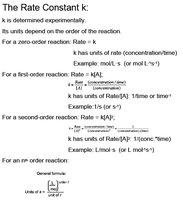
The rate constant is a proportionality constant in the rate law. Its units depend on the overall order of the reaction.
Zero order: (units: mol/L·s)
First order: (units: 1/s)
Second order: or (units: L/mol·s)
Integrated Rate Laws
General Forms
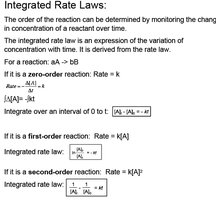
Integrated rate laws relate reactant concentration to time and depend on the reaction order.
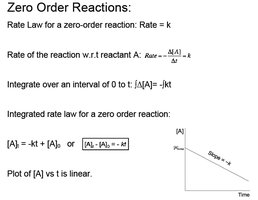
Zero Order:
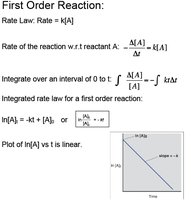
First Order:
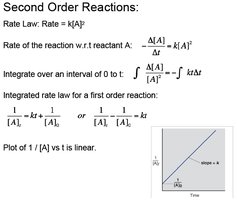
Second Order:
Zero Order Reactions
For zero order reactions, the rate is independent of reactant concentration. A plot of [A] vs. t is linear with a slope of -k.
First Order Reactions
For first order reactions, the rate depends linearly on [A]. A plot of ln[A] vs. t is linear with a slope of -k.
Second Order Reactions
For second order reactions, the rate depends on the square of [A] or the product of two reactant concentrations. A plot of 1/[A] vs. t is linear with a slope of k.
Graphical Methods for Determining Reaction Order
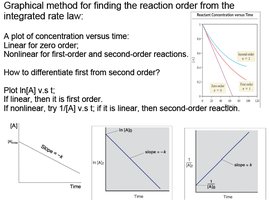
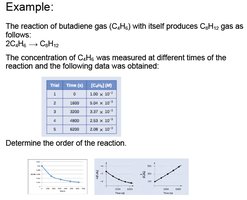
To determine reaction order, plot concentration data in different forms:
[A] vs. t: Linear for zero order
ln[A] vs. t: Linear for first order
1/[A] vs. t: Linear for second order
Half-Life of Reactions
Definition and Equations
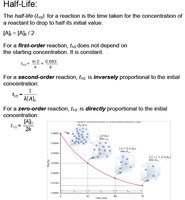
The half-life (t1/2) is the time required for the concentration of a reactant to decrease to half its initial value. The expression for half-life depends on the reaction order:
First order: (independent of [A]0)
Second order: (inversely proportional to [A]0)
Zero order: (directly proportional to [A]0)
Collision Theory and Activation Energy
Collision Theory
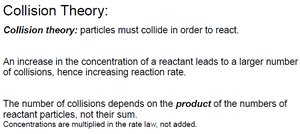
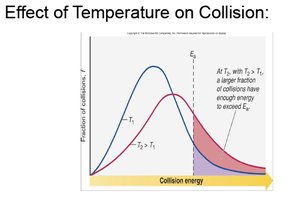
According to collision theory, particles must collide to react. The rate depends on the frequency and energy of collisions. Only collisions with sufficient energy (activation energy) and proper orientation are effective.
Activation Energy
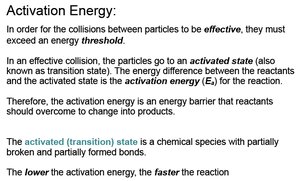
The activation energy (Ea) is the minimum energy required for a reaction to occur. The activated complex or transition state is a high-energy, unstable arrangement of atoms.
Lower activation energy means a faster reaction.
Temperature and the Rate Constant
Arrhenius Equation
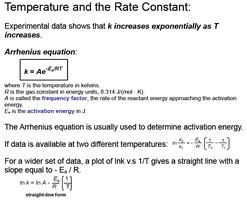
The rate constant increases exponentially with temperature, described by the Arrhenius equation:
ln k vs. 1/T yields a straight line with slope
Catalysts
Role and Effect
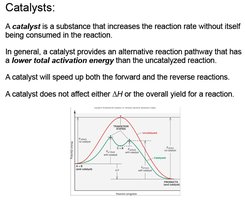
A catalyst increases the reaction rate by providing an alternative pathway with lower activation energy. Catalysts are not consumed in the reaction and do not affect the overall thermodynamics (ΔH or yield).
Reaction Mechanisms
Elementary Steps and Molecularity
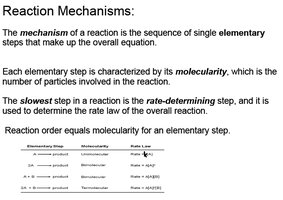
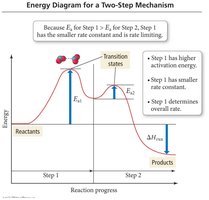
The mechanism of a reaction is the sequence of elementary steps that make up the overall reaction. Each step is characterized by its molecularity (number of particles involved).
The slowest step is the rate-determining step.
For an elementary step, the rate law can be written directly from the molecularity.
Validating Mechanisms
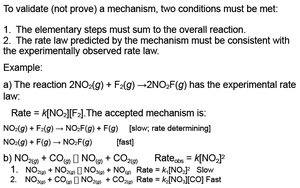
To validate a proposed mechanism:
The sum of elementary steps must equal the overall reaction.
The predicted rate law must match the experimentally determined rate law.
Mixed Mechanisms (with Equilibrium Steps)
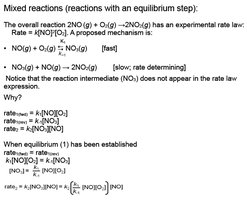
Some mechanisms involve a fast equilibrium followed by a slow step. The rate law may involve intermediates, which are eliminated using equilibrium expressions.
Example: For 2NO(g) + O2(g) → 2NO2(g), the mechanism involves a fast equilibrium and a slow step.