 Indietro
Chemical Reactions and Redox Reactions: General Chemistry Study Notes
Guida di studio - Note intelligenti
 Appunti personalizzati basati sui tuoi materiali, ampliati con definizioni chiave, esempi e contesto.
Chemical Reactions
Introduction to Chemical Reactions
Chemical reactions involve the transformation of substances into new products through the breaking and forming of chemical bonds. Understanding how to write, balance, and predict the outcomes of chemical reactions is fundamental in general chemistry.
Chemical Equation: A symbolic representation of a chemical reaction using chemical formulas and symbols.
Reactants: Substances present before the reaction.
Products: Substances formed as a result of the reaction.
State Symbols: Indicate the physical state of each substance: (s) for solid, (l) for liquid, (g) for gas, (aq) for aqueous.
Δ (Delta): Indicates that heat is applied.
Balancing Chemical Equations
Balancing chemical equations ensures the law of conservation of mass is obeyed, meaning the number of atoms of each element is the same on both sides of the equation.
Count all atoms of each element on both sides.
Balance polyatomic ions as units if they remain unchanged.
Assign coefficients to balance atoms, not subscripts.
Balance elements that appear in only one reactant and one product first.
Balance individual elements last, especially hydrogen and oxygen.
Fractional coefficients can be used temporarily but must be cleared by multiplying the entire equation by a common factor.
Example: Balancing the decomposition of hydrogen peroxide:
Types of Chemical Reactions
Synthesis (Combination): Two or more elements or compounds combine to form one product. General form:
Decomposition: A single compound breaks down into two or more simpler substances. General form:
Single Replacement: One element replaces another in a compound. General form:
Double Replacement (Metathesis): Exchange of ions between two compounds. General form:
Combustion: A hydrocarbon reacts with oxygen to produce carbon dioxide and water. General form:
Special Reaction Types
Acid-Base Neutralization: Acid reacts with base to form water and an ionic compound (salt).
Carbonate Decomposition: Metal carbonates decompose upon heating to form metal oxides and carbon dioxide.
Carbonate Acid Decomposition: Carbonates or bicarbonates react with acids to produce CO2, water, and an ionic compound.
Sulfurous Acid Decomposition: Sulfites or bisulfites react with acids to produce SO2, water, and an ionic compound.
Redox (Reduction-Oxidation) Reactions
Introduction to Redox Reactions
Redox reactions involve the transfer of electrons between substances, resulting in changes in oxidation states. These reactions are essential for processes such as combustion, corrosion, and metabolism.
Oxidation: Loss of electrons (increase in oxidation state).
Reduction: Gain of electrons (decrease in oxidation state).
OIL RIG: Oxidation Is Loss, Reduction Is Gain (of electrons).
Oxidizing Agent: Substance that causes oxidation (is itself reduced).
Reducing Agent: Substance that causes reduction (is itself oxidized).
Assigning Oxidation States
Oxidation states are assigned to atoms in compounds to track electron transfer in redox reactions. The following rules are used:
Free elements: Oxidation state = 0 (e.g., , )
Monatomic ions: Oxidation state = ion charge (e.g., is +2)
Sum of oxidation states in a neutral molecule = 0; in a polyatomic ion = ion charge
Group 1A metals: +1; Group 2A metals: +2 in compounds
Nonmetals have characteristic oxidation states (see table below)
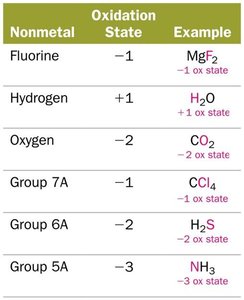
Table: Common Oxidation States of Nonmetals
Nonmetal | Oxidation State | Example |
|---|---|---|
Fluorine | −1 | MgF2 |
Hydrogen | +1 | H2O |
Oxygen | −2 | CO2 |
Group 7A | −1 | CCl4 |
Group 6A | −2 | H2S |
Group 5A | −3 | NH3 |
Identifying Redox Reactions
A reaction is a redox reaction if there is a change in oxidation state for one or more elements. The substance that is oxidized is the reducing agent, and the substance that is reduced is the oxidizing agent.
Example: Na is oxidized (0 to +1), Cl is reduced (0 to −1).
Practice Problems
Assign oxidation states to all atoms in the following: Cr, FeBr3, SO3, CO2, SO42−, K2O2.
Identify the reducing and oxidizing agents in reactions such as combustion of hydrocarbons and metal displacement reactions.
Stoichiometry and Mass Percent Composition
Mass Percent Composition
Mass percent composition is the percentage by mass of each element in a compound or mixture. It is calculated as:
Used to determine empirical formulas and analyze mixtures.
Stoichiometry and Percent Yield
Stoichiometry involves the calculation of reactants and products in chemical reactions using balanced equations. Percent yield compares the actual yield to the theoretical yield:
Used to assess the efficiency of chemical reactions in laboratory and industrial settings.
Visual Example: Synthesis Reaction
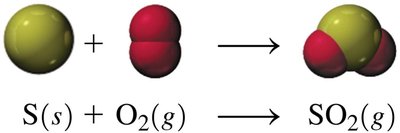
The reaction of sulfur with oxygen to form sulfur dioxide is a classic example of a synthesis reaction, where two elements combine to form a compound:
Key Points:
Both reactants are elements in their standard states.
The product, SO2, is a molecular compound formed by the direct combination of sulfur and oxygen.
Additional info: The visual representation helps illustrate the rearrangement of atoms during the reaction, reinforcing the concept of conservation of mass and the necessity of balancing chemical equations.
