 Indietro
Crystal Field Theory and Transition Metal Complexes: Structure, Colour, and Applications
Guida di studio - Note intelligenti
 Appunti personalizzati basati sui tuoi materiali, ampliati con definizioni chiave, esempi e contesto.
Bonding in Transition Metal Complexes
Crystal Field Theory (CFT)
Crystal Field Theory is a model used to explain the electronic, thermodynamic, and structural properties of transition metal complexes. It describes the interaction between the metal ion's d electrons and the negative charges of the ligands, which are considered as point charges. CFT is an ionic model and does not account for covalent bonding between ligands and the metal ion.
Key Point: Ligands are treated as point negative charges, and their interaction with the metal ion's d orbitals leads to energy splitting.
Key Point: The shape and orientation of the five d orbitals are crucial in determining their interaction with ligands in an octahedral field.
Example: In an octahedral complex, six ligands are placed along the x, y, and z axes.
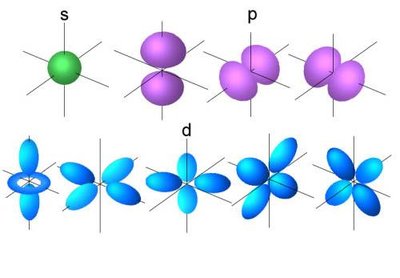
Atomic Orbitals and d-Orbital Directionality
Each atomic orbital is defined by quantum numbers n (energy), ℓ (angular momentum), and m (angular momentum vector). The five d orbitals (dz2, dx2-y2, dxy, dxz, dyz) have distinct shapes and directionalities, which affect their interaction with ligands.
Key Point: The dx2-y2 and dz2 orbitals point directly toward the ligands in an octahedral field, experiencing greater repulsion.
Key Point: The dxy, dxz, and dyz orbitals point between the ligands, experiencing less repulsion.
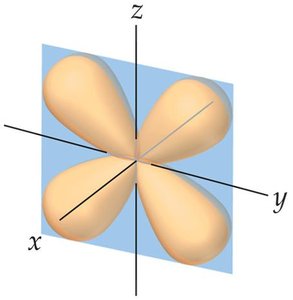
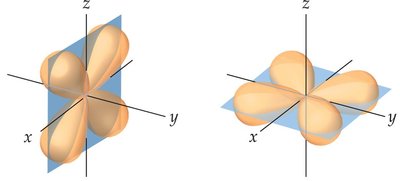
Crystal Field Splitting in Octahedral Complexes
Degeneracy and Energy Splitting
In a free metal ion, all five d orbitals are degenerate (same energy). When placed in a symmetrical field of negative charge, the energy of all d orbitals increases equally. However, in an octahedral field, the d orbitals split into two sets due to varying repulsion from ligands.
Key Point: The dx2-y2 and dz2 orbitals (eg set) are raised to higher energy, while dxy, dxz, and dyz (t2g set) remain at lower energy.
Key Point: The energy difference between these sets is called the octahedral crystal field splitting, denoted as .
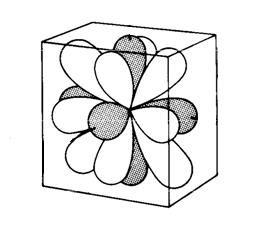
Magnitude of Crystal Field Splitting ()
The magnitude of depends on both the metal ion and the nature of the ligands. Ligands are ranked in the spectrochemical series according to their ability to cause splitting.
Key Point: Weak field ligands (halides) cause smaller ; strong field ligands (CO, CN-) cause larger $\Delta_o$.
Key Point: The spectrochemical series: Halides < Oxygen donors < Nitrogen donors < CN- < CO.
Ligand Type | Field Strength | |
|---|---|---|
Halides | Weak | Small |
Oxygen donors | Moderate | Medium |
Nitrogen donors | Strong | Large |
CO, CN- | Very Strong | Very Large |
Electron Configurations in Transition Metal Complexes
High Spin vs Low Spin Complexes
The arrangement of d electrons in an octahedral field depends on the relative values of and the pairing energy (P). Hund's Rule states that electrons fill separate orbitals with parallel spins for maximum stability.
Key Point: High spin complexes occur with weak field ligands (), maximizing unpaired electrons.
Key Point: Low spin complexes occur with strong field ligands (), maximizing paired electrons.
Example: [FeF6]3- (weak field, high spin, 5 unpaired electrons); [Fe(CN)6]3- (strong field, low spin, 1 unpaired electron).
Colour in Transition Metal Complexes
Origin of Colour
Transition metal complexes are often coloured because they absorb specific wavelengths of visible light. This absorption occurs when the energy of a photon matches the energy required to promote an electron from the lower energy d orbital set (t2g) to the higher energy set (eg).
Key Point: The energy difference determines the wavelength of light absorbed.
Key Point: The observed colour is the complement of the absorbed wavelength.
Formula: , where is Planck's constant, is the speed of light, and is the wavelength.
Spectrochemical Series and Colour
The wavelength () or frequency () of absorbed light depends on the magnitude of . Complexes with weak field ligands absorb at longer wavelengths (lower energy), while those with strong field ligands absorb at shorter wavelengths (higher energy).
Key Point:
Key Point: Cu(I) and Ti(IV) complexes are colourless due to their d10 and d0 electron configurations, respectively.
Applications of Transition Metal Chemistry in Medicine
Chelation Therapy
Chelation therapy uses polydentate ligands to remove toxic metal ions from biological systems. Chelating ligands, such as EDTA, bind more strongly to metal ions than monodentate ligands due to the chelate effect, which is primarily entropic in origin.
Key Point: Chelating agents are used to treat heavy metal poisoning, Wilson's disease (Cu), and thalassemia (Fe).
Key Point: The formation constant () for chelated complexes is much higher than for non-chelated complexes.
Example: (); ().
Complex | Formation Constant () |
|---|---|
[Ni(NH3)6]2+ | 4 x 10⁸ |
[Ni(en)3]2+ | 2 x 10¹⁸ |

Metal-Based Anti-Tumor Agents: Cisplatin
Cisplatin is a platinum-based anti-cancer drug that targets DNA. It forms 1,2-intra-strand adducts with guanine residues, disrupting DNA transcription, replication, and repair, ultimately leading to cell death. The geometry of cisplatin is crucial for its activity; transplatin does not form the same adducts.
Key Point: Cisplatin is administered in saline to prevent hydrolysis; inside cells, chloride ligands are replaced by water, allowing binding to DNA.
Key Point: The primary target is the N7 position of guanine in DNA.
Coordination Chemistry in Living Systems
Hemoglobin and Oxygen Transport
Hemoglobin is an iron-containing protein in red blood cells responsible for oxygen transport. The coordination chemistry of Fe2+ in the haem group explains the magnetic properties of oxy- and deoxyhemoglobin, which are important for medical imaging techniques like fMRI.
Key Point: Deoxyhemoglobin (with H2O ligand) is high spin and paramagnetic; oxyhemoglobin (with O2 ligand) is low spin and diamagnetic.
Key Point: Carbon monoxide binds much more strongly to hemoglobin than oxygen, forming carboxyhemoglobin and preventing effective oxygen transport.
Pulse Oximetry
Pulse oximetry is a non-invasive method for monitoring oxygen saturation in blood. It uses two light sources of different wavelengths to compare absorbance by oxy- and deoxyhemoglobin, allowing estimation of O2 saturation.
Key Point: The technique relies on the different absorbance properties of hemoglobin species at specific wavelengths.
