 Indietro
Chapter 2: General Chemistry: Atomic Structure, Isotopes, and Periodic Table Study Guide
Guida di studio - Note intelligenti
 Appunti personalizzati basati sui tuoi materiali, ampliati con definizioni chiave, esempi e contesto.
Q1. In Dalton’s atomic theory, matter is neither created nor destroyed. What law does this refer to?
Background
Topic: Laws of Chemistry – Conservation of Mass
This question tests your understanding of the fundamental laws that underpin atomic theory, specifically the law that states matter cannot be created or destroyed in a chemical reaction.
Key Terms and Formulas:
Law of Conservation of Mass: In a chemical reaction, the total mass of reactants equals the total mass of products.
Dalton’s Atomic Theory: One postulate is that atoms cannot be created or destroyed in chemical reactions.
Step-by-Step Guidance
Recall the main postulates of Dalton’s atomic theory, especially those related to chemical reactions.
Think about which law states that the total amount of matter remains constant during a chemical reaction.
Match this law to the statement in Dalton’s theory about atoms not being created or destroyed.
Try solving on your own before revealing the answer!
Final Answer: Law of Conservation of Mass
This law states that matter is neither created nor destroyed in a chemical reaction, which is reflected in Dalton’s atomic theory.
Q2. All samples of a given compound, regardless of their source or how they were prepared, have the same composition. What law does this refer to?
Background
Topic: Laws of Definite and Multiple Proportions
This question is about the law that states a chemical compound always contains the same proportion of elements by mass.
Key Terms and Formulas:
Law of Definite Proportions: A given compound always contains exactly the same proportion of elements by mass.
Law of Multiple Proportions: When two elements form more than one compound, the ratios of the masses of the second element combine with a fixed mass of the first element in small whole numbers.
Step-by-Step Guidance
Identify which law states that the composition of a compound is always the same, regardless of its source.
Recall the difference between the law of definite proportions and the law of multiple proportions.
Choose the law that best fits the description in the question.
Try solving on your own before revealing the answer!
Final Answer: Law of Definite Proportions
This law states that a chemical compound always contains the same elements in exactly the same proportions by mass.
Q3. When two elements form different compounds, the masses of element B that combine with 1 g of element A can be expressed as a ratio of small whole numbers. What law does this refer to?
Background
Topic: Law of Multiple Proportions
This question tests your understanding of how elements combine in different ratios to form different compounds.
Key Terms and Formulas:
Law of Multiple Proportions: When two elements form more than one compound, the masses of one element that combine with a fixed mass of the other are in ratios of small whole numbers.
Step-by-Step Guidance
Recall the law that deals with the ratios of masses of elements in different compounds.
Think about how this law applies when two elements can form more than one compound.
Identify the law that describes the ratio of masses as small whole numbers.
Try solving on your own before revealing the answer!
Final Answer: Law of Multiple Proportions
This law explains that the masses of one element that combine with a fixed mass of another element are in ratios of small whole numbers.
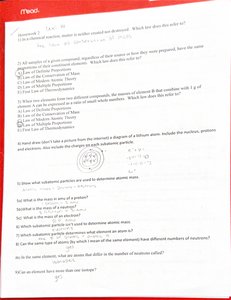
Q4. Draw and label a picture of a lithium atom. Include the nucleus, protons, neutrons, and electrons. Also include the charges on each particle.
Background
Topic: Atomic Structure
This question tests your understanding of the structure of an atom, including the arrangement and charges of subatomic particles.
Key Terms and Formulas:
Proton: Positively charged particle in the nucleus.
Neutron: Neutral particle in the nucleus.
Electron: Negatively charged particle outside the nucleus.
Step-by-Step Guidance
Recall the atomic number of lithium (Z = 3), which tells you the number of protons and electrons in a neutral atom.
Find the most common isotope of lithium to determine the number of neutrons (mass number - atomic number).
Draw a nucleus with the correct number of protons and neutrons, and show electrons in shells around the nucleus.
Label each particle with its charge: protons (+), neutrons (0), electrons (−).
Try solving on your own before revealing the answer!
Final Answer:
Lithium has 3 protons (+), 3 neutrons (0), and 3 electrons (−). The protons and neutrons are in the nucleus, and the electrons are outside the nucleus. Charges: proton (+1), neutron (0), electron (−1).
Q5. Name what subatomic particles are used to determine atomic mass and atomic number.
Background
Topic: Atomic Number and Mass Number
This question tests your knowledge of which particles define an element’s identity and its mass.
Key Terms and Formulas:
Atomic Number (Z): Number of protons in the nucleus.
Mass Number (A): Total number of protons and neutrons in the nucleus.
Step-by-Step Guidance
Recall which particle determines the atomic number (identity of the element).
Recall which particles are added together to get the mass number.
Write down the definitions for atomic number and mass number using the correct subatomic particles.
Try solving on your own before revealing the answer!
Final Answer:
Atomic number is determined by the number of protons. Atomic mass (mass number) is determined by the sum of protons and neutrons.
