 Indietro
General Chemistry: Chemical Bonding, Molecular Structure, and Stoichiometry Study Notes
Guida di studio - Note intelligenti
 Appunti personalizzati basati sui tuoi materiali, ampliati con definizioni chiave, esempi e contesto.
Chemical Bonding and Molecular Structure
Types of Chemical Bonds
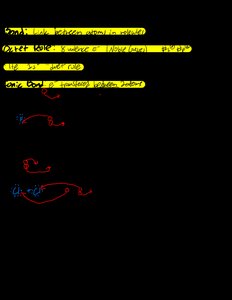
Chemical bonds are the attractive forces that hold atoms together in compounds. The main types of chemical bonds are ionic, covalent, and metallic bonds.
Ionic Bonds: Formed by the transfer of electrons from one atom to another, typically between metals and nonmetals. The resulting ions are held together by electrostatic attraction.
Covalent Bonds: Formed by the sharing of electrons between two nonmetal atoms. The shared electrons allow each atom to attain a stable electron configuration.
Polar Covalent Bonds: A type of covalent bond where electrons are shared unequally due to differences in electronegativity between the atoms.
Lewis Structures and the Octet Rule
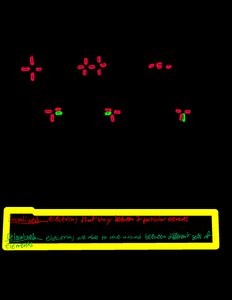
Lewis structures are diagrams that show the bonding between atoms and the lone pairs of electrons in a molecule. The octet rule states that atoms tend to form bonds until they are surrounded by eight valence electrons.
Steps to Draw Lewis Structures:
Count the total number of valence electrons.
Arrange atoms and connect them with single bonds.
Distribute remaining electrons to satisfy the octet rule.
Use double or triple bonds if necessary to complete octets.
Formal Charge: Used to determine the most stable Lewis structure. Calculated as:
VSEPR Theory and Molecular Geometry
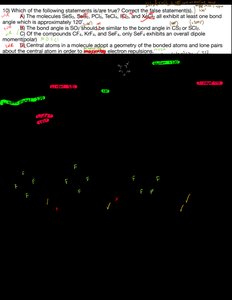
The Valence Shell Electron Pair Repulsion (VSEPR) theory is used to predict the shapes of molecules based on the repulsion between electron pairs around a central atom.
Common Geometries:
Linear: 180° bond angle
Trigonal planar: 120° bond angle
Tetrahedral: 109.5° bond angle
Trigonal bipyramidal: 90°, 120° bond angles
Octahedral: 90° bond angles
Lone pairs on the central atom can distort bond angles from their ideal values.
Polarity and Dipole Moments
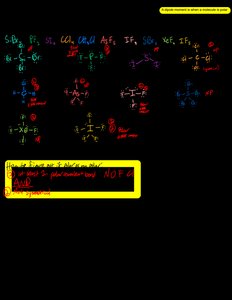
Molecular polarity depends on both the polarity of individual bonds and the geometry of the molecule. A molecule is polar if it has a net dipole moment.
Bond Polarity: Determined by the difference in electronegativity between bonded atoms.
Molecular Polarity: Determined by vector addition of bond dipoles. Symmetrical molecules (e.g., CO2, CF4) are often nonpolar even if they contain polar bonds.
Stoichiometry and Chemical Calculations
The Mole Concept and Avogadro's Number
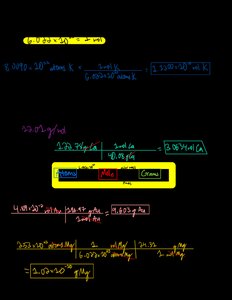
The mole is the SI unit for the amount of substance. One mole contains Avogadro's number () of particles (atoms, molecules, or ions).
Molar Mass: The mass of one mole of a substance, expressed in grams per mole (g/mol).
Conversions: Use dimensional analysis to convert between grams, moles, and number of particles.
Percent Composition and Empirical Formulas
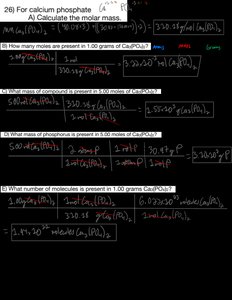
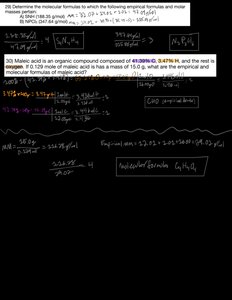
Percent composition is the percent by mass of each element in a compound. The empirical formula is the simplest whole-number ratio of atoms in a compound.
Percent Composition Formula:
Empirical Formula Calculation:
Convert mass percentages to grams (assume 100 g sample).
Convert grams to moles for each element.
Divide by the smallest number of moles to get the simplest ratio.
Stoichiometric Calculations
Stoichiometry involves using balanced chemical equations to calculate the quantities of reactants and products involved in a reaction.
Steps:
Write and balance the chemical equation.
Convert given quantities to moles.
Use mole ratios from the balanced equation to find moles of desired substance.
Convert moles back to grams or other units as needed.

Additional Topics
Significant Figures and Unit Conversions
Significant figures reflect the precision of a measurement. Unit conversions are essential for solving chemistry problems and require careful attention to significant figures.
Rules for Significant Figures:
All nonzero digits are significant.
Zeros between nonzero digits are significant.
Leading zeros are not significant.
Trailing zeros in a decimal number are significant.
Unit Conversion: Use conversion factors to change from one unit to another, ensuring units cancel appropriately.
Hybridization and Molecular Orbitals
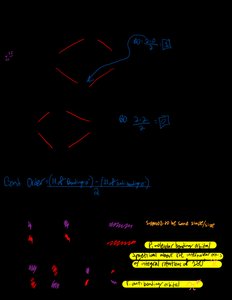
Hybridization describes the mixing of atomic orbitals to form new hybrid orbitals for bonding. Molecular orbital theory explains bonding in terms of the combination of atomic orbitals to form molecular orbitals.
Common Types of Hybridization:
sp: Linear geometry
sp2: Trigonal planar geometry
sp3: Tetrahedral geometry
Bond Order: Indicates the number of chemical bonds between a pair of atoms. Calculated as:
Practice Problems and Applications
Applying these concepts to solve problems is essential for mastering general chemistry. Practice includes drawing Lewis structures, predicting molecular shapes, calculating molar masses, and performing stoichiometric calculations.
Example: Calculating the empirical formula of a compound given percent composition.
Example: Determining the polarity of a molecule based on its geometry and bond polarities.
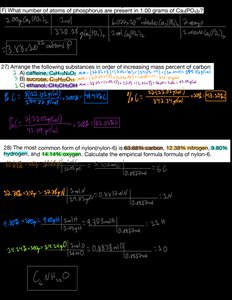
Additional info: These notes integrate key concepts from chemical bonding, molecular structure, stoichiometry, and related calculations, as covered in a typical General Chemistry curriculum. The images included are directly relevant to the explanations and reinforce the academic content.
