 Indietro
General Chemistry Exam Review: Solutions, Solubility, Ionic Equations, Acids/Bases, Redox, IMFs, and Phase Diagrams
Guida di studio - Note intelligenti
 Appunti personalizzati basati sui tuoi materiali, ampliati con definizioni chiave, esempi e contesto.
Q1. A student adds a small amount of solid NaCl to a beaker containing an aqueous NaCl solution at a constant temperature. The added NaCl completely dissolves. Which of the following best describes the original NaCl solution?
Background
Topic: Solution Chemistry – Solubility and Types of Solutions
This question tests your understanding of the definitions of saturated, unsaturated, and supersaturated solutions, and how the solubility limit relates to these terms.
Key Terms:
Solubility: The maximum amount of solute that can dissolve in a solvent at a specific temperature.
Unsaturated solution: Contains less solute than the solubility limit; more solute can dissolve.
Saturated solution: Contains the maximum amount of dissolved solute; no more will dissolve.
Supersaturated solution: Contains more solute than the solubility limit; unstable.
Step-by-Step Guidance
Consider what happens when you add more NaCl to the solution and it dissolves completely. This means the solution can still accept more solute.
Recall the definition of an unsaturated solution: it can dissolve more solute.
Compare this to a saturated solution, where any added solute would not dissolve and would remain as a solid.
Think about the supersaturated solution: it is unstable and would typically precipitate excess solute if disturbed.
Try solving on your own before revealing the answer!
Final Answer: The solution was unsaturated.
Since the added NaCl dissolved completely, the original solution had not reached its solubility limit and was unsaturated.
Q2. The solubility of gases in water usually increases with:
Background
Topic: Solubility of Gases – Effects of Temperature and Pressure
This question tests your knowledge of how temperature and pressure affect the solubility of gases in water.
Key Concepts:
For gases, solubility increases with increasing pressure (Henry's Law).
Solubility decreases with increasing temperature.
Step-by-Step Guidance
Recall Henry's Law: (solubility of gas is proportional to pressure).
Think about how temperature affects gas solubility: higher temperature gives gas molecules more energy to escape the solution.
Combine these effects to determine the conditions that increase gas solubility.
Try solving on your own before revealing the answer!
Final Answer: Decreasing temperature and increasing pressure.
Gas solubility increases as temperature decreases and pressure increases.
Q3. Which of the following is the net ionic equation for this reaction: 2 Na3PO4 (aq) + 3 CaCl2 (aq) → 6 NaCl (aq) + Ca3(PO4)2 (s)
Background
Topic: Ionic Equations – Precipitation Reactions
This question tests your ability to write net ionic equations and identify spectator ions in a precipitation reaction.
Key Terms and Concepts:
Complete ionic equation: shows all ions separately.
Net ionic equation: shows only the ions and compounds involved in the reaction.
Spectator ions: ions that do not participate in the reaction.
Step-by-Step Guidance
Write the complete ionic equation by dissociating all soluble compounds into their ions.
Identify the insoluble product (precipitate) that remains intact.
Cancel out the spectator ions that appear on both sides of the equation.
Write the net ionic equation with only the ions that form the precipitate.
Try solving on your own before revealing the answer!
Final Answer:
The net ionic equation shows only the ions that form the insoluble product, calcium phosphate.
Q4. Within the Brønsted–Lowry acid–base model, consider the following acid–base reaction: NH3 (aq) + H2O (l) ⇌ NH4+ (aq) + OH- (aq). Which statement correctly identifies the acid, base, and/or conjugate acid–base pair?
Background
Topic: Brønsted–Lowry Acids and Bases
This question tests your understanding of acid–base reactions, specifically identifying acids, bases, and their conjugate pairs.
Key Terms:
Brønsted–Lowry acid: H+ donor
Brønsted–Lowry base: H+ acceptor
Conjugate acid: formed when a base gains H+
Conjugate base: formed when an acid loses H+
Step-by-Step Guidance
Identify which species donates a proton (H+) and which accepts it.
Determine the conjugate acid and conjugate base formed in the reaction.
Match the reactants and products to their roles as acid, base, conjugate acid, and conjugate base.
Try solving on your own before revealing the answer!
Final Answer: NH3 is the base, and NH4+ is its conjugate acid.
NH3 accepts a proton from water, forming NH4+ (conjugate acid) and OH- (conjugate base).
Q5. Consider the reaction of nitrogen with hydrogen to form ammonia: N2 + 3 H2 → 2 NH3. Which of the following statements about the change in oxidation state is correct?
Background
Topic: Oxidation Numbers and Redox Reactions
This question tests your ability to assign oxidation numbers and identify oxidation and reduction in a chemical reaction.
Key Terms:
Oxidation: Increase in oxidation number (loss of electrons)
Reduction: Decrease in oxidation number (gain of electrons)
Oxidation number: Assigned value to atoms based on electron distribution
Step-by-Step Guidance
Assign oxidation numbers to nitrogen in N2 (elemental form) and in NH3 (compound).
Determine whether the oxidation number increases or decreases for nitrogen.
Identify if nitrogen is oxidized or reduced based on the change in oxidation number.
Try solving on your own before revealing the answer!
Final Answer: N is reduced – oxidation state changes from 0 to -3.
Nitrogen goes from elemental (0) to -3 in ammonia, indicating reduction (gain of electrons).
Q6. Based on the activity series, which one of the following reactions will occur?
Background
Topic: Single Displacement Reactions and Activity Series
This question tests your ability to use the activity series to predict whether a single displacement reaction will occur.
Key Terms:
Activity series: List of metals in order of reactivity
Single displacement reaction: A metal displaces another metal ion from solution
Step-by-Step Guidance
Review the activity series table to compare the reactivity of the metals involved in each reaction.
Recall that a metal can displace another metal ion if it is higher in the activity series.
Apply the diagonal rule: the elemental metal can displace ions to the right and below it in the series.
Check each reaction to see if the displacement is possible based on the activity series.

Try solving on your own before revealing the answer!
Final Answer: Zn (s) + MnI2 (aq) → ZnI2 (aq) + Mn (s) will occur.
Zinc is above manganese in the activity series, so it can displace manganese ions from solution.
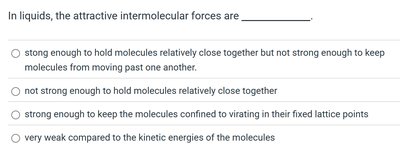
Q7. In liquids, the attractive intermolecular forces are ____________.
Background
Topic: Intermolecular Forces in Liquids
This question tests your understanding of the strength and effect of intermolecular forces in the liquid phase.
Key Terms:
Intermolecular forces (IMFs): Forces between molecules
Liquid phase: Molecules are close together but can move past each other
Step-by-Step Guidance
Recall that IMFs in liquids are strong enough to keep molecules close, but not so strong as to prevent movement.
Compare this to solids (where molecules are fixed) and gases (where IMFs are very weak).
Think about how IMFs allow liquids to flow while maintaining cohesion.
Try solving on your own before revealing the answer!
Final Answer: Strong enough to hold molecules relatively close together but not strong enough to keep molecules from moving past one another.
This describes the balance of attractive forces in the liquid phase.
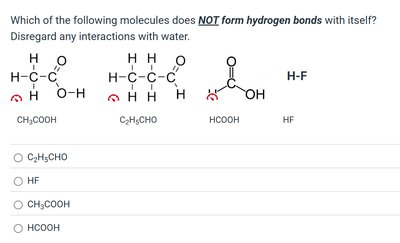
Q8. Which of the following molecules does NOT form hydrogen bonds with itself? (Disregard any interactions with water.)
Background
Topic: Hydrogen Bonding
This question tests your ability to identify molecules capable of hydrogen bonding based on their structure.
Key Terms:
Hydrogen bond: Strong IMF between H and N, O, or F
Self-hydrogen bonding: Molecule must have both a hydrogen donor and acceptor
Step-by-Step Guidance
Examine each molecule for the presence of N, O, or F bonded to H.
Check if the molecule has lone pairs on N, O, or F to accept hydrogen bonds.
Determine if the molecule can form hydrogen bonds with itself (not just with water).
Try solving on your own before revealing the answer!
Final Answer: C2H5CHO does NOT form hydrogen bonds with itself.
This molecule lacks the necessary N, O, or F bonded to H for self-hydrogen bonding.
Q9. Identify the correct order in the boiling points, highest to lowest, of the following molecules: CH4, C2H6, C3H8, C4H10
Background
Topic: Boiling Points and Intermolecular Forces
This question tests your understanding of how molecular size and IMFs affect boiling points.
Key Concepts:
London dispersion forces increase with molecular size/mass.
Boiling point increases as IMFs become stronger.
Step-by-Step Guidance
Compare the molar masses of the molecules listed.
Recall that larger molecules have stronger London dispersion forces.
Arrange the molecules from highest to lowest boiling point based on size and IMF strength.

Try solving on your own before revealing the answer!
Final Answer: C4H10 > C3H8 > C2H6 > CH4
Boiling point increases with molecular size due to stronger London dispersion forces.
Q10. Use the general rules for predicting relative intermolecular force strength to determine which of the following is expected to have the higher boiling point, CHCl3 or CCl4, and the reason.
Background
Topic: Boiling Point and Intermolecular Forces
This question tests your ability to compare boiling points based on hydrogen bonding, dipole-dipole, and dispersion forces.
Key Concepts:
Hydrogen bonding is the strongest IMF.
Dipole-dipole forces are stronger than dispersion forces.
Dispersion forces increase with molecular mass.
Step-by-Step Guidance
Check if either molecule can hydrogen bond (look for H bonded to N, O, or F).
Compare the polarity of CHCl3 and CCl4 (dipole-dipole vs. dispersion).
Consider the molecular mass and the type of IMFs present in each molecule.
Try solving on your own before revealing the answer!
Final Answer: CHCl3 has the higher boiling point because it has dipole-dipole forces while CCl4 does not.
CHCl3 is polar and experiences dipole-dipole interactions, raising its boiling point above CCl4.
Q11. Based on the graph of vapor pressure vs temperature, arrange the three compounds in the correct order of volatility: acetylacetone, pyrrole, pyridine.
Background
Topic: Vapor Pressure and Volatility
This question tests your ability to interpret vapor pressure graphs and relate them to volatility.
Key Concepts:
Volatility: How easily a substance vaporizes.
Higher vapor pressure = higher volatility.
Step-by-Step Guidance
Examine the graph and identify which compound has the highest vapor pressure at a given temperature.
Rank the compounds from highest to lowest vapor pressure.
Arrange the compounds in order of volatility based on their vapor pressures.
Try solving on your own before revealing the answer!
Final Answer: pyrrole > pyridine > acetylacetone
Pyrrole has the highest vapor pressure and is the most volatile, followed by pyridine and acetylacetone.
Q12. Which statements about viscosity are true?
Background
Topic: Viscosity and Intermolecular Forces
This question tests your understanding of how viscosity is affected by temperature, molecular weight, and IMFs.
Key Concepts:
Viscosity increases as temperature decreases.
Viscosity increases as molecular weight increases.
Viscosity increases as intermolecular forces increase.
Step-by-Step Guidance
Recall the relationship between temperature and viscosity: lower temperature means higher viscosity.
Consider how larger molecules (higher molecular weight) interact more strongly, increasing viscosity.
Stronger IMFs make it harder for molecules to flow, increasing viscosity.
Try solving on your own before revealing the answer!
Final Answer: 1, 2, & 3 are true.
All three statements correctly describe how viscosity is affected by temperature, molecular weight, and IMFs.
Q13. Consider the phase diagram below for an unknown substance. Which of the following pressure/temperature combinations is incorrectly matched with the phase of the unknown substance?
Background
Topic: Phase Diagrams
This question tests your ability to interpret phase diagrams and match pressure/temperature conditions to the correct phase.
Key Concepts:
Phase diagram: Shows regions of solid, liquid, and gas based on pressure and temperature.
Each region corresponds to a physical state.
Step-by-Step Guidance
Locate each pressure/temperature combination on the phase diagram.
Identify which region (solid, liquid, gas) each point falls into.
Compare the stated phase with the actual region on the diagram.
Try solving on your own before revealing the answer!
Final Answer: 60°C and 1.6 atm (substance is in the gas phase) is incorrectly matched.
At 60°C and 1.6 atm, the substance is in the liquid phase, not the gas phase, according to the diagram.
