 Indietro
General Chemistry Practice Exam 1 – Step-by-Step Study Guidance
Guida di studio - Note intelligenti
 Appunti personalizzati basati sui tuoi materiali, ampliati con definizioni chiave, esempi e contesto.
Q1. Convert between prefix multipliers and scientific notations.
Background
Topic: Scientific Notation and SI Prefixes
This question tests your ability to convert between scientific notation and SI prefix multipliers, and vice versa. Understanding how to express quantities in different forms is essential for clear scientific communication.
Key Terms and Formulas:
Scientific notation:
SI Prefix multipliers (e.g., milli-, micro-, kilo-, Mega-, etc.)
1 Mega (M) =
1 milli (m) =
Step-by-Step Guidance
For part (a), identify the exponent in and match it to the closest SI prefix (e.g., micro, nano, etc.).
Rewrite the number using the appropriate prefix so that the exponent is eliminated.
For part (b), recognize that "ML" stands for MegaLiters. Convert MegaLiters to Liters using the relationship .
Express 128 ML in scientific notation with only the base unit (L).
Try solving on your own before revealing the answer!
Final Answer:
(a) m = 34.2 μm (micrometers)
(b) 128 ML = L
We matched the exponent to the correct SI prefix and converted MegaLiters to Liters using the appropriate power of ten.
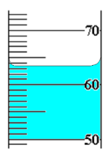
Q2. Read the measurement to the correct number of significant figures in the following laboratory glassware.
Background
Topic: Significant Figures and Measurement
This question tests your ability to correctly read a measurement from laboratory glassware, taking into account the correct number of significant figures based on the instrument's precision.
Key Terms:
Significant figures: The digits in a measurement that are known with certainty plus one digit that is estimated.
Graduated cylinder: Used to measure liquid volume accurately.
Step-by-Step Guidance
Examine the meniscus (the curve at the surface of the liquid) and determine the value at the bottom of the meniscus.
Count the number of decimal places based on the smallest graduation on the cylinder. Typically, you estimate one digit beyond the smallest marked increment.
Compare the given options and identify which one matches the correct number of significant figures for this measurement.
Try solving on your own before revealing the answer!
Final Answer:
The correct reading is 64.40 mL (option a), which has four significant figures. This matches the precision of the graduated cylinder shown.
Q3. Which of the following has five significant figures?
Background
Topic: Significant Figures
This question tests your understanding of how to count significant figures in different types of numbers, including those with zeros, scientific notation, and whole numbers.
Key Terms:
Significant figures: All nonzero digits, zeros between nonzero digits, and trailing zeros in a decimal number are significant.
Scientific notation: All digits in the coefficient are significant.
Step-by-Step Guidance
Review each option and count the number of significant figures, paying attention to zeros and decimal points.
Remember that in scientific notation, only the digits in the coefficient count as significant figures.
For whole numbers without a decimal, trailing zeros may or may not be significant depending on notation.
Try solving on your own before revealing the answer!
Final Answer:
Option e) 1.0061 × 10¹³ has five significant figures (1, 0, 0, 6, 1).
Q4. Calculate to the correct number of significant figures: (512.0 ÷ 98.67) + 5.44
Background
Topic: Significant Figures in Calculations
This question tests your ability to apply the rules for significant figures in both multiplication/division and addition/subtraction.
Key Terms and Formulas:
For multiplication/division: The result should have as many significant figures as the measurement with the fewest significant figures.
For addition/subtraction: The result should have as many decimal places as the measurement with the fewest decimal places.
Step-by-Step Guidance
First, divide 512.0 by 98.67. Determine the number of significant figures for this step.
Next, add the result to 5.44. Consider the number of decimal places for the addition.
Round the final answer to the correct number of significant figures or decimal places as appropriate.
Try solving on your own before revealing the answer!
Final Answer:
(512.0 ÷ 98.67) + 5.44 = 10.6 (rounded to three significant figures, based on the rules for significant figures in calculations).
Q5. A certain European automobile has a gas mileage of 19 km/L. What is the gas mileage in miles per gallon?
Background
Topic: Unit Conversion (Dimensional Analysis)
This question tests your ability to convert units using dimensional analysis, specifically converting kilometers per liter to miles per gallon.
Key Terms and Conversion Factors:
1 mile = 1.609 km
1 gallon = 3.785 L
Step-by-Step Guidance
Set up the conversion starting with 19 km/L.
Convert kilometers to miles using the conversion factor.
Convert liters to gallons using the conversion factor.
Multiply and divide as appropriate to get the final unit of mi/gal.
Try solving on your own before revealing the answer!
Final Answer:
19 km/L = 45 mi/gal (option b). The conversion uses both the km-to-mi and L-to-gal factors.
Q6. A metal block displaces 9.36 cm³ of water and has a mass of 180.6 g. What is the metal?
Background
Topic: Density and Identification of Substances
This question tests your ability to calculate the density of a substance and use it to identify the material from a list of options.
Key Formula:
Density:
Step-by-Step Guidance
Calculate the density using the given mass and volume.
Compare the calculated density to known densities of the metals listed in the options.
Select the metal whose density matches your calculation.
Try solving on your own before revealing the answer!
Final Answer:
The density is approximately 19.3 g/cm³, which matches platinum (option d).
Q7. Two samples of sodium chloride are decomposed into their constituent elements. One sample produces 6.98 g of sodium and 10.7 g of chlorine. The second sample produces 11.2 g of sodium and an unknown amount of chlorine. What unknown amount of chlorine does the second sample produce?
Background
Topic: Law of Definite Proportions
This question tests your understanding of the law of definite proportions, which states that a chemical compound always contains exactly the same proportion of elements by mass.
Key Formula:
Set up a proportion: is constant for both samples.
Step-by-Step Guidance
Calculate the mass ratio of sodium to chlorine in the first sample.
Set up a proportion using the mass of sodium in the second sample and solve for the unknown mass of chlorine.
Cross-multiply and solve for the unknown.
Try solving on your own before revealing the answer!
Final Answer:
The unknown amount of chlorine is 17.2 g (option d).
Q8. Two osmium compounds have the following masses of oxygen per gram of osmium: 0.336 and 0.168 g. Apply the law of multiple proportions and predict if the two are pure substances containing only osmium and oxygen.
Background
Topic: Law of Multiple Proportions
This question tests your understanding of the law of multiple proportions, which states that when two elements form more than one compound, the masses of one element that combine with a fixed mass of the other are in ratios of small whole numbers.
Step-by-Step Guidance
Calculate the ratio of the two oxygen masses per gram of osmium.
Determine if this ratio is a small whole number (e.g., 2:1, 3:2, etc.).
If the ratio is a small whole number, the law is obeyed; otherwise, it is not.
Try solving on your own before revealing the answer!
Final Answer:
The ratio is 2:1, so the data is consistent with the law of multiple proportions (option a).
Q9. Which reaction is inconsistent with Dalton’s Atomic Theory?
Background
Topic: Dalton’s Atomic Theory and Chemical Reactions
This question tests your understanding of Dalton’s Atomic Theory, particularly the idea that atoms cannot be created or destroyed in chemical reactions and that elements are composed of only one type of atom.
Step-by-Step Guidance
Review each reaction and check if any violate the conservation of atoms or involve the creation of new elements from others.
Identify the reaction where the products are not possible according to Dalton’s theory.
Try solving on your own before revealing the answer!
Final Answer:
Option d) Ag + Pb → Au + Li is inconsistent, as it suggests atoms of one element are transformed into another, violating Dalton’s theory.
Q10. Which statement about subatomic particles is false?
Background
Topic: Structure of the Atom
This question tests your knowledge of the properties of electrons, protons, and neutrons, including their masses, charges, and locations in the atom.
Step-by-Step Guidance
Review each statement and recall the properties of subatomic particles.
Identify the statement that is not consistent with established atomic theory.
Try solving on your own before revealing the answer!
Final Answer:
Option c) is false: Protons and neutrons do not have charges of the same magnitude but opposite signs; protons are positive, neutrons are neutral.
Q11. What will form when 59Ni loses two electrons?
Background
Topic: Ions and Isotopes
This question tests your understanding of how ions are formed when atoms lose or gain electrons, and how to write the correct symbol for the resulting ion.
Step-by-Step Guidance
Recognize that losing electrons forms a cation (positive ion).
Determine the charge on the ion after losing two electrons.
Write the correct isotope symbol, keeping the mass number the same.
Try solving on your own before revealing the answer!
Final Answer:
The ion formed is 59Ni2+ (option e).
Q12. A gold sample contains 4.65 × 1024 Au atoms. How many moles of gold does the sample contain?
Background
Topic: The Mole and Avogadro’s Number
This question tests your ability to convert between the number of atoms and moles using Avogadro’s number.
Key Formula:
Avogadro’s number: atoms/mol
Moles =
Step-by-Step Guidance
Divide the given number of atoms by Avogadro’s number to find the number of moles.
Express the answer to the correct number of significant figures.
Try solving on your own before revealing the answer!
Final Answer:
Number of moles = 7.72 mol (option c).
Q13. What is the wavelength (in nm) of a subatomic particle of mass 7.21 × 10⁻³¹ kg traveling at a speed of 1150 m·s–1?
Background
Topic: de Broglie Wavelength
This question tests your ability to calculate the wavelength of a particle using the de Broglie equation.
Key Formula:
de Broglie wavelength:
Planck’s constant, J·s
Step-by-Step Guidance
Plug the values for , , and into the de Broglie equation.
Calculate the wavelength in meters, then convert to nanometers (1 nm = m).
Try solving on your own before revealing the answer!
Final Answer:
The wavelength is 799 nm (option e).
Q14. Calculate the energy of a photon of frequency 15.77 × 10¹⁷ Hz.
Background
Topic: Energy of a Photon
This question tests your ability to use Planck’s equation to calculate the energy of a photon from its frequency.
Key Formula:
Planck’s constant, J·s
Step-by-Step Guidance
Multiply the frequency by Planck’s constant to find the energy in joules.
Express the answer in scientific notation with the correct number of significant figures.
Try solving on your own before revealing the answer!
Final Answer:
The energy is J (option a).
Q15. Which of the following combinations of n, l and ml is not allowed?
Background
Topic: Quantum Numbers
This question tests your understanding of the rules for quantum numbers in atomic orbitals.
Key Terms:
n: Principal quantum number (must be a positive integer, n = 1, 2, 3, ...)
l: Angular momentum quantum number (0 ≤ l < n)
ml: Magnetic quantum number (–l ≤ ml ≤ +l)
Step-by-Step Guidance
Check each set of quantum numbers to see if they follow the rules above.
Identify any set where l is not less than n, or ml is not between –l and +l.
Try solving on your own before revealing the answer!
Final Answer:
Option a) n = 0, l = 0, ml = +1 is not allowed because n cannot be zero.
Q16. Which of the following sets of electron orbitals are degenerate?
Background
Topic: Degeneracy of Orbitals
This question tests your understanding of what it means for orbitals to be degenerate (having the same energy) in a given principal energy level.
Key Terms:
Degenerate orbitals: Orbitals with the same energy in a given atom (in the absence of external fields).
Step-by-Step Guidance
Recall that within a given principal quantum number (n), all orbitals of the same type (e.g., all 2p) are degenerate.
Identify which set of orbitals in the options are all within the same principal energy level and of the same type.
Try solving on your own before revealing the answer!
Final Answer:
Option e) Each of the seven 4f orbitals in principal level n = 4 are degenerate.
Q17. Which is an alkali metal?
Background
Topic: Periodic Table Groups
This question tests your knowledge of the location and identity of alkali metals in the periodic table.
Key Terms:
Alkali metals: Group 1 elements (Li, Na, K, Rb, Cs, Fr)
Step-by-Step Guidance
Identify which element in the list is in Group 1 of the periodic table.
Recall the chemical symbol for each element to match with the options.
Try solving on your own before revealing the answer!
Final Answer:
Option b) Cs (cesium) is an alkali metal.
Q18. Write the complete electron configuration of Ge and circle the valence electrons.
Background
Topic: Electron Configuration
This question tests your ability to write the full electron configuration for an element and identify its valence electrons.
Key Terms:
Electron configuration: The arrangement of electrons in an atom’s orbitals.
Valence electrons: Electrons in the outermost shell (highest n value).
Step-by-Step Guidance
Find the atomic number of Ge (germanium) to determine the total number of electrons.
Write the electron configuration, filling orbitals in order of increasing energy (using the Aufbau principle).
Identify and circle the electrons in the outermost shell (valence electrons).
Try solving on your own before revealing the answer!
Final Answer:
Ge: 1s2 2s2 2p6 3s2 3p6 4s2 3d10 4p2
Valence electrons: 4s2 4p2 (total of 4 valence electrons)
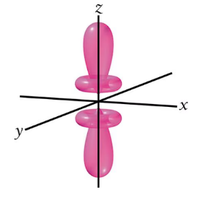
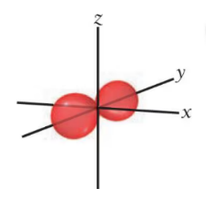
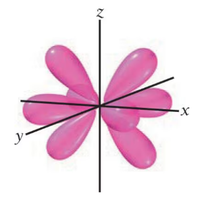
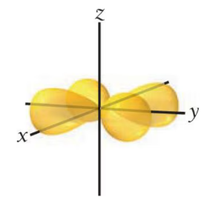
Q20c. Which orbital has l = 2?
Background
Topic: Quantum Numbers and Orbital Shapes
This question tests your ability to identify the type of atomic orbital based on the angular momentum quantum number l.
Key Terms:
l = 0: s orbital
l = 1: p orbital
l = 2: d orbital
l = 3: f orbital
Step-by-Step Guidance
Recall the correspondence between the quantum number l and orbital type.
Examine the images and match the correct orbital shape to l = 2 (d orbital).
Choose the correct image (a, b, c, or d) that represents a d orbital.
Try solving on your own before revealing the answer!
Final Answer:
Image d) (image_5) is a d orbital, which corresponds to l = 2.
