 Indietro
Intermolecular Forces, Covalent Bonds, and Physical Properties of Diatomic Molecules
Guida di studio - Note intelligenti
 Appunti personalizzati basati sui tuoi materiali, ampliati con definizioni chiave, esempi e contesto.
Comparing Boiling Points of Neon and Xenon
London Dispersion Forces and Boiling Points
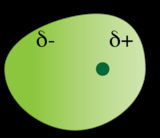
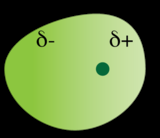
The boiling points of noble gases such as neon (Ne) and xenon (Xe) are determined primarily by the strength of their intermolecular forces, specifically London Dispersion Forces (LDFs). LDFs arise from temporary fluctuations in electron distribution, creating instantaneous dipoles that induce dipoles in neighboring atoms.
Neon: Boiling point = 27 K
Xenon: Boiling point = 165 K
Key Point: The higher boiling point of xenon indicates stronger LDFs compared to neon.
Reason: Xenon has more electrons and a larger, more polarizable electron cloud, resulting in stronger instantaneous and induced dipoles.
Example: The boiling point difference between Ne and Xe is evidence of the effect of atomic size and electron count on LDF strength.
Kinetic and Potential Energy in Atomic Interactions
Energy Changes as Atoms Approach
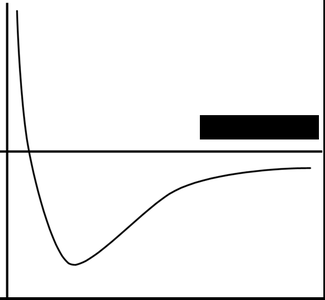
When two atoms approach each other, their kinetic and potential energies change due to attractive and repulsive forces. The total energy is the sum of kinetic energy (KE) and potential energy (Ep).
Attraction: As atoms move closer, attraction increases and Ep decreases.
Repulsion: If atoms get too close, repulsive forces dominate, increasing Ep and reducing KE.
Stable Point: The most stable configuration is where attractive and repulsive forces are balanced, resulting in the lowest Ep and highest KE.
Example: The potential energy well illustrates the energy required to separate two atoms.
Breaking Intermolecular Forces: Phase Changes
Energy Transfer During Boiling
To convert a liquid to a gas, energy must be supplied to overcome intermolecular forces such as LDFs. This energy is transferred from the surroundings to the system, increasing the kinetic energy of the atoms.
Step 1: Surroundings transfer energy to container walls.
Step 2: Container walls transfer energy to the liquid, increasing temperature.
Step 3: At boiling point, atoms separate and liquid becomes gas; temperature remains constant during the phase change.
Step 4: Gaseous atoms gain more energy and temperature increases.
Example: Boiling neon at 27 K requires overcoming all LDFs between Ne atoms.

Thermal Energy vs. Temperature
Definitions and Differences
Thermal Energy is the total energy of random motion of particles in a system, measured in Joules. Temperature is the average kinetic energy of particles, measured in Kelvin or Celsius.
Same Temperature: Two samples at the same temperature have the same average kinetic energy per particle.
Different Thermal Energy: A larger sample at the same temperature has more total thermal energy due to more particles.
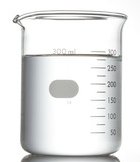
Example: 75 mL and 280 mL of water at 20°C have the same temperature, but the larger volume has more thermal energy.
Strength of London Dispersion Forces (LDFs)
Factors Affecting LDF Strength
The strength of LDFs increases with the number of electrons and the size of the atom or molecule. Larger, more diffuse electron clouds are more easily distorted, leading to stronger dipoles and greater electrostatic attraction.
Polarizability: Greater polarizability leads to stronger LDFs.
Coulomb’s Law: Larger partial charges create stronger electrostatic forces.
Example: Xenon atoms have stronger LDFs than neon atoms due to their larger size and electron count.
Potential Energy Wells: Neon vs. Xenon
Comparing Atomic Interactions
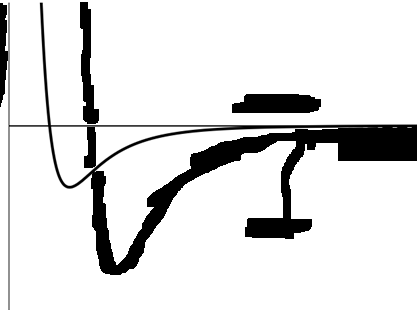
The potential energy well represents the energy required to separate two atoms. The depth of the well indicates the strength of attraction, and the position of the minimum indicates the equilibrium internuclear distance.
Neon: Shallower well, shorter equilibrium distance.
Xenon: Deeper well, longer equilibrium distance.
Example: Xenon’s potential energy well is deeper and wider than neon’s, reflecting stronger LDFs and greater atomic size.

Covalent Bonds in Diatomic Molecules
Formation and Properties
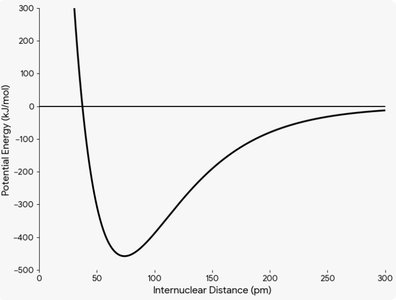
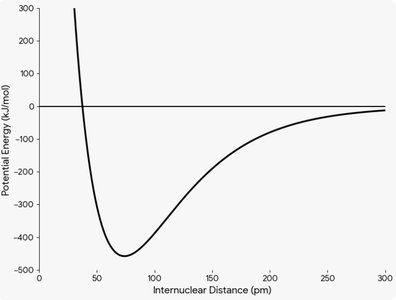
When two hydrogen atoms approach, they form a strong covalent bond, creating a new chemical species: the hydrogen molecule (H2). Covalent bonds are much stronger than intermolecular forces and require significant energy to break.
Hydrogen Atom (H): Highly unstable and reactive.
Hydrogen Molecule (H2): Extremely stable, exists naturally as a gas.
Bond Formation: Covalent bonds result in new chemical and physical properties.
Example: Helium and neon do not form diatomic molecules; hydrogen does.
Elements That Form Diatomic Molecules
List and Stability
Certain elements form stable diatomic molecules due to strong covalent bonding between identical atoms. These include hydrogen, nitrogen, oxygen, fluorine, chlorine, bromine, and iodine.
Diatomic Elements: H2, N2, O2, F2, Cl2, Br2, I2
Stability: These molecules are very stable and exist naturally in their diatomic form.
Example: Oxygen exists as O2 in the atmosphere.
Intermolecular vs. Intramolecular Forces
Definitions and Differences
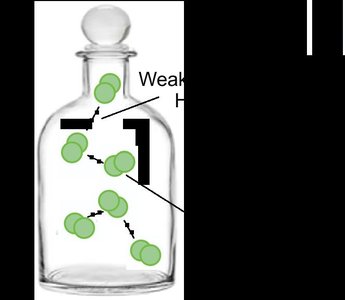
Intermolecular Forces (IMFs) occur between separate molecules and include LDFs and other interactions. Intramolecular Forces (such as covalent bonds) occur within a molecule, linking atoms together.
IMFs: Weak, govern melting and boiling points.
Covalent Bonds: Strong, build molecules.
Example: The depth of the potential well for H2 (458 kJ/mol) is much greater than for He atoms (0.09 kJ/mol).
Physical States of Diatomic Elements
Role of Intermolecular Forces
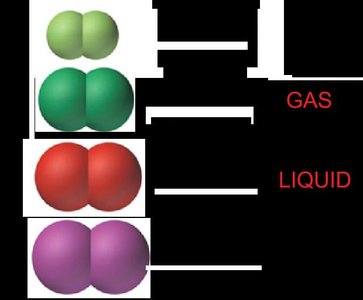
The physical state of diatomic elements at room temperature is determined by the strength of intermolecular forces, not the strength of the covalent bond. For example, fluorine (F2) is a gas, while iodine (I2) is a solid.
F2: Gas at room temperature
I2: Solid at room temperature
Example: The weak IMFs between F2 molecules result in a gaseous state, while stronger IMFs between I2 molecules result in a solid state.
Summary Table: Comparison of Neon and Xenon
Boiling Points and LDF Strength
Element | Boiling Point (K) | Number of Electrons | LDF Strength |
|---|---|---|---|
Neon (Ne) | 27 | 10 | Weak |
Xenon (Xe) | 165 | 54 | Strong |
Additional info: The table summarizes the relationship between atomic properties and intermolecular force strength.
----------------------------------------
