 Indietro
Matter, Elements, Compounds, and Nomenclature: Foundations of General Chemistry
Guida di studio - Note intelligenti
 Appunti personalizzati basati sui tuoi materiali, ampliati con definizioni chiave, esempi e contesto.
Matter: Classifications and Properties
States of Matter
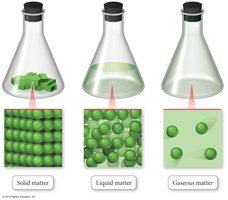
Matter is defined as anything that has mass and occupies space. It exists in three primary states: solid, liquid, and gas. Each state is characterized by the arrangement and movement of its constituent particles (atoms or molecules).
Solid: Particles are closely packed in a fixed, orderly arrangement. Solids have definite shape and volume.
Liquid: Particles are close together but can move past one another. Liquids have definite volume but take the shape of their container.
Gas: Particles are far apart and move freely. Gases have neither definite shape nor volume.
Phase Changes and Phase Diagram
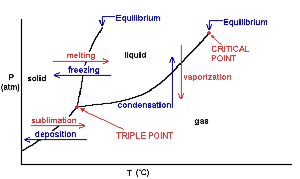
Phase changes occur when matter transitions between solid, liquid, and gas due to changes in temperature and pressure. The phase diagram illustrates these transitions and critical points.
Melting/Freezing: Transition between solid and liquid.
Vaporization/Condensation: Transition between liquid and gas.
Sublimation/Deposition: Direct transition between solid and gas.
Triple Point: The unique set of conditions where all three phases coexist in equilibrium.
Critical Point: The end point of the liquid-gas boundary, beyond which the liquid and gas phases are indistinguishable.
Classification of Matter
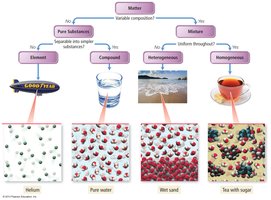
Matter can be classified based on its composition as either a pure substance or a mixture. Pure substances include elements and compounds, while mixtures can be homogeneous or heterogeneous.
Element: A pure substance consisting of only one type of atom (e.g., Helium).
Compound: A pure substance composed of two or more elements in fixed ratios (e.g., H2O).
Homogeneous Mixture: Uniform composition throughout (e.g., tea with sugar).
Heterogeneous Mixture: Non-uniform composition (e.g., wet sand).
Atoms & Elements
The Periodic Table of Elements
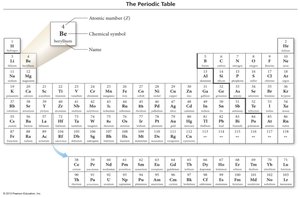
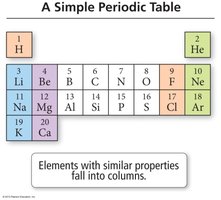
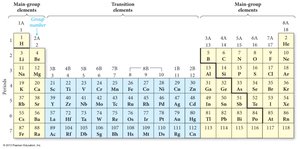
The periodic table organizes all known elements by increasing atomic number (number of protons). Each element is represented by a unique symbol and name. Elements are arranged in rows (periods) and columns (groups or families), with elements in the same group sharing similar chemical properties.
Atomic Number (Z): Number of protons in the nucleus of an atom.
Chemical Symbol: One- or two-letter abbreviation for an element (e.g., O for oxygen, Fe for iron).
Groups/Families: Vertical columns; elements in the same group have similar properties.
Periods: Horizontal rows; properties change progressively across a period.
Major Divisions of the Periodic Table
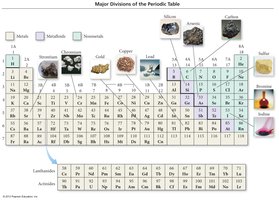
The periodic table is divided into metals, nonmetals, and metalloids based on their physical and chemical properties.
Metals: Good conductors of heat and electricity, malleable, ductile, mostly solids at room temperature (except Hg).
Nonmetals: Poor conductors, can be solid, liquid, or gas, brittle when solid.
Metalloids: Exhibit properties intermediate between metals and nonmetals; often semiconductors.
Chemical Compounds and Bonding
Classification of Elements and Compounds
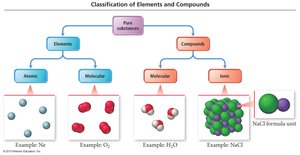
Pure substances can be further classified as atomic elements, molecular elements, molecular compounds, or ionic compounds.
Atomic Elements: Exist as single atoms (e.g., Ne).
Molecular Elements: Exist as molecules with two or more atoms of the same element (e.g., O2).
Molecular Compounds: Composed of molecules formed from nonmetals (e.g., H2O).
Ionic Compounds: Composed of cations (metals) and anions (nonmetals) (e.g., NaCl).
Chemical Bonds
Chemical bonds are the forces that hold atoms together in compounds. There are two main types:
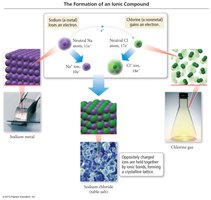
Ionic Bonds: Formed by the transfer of electrons from a metal to a nonmetal, resulting in the formation of cations and anions held together by electrostatic attraction.
Covalent Bonds: Formed by the sharing of electrons between nonmetal atoms.
Formation of Ionic Compounds
Ionic compounds are formed when metals transfer electrons to nonmetals, creating oppositely charged ions that attract each other. The resulting compound is electrically neutral.
Example: Sodium (Na) transfers an electron to chlorine (Cl), forming Na+ and Cl−, which combine to form NaCl.
Empirical and Molecular Formulas
Empirical Formulas
The empirical formula of a compound gives the simplest whole-number ratio of atoms of each element present. The molecular formula gives the actual number of atoms of each element in a molecule.
Example: Hydrogen peroxide (H2O2) has an empirical formula of HO.
Example: Glucose (C6H12O6) has an empirical formula of CH2O.
Nomenclature: Naming Compounds
Naming Ionic Compounds
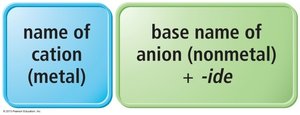
Ionic compounds are named by stating the cation (metal) first, followed by the anion (nonmetal) with its ending changed to “-ide.” For metals with variable charges, the charge is indicated in Roman numerals.
Example: NaCl is sodium chloride.
Example: FeCl3 is iron (III) chloride.
Naming Molecular Compounds
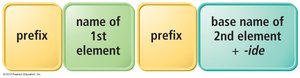
Molecular compounds (nonmetal + nonmetal) use prefixes to indicate the number of each atom. The first element is named fully; the second element’s ending is changed to “-ide.”
Prefixes: mono-, di-, tri-, tetra-, penta-, hexa-, hepta-, octa-, nona-, deca-
Example: CO2 is carbon dioxide; N2O4 is dinitrogen tetroxide.
Naming Hydrated Compounds
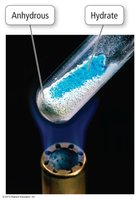
Hydrates are ionic compounds that contain a specific number of water molecules. The number of waters is indicated by a prefix and the word “hydrate.”
Example: CoCl2·6H2O is cobalt(II) chloride hexahydrate.
Organic Compounds: Hydrocarbons and Functional Groups
Hydrocarbons
Hydrocarbons are organic compounds composed only of carbon and hydrogen. They are classified based on the types of bonds between carbon atoms:
Alkanes: Only single bonds (saturated hydrocarbons).
Alkenes: At least one double bond.
Alkynes: At least one triple bond.
Cyclic Hydrocarbons: Carbon atoms arranged in rings.
Aromatic Hydrocarbons: Contain benzene rings.
Functionalized Hydrocarbons
Functional groups are specific groups of atoms within molecules that determine the characteristic chemical reactions of those molecules. Common functional groups include alcohols, ethers, aldehydes, ketones, carboxylic acids, and amines.
Chemical Quantities: Formula Mass and the Mole Concept
Formula Mass
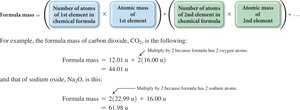
The formula mass of a compound is the sum of the atomic masses of all atoms in its chemical formula. It is usually expressed in atomic mass units (u or amu).
Formula:
Example: For CO2:
The Mole Concept
A mole is a counting unit in chemistry, representing entities (Avogadro's number). It allows chemists to relate the mass of a substance to the number of particles it contains.
1 mole of CO2 molecules: molecules
Molar mass: The mass of one mole of a substance, numerically equal to its formula mass in grams.
