 Indietro
Periodic Properties of the Elements: Atomic Structure and Trends
Guida di studio - Note intelligenti
 Appunti personalizzati basati sui tuoi materiali, ampliati con definizioni chiave, esempi e contesto.
Periodic Properties of the Elements
Atomic Number and the Periodic Table
The periodic table organizes elements based on their atomic number, which is the number of protons in the nucleus. Early versions of the table, such as Mendeleev’s, were based on atomic masses, but the modern table uses atomic number as the fundamental organizing principle, thanks to the work of Henry Moseley. The atomic number determines the element’s identity and its periodic properties.
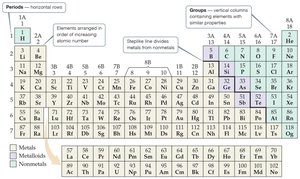
Periodic Properties Overview
Periodic properties are characteristics of elements that show predictable trends across periods (rows) and groups (columns) of the periodic table. The main periodic properties discussed in this chapter include:
Sizes of atoms and ions
Ionization energy
Electron affinity
Chemical property trends within groups
A fundamental property underlying many of these trends is the effective nuclear charge.
Effective Nuclear Charge
Many atomic properties depend on the attraction between valence electrons and the nucleus. Electrons are attracted to the nucleus but also repelled by other electrons, especially those in inner shells. The effective nuclear charge (Zeff) is the net positive charge experienced by an electron in a multi-electron atom, accounting for both the attraction to the nucleus and the repulsion from other electrons.
Formula: where Z is the atomic number and S is the screening constant (usually the number of core electrons).
Trend: Effective nuclear charge increases from left to right across a period.
Sizes of Atoms and Ions
The size of an atom can be described by different radii:
Nonbonding atomic radius (van der Waals radius): Half the shortest distance between nuclei of two colliding atoms.
Bonding atomic radius (covalent radius): Half the distance between nuclei in a bond.
Trends:
Bonding atomic radius decreases from left to right across a period.
Bonding atomic radius increases from top to bottom within a group.
Example: Atomic Size Order
Arrange Al, Mg, Na in order of decreasing atomic size: Na > Mg > Al
Sizes of Ions (Ionic Radii)
Cations (positively charged ions) are smaller than their parent atoms because electrons are removed and electron repulsions decrease.
Anions (negatively charged ions) are larger than their parent atoms because electrons are added and electron repulsions increase.
For ions with the same charge, ionic radius increases as you move down a column in the periodic table.
Example: Ionic Radius Order
Arrange Mg2+, Ca2+, and Ca in order of decreasing radius: Ca > Ca2+ > Mg2+
Isoelectronic Series and Ion Size
An isoelectronic series consists of ions with the same number of electrons. Within such a series, ionic size decreases as nuclear charge increases.
Example: Neon (10 electrons) and ions such as Na+, Mg2+, F-, O2- are isoelectronic. As atomic number increases, ionic radius decreases.
Ionization Energy
Ionization energy (I) is the minimum energy required to remove an electron from the ground state of a gaseous atom or ion. The first ionization energy removes the first electron; the second ionization energy removes the second electron, and so on. Higher ionization energy means it is more difficult to remove an electron.
Equation for first ionization of aluminum:
Equation for second ionization of calcium:
Trends:
First ionization energy generally increases across a period.
First ionization energy generally decreases down a group.
Irregularities in Ionization Energy Trends
Trends are not followed when the added valence electron enters a new (higher energy) sublevel.
Trends are not followed when the added electron is the first to pair in an orbital, due to increased electron repulsions.
Factors Influencing Ionization Energy
Smaller atoms have higher ionization energies.
Ionization energy depends on effective nuclear charge and the average distance of the electron from the nucleus.
Electron Configurations of Ions
Cations: Electrons are lost from the highest energy level (highest n value).
Anions: Electron configurations are filled to accommodate the added electrons (e.g., gaining one electron in 2p).
Electron Affinity
Electron affinity (EA) is the energy change accompanying the addition of an electron to a gaseous atom. It is typically exothermic (negative) for most elements.
General trend: Electron affinity generally increases across a period.
Exceptions: Group 2A (s sublevel full), Group 5A (p sublevel half-full), Group 8A (p sublevel full) often have positive electron affinities.
Note: The electron affinity for many of these elements is positive, meaning energy is required to add an electron.
Summary Table: Periodic Trends
Property | Across a Period | Down a Group |
|---|---|---|
Atomic Radius | Decreases | Increases |
Ionization Energy | Increases | Decreases |
Electron Affinity | Generally increases | Varies |
Effective Nuclear Charge | Increases | Varies |
