Indietro
Periodic Properties of the Elements: Structure, Trends, and Reactivity
Guida di studio - Note intelligenti
 Appunti personalizzati basati sui tuoi materiali, ampliati con definizioni chiave, esempi e contesto.
Development of the Periodic Table
Historical Evolution
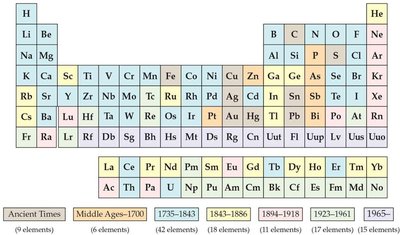
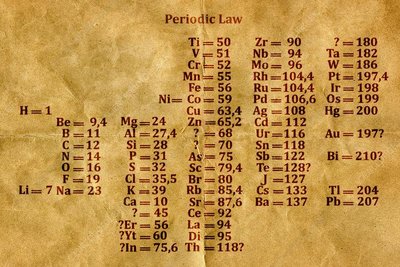
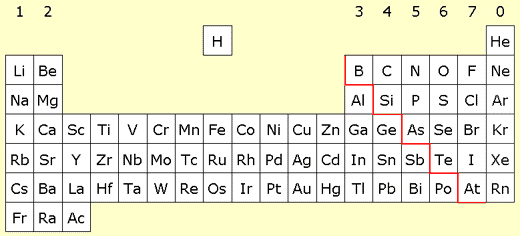
The periodic table is a systematic arrangement of elements based on their atomic number and properties. Dmitri Mendeleev and Lothar Meyer independently proposed grouping elements by their chemical properties, while Henry Moseley later established the concept of atomic numbers, which is the number of protons in the nucleus.
Mendeleev's Predictions: Mendeleev predicted the existence and properties of undiscovered elements, such as germanium (eka-silicon), based on gaps in his periodic table.
Periodic Law: The properties of elements are periodic functions of their atomic numbers.
Predictions and Observations
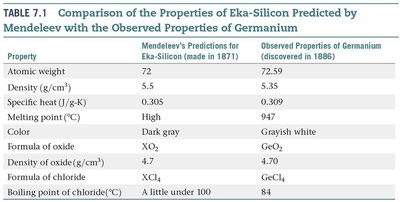
Mendeleev's predictions for eka-silicon (germanium) were remarkably accurate, demonstrating the power of the periodic law.
Property | Mendeleev's Prediction (Eka-Silicon) | Observed (Germanium) |
|---|---|---|
Atomic weight | 72 | 72.59 |
Density (g/cm3) | 5.5 | 5.35 |
Specific heat (J/g·K) | 0.305 | 0.309 |
Melting point (°C) | High | 947 |
Color | Dark gray | Grayish white |
Formula of oxide | XO2 | GeO2 |
Density of oxide (g/cm3) | 4.7 | 4.70 |
Formula of chloride | XCl4 | GeCl4 |
Boiling point of chloride (°C) | A little under 100 | 84 |
Effective Nuclear Charge (Zeff)
Definition and Calculation
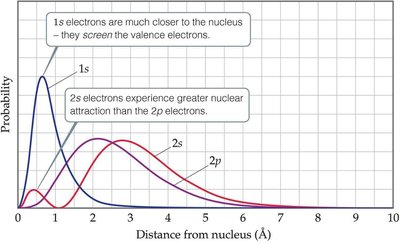
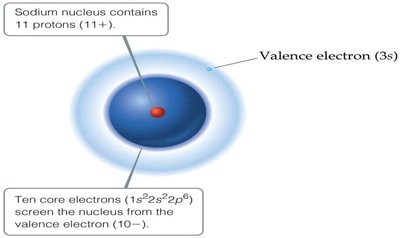
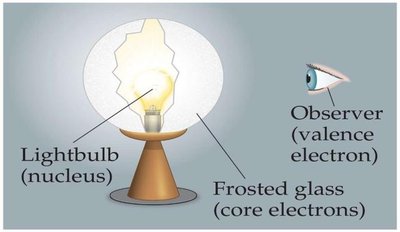
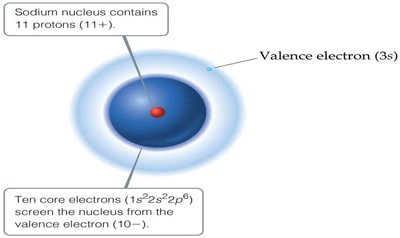
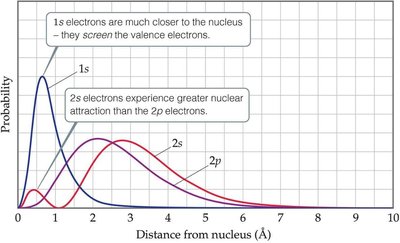
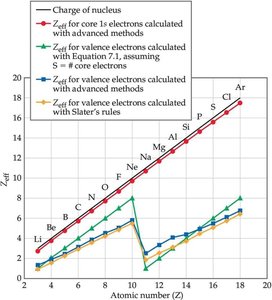
In multi-electron atoms, electrons are attracted to the nucleus and repelled by other electrons. The effective nuclear charge (Zeff) is the net positive charge experienced by an electron, accounting for both attraction to the nucleus and repulsion by other electrons.
Formula: where Z is the atomic number and S is the screening constant (number of core electrons).
Valence electrons do not screen as efficiently as core electrons.
Trends in Effective Nuclear Charge
Zeff increases across a period due to increasing nuclear charge and relatively constant shielding. It increases slightly down a group.
Slater's Rules: Used for more accurate calculation of S, considering electron configuration and orbital types.
Atomic and Ionic Radii
Definitions
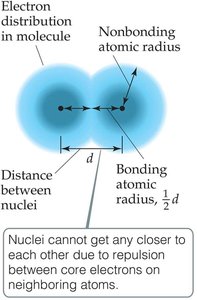
The nonbonding atomic radius (van der Waals radius) is half the shortest distance between nuclei during atomic collisions. The bonding atomic radius is half the distance between covalently bonded nuclei.
Periodic Trends in Atomic Radii
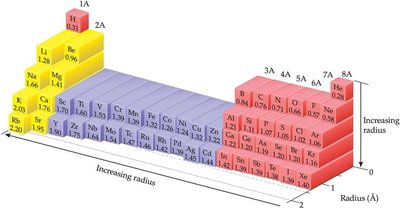
Atomic radius decreases from left to right across a period due to increasing Zeff, and increases from top to bottom of a group due to increasing principal quantum number (n).
Sizes of Ions
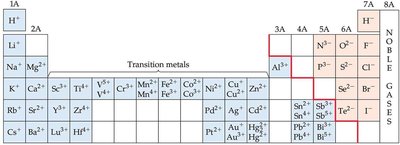
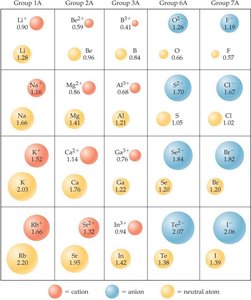
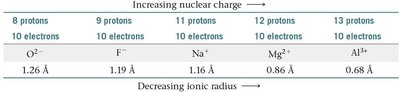
Ionic size depends on nuclear charge, number of electrons, and electron orbitals. Cations are smaller than their parent atoms, while anions are larger.
Isoelectronic Series: Ions with the same number of electrons; size decreases with increasing nuclear charge.
Ionization Energy
Definition and Trends
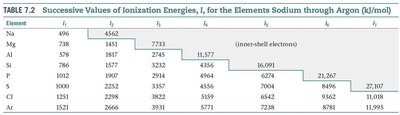
Ionization energy is the energy required to remove an electron from a gaseous atom or ion. The first ionization energy (I1) is for removing the first electron, the second (I2) for the second, and so on.
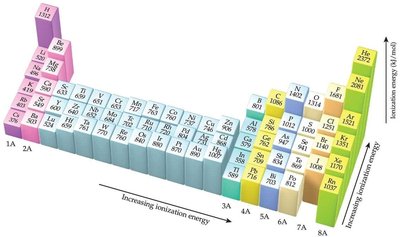
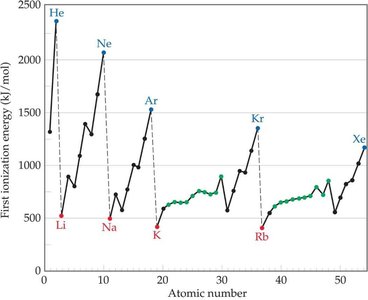
I1 decreases down a group (electrons farther from nucleus).
I1 increases across a period (higher Zeff).
Large jumps in ionization energy occur when removing core electrons.
Irregularities in Ionization Energy
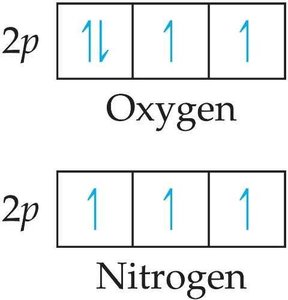
Discontinuities occur between Groups IIA and IIIA (removal from p-orbital vs s-orbital) and Groups VA and VIA (removal from doubly occupied orbital).
Electron Configurations of Ions
Formation of Cations and Anions
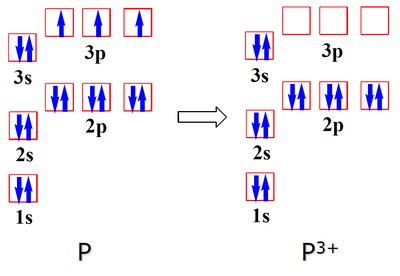
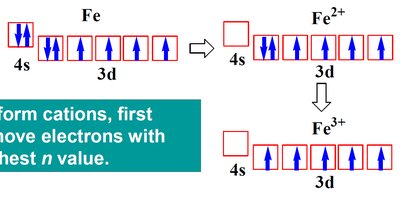
To form cations, electrons are removed from the subshell with the highest principal quantum number (n). For transition metals, remove ns electrons before (n-1)d electrons.
Example:
Electron Affinity
Definition and Trends
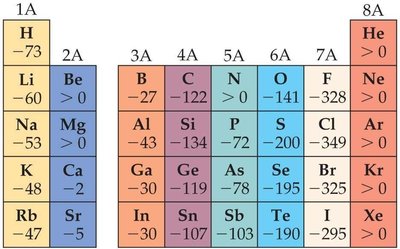
Electron affinity is the energy change when a neutral atom attracts an electron to become a negative ion. It generally becomes more exothermic across a period, with exceptions for Groups 2A, 5A, and 8A due to electron configurations.
Metals, Nonmetals, and Metalloids
Classification and Properties
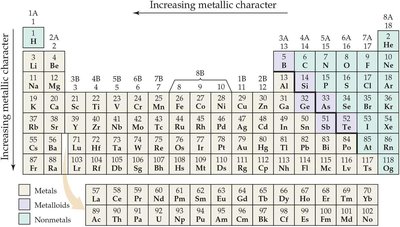
Elements are classified as metals, nonmetals, or metalloids based on their physical and chemical properties.
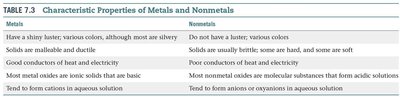
Metals: Shiny, malleable, good conductors, tend to form cations, basic oxides.
Nonmetals: Dull, brittle, poor conductors, tend to form anions, acidic oxides.
Metalloids: Intermediate properties; e.g., silicon is shiny but brittle and a semiconductor.
Metals | Nonmetals |
|---|---|
Shiny luster, various colors | No luster, various colors |
Malleable and ductile | Brittle, some hard, some soft |
Good conductors | Poor conductors |
Basic oxides | Acidic oxides |
Form cations | Form anions |
Group Trends and Reactivity
Alkali and Alkaline Earth Metals
Group 1A (alkali metals) and Group 2A (alkaline earth metals) show distinct trends in density, melting point, ionization energy, and reactivity.
Alkali metals are soft, low-density, highly reactive, and form cations.
Alkaline earth metals are harder, denser, and less reactive than alkali metals.
Chalcogens, Halogens, and Noble Gases
Group 6A (chalcogens), 7A (halogens), and 8A (noble gases) display unique chemical reactivity and physical properties based on their electron configurations and periodic trends.
Chalcogens: Oxygen, sulfur, selenium (nonmetals); tellurium (metalloid); polonium (metal).
Halogens: Highly reactive, form salts, most negative electron affinity.
Noble gases: Inert, full valence shell.