 Indietro
Principles of Chemical Equilibrium – Study Notes
Guida di studio - Note intelligenti
 Appunti personalizzati basati sui tuoi materiali, ampliati con definizioni chiave, esempi e contesto.
Principles of Chemical Equilibrium
Introduction to Chemical Equilibrium
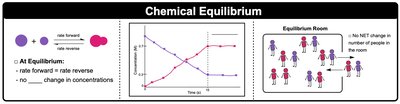
Chemical equilibrium is a fundamental concept in chemistry describing the state in which the rates of the forward and reverse reactions are equal, resulting in no net change in the concentrations of reactants and products. Most chemical reactions do not proceed to completion but instead reach a dynamic equilibrium.
Chemical Equilibrium: A dynamic process where the rate of the forward reaction equals the rate of the reverse reaction.
Dynamic Process: The reaction continues in both directions, but the concentrations of reactants and products remain constant over time.
Equilibrium is represented by a double arrow (⇌).
Equilibrium can be homogeneous (all species in the same phase) or heterogeneous (species in different phases).
Equilibrium Constant (K)
The equilibrium constant (K) quantifies the position of equilibrium for a chemical reaction. It is a ratio of the concentrations of products to reactants, each raised to the power of their coefficients in the balanced equation.
K (Equilibrium Constant): Indicates the extent to which a reaction proceeds at a given temperature.
k (Rate Constant): Describes the speed of a reaction, not its position at equilibrium.
K is temperature dependent; changing temperature alters the value of K.
Solids and pure liquids are omitted from K expressions because their concentrations do not change.

General Expression:
where [A], [B], [C], [D] are the equilibrium concentrations of the respective species, and a, b, c, d are their coefficients in the balanced equation.
Magnitude of the Equilibrium Constant
The value of K indicates the relative amounts of products and reactants at equilibrium:
K > 1: Products are favored; equilibrium lies to the right.
K < 1: Reactants are favored; equilibrium lies to the left.
K ≈ 1: Neither side is favored; significant amounts of both reactants and products are present.
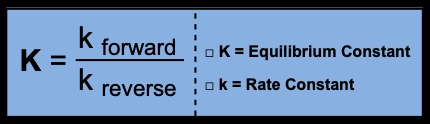
K can also be determined from the ratio of the rate constants for the forward and reverse reactions:
Manipulating Equilibrium Expressions
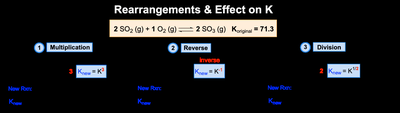
When chemical equations are reversed, multiplied, or divided, the equilibrium constant changes accordingly:
Reversing the equation: Take the reciprocal of K.
Multiplying the equation by n: Raise K to the nth power.
Dividing the equation by n: Take the nth root of K.
Kp and Kc: Equilibrium Constants for Gases and Solutions
Equilibrium constants can be expressed in terms of concentration (Kc) or partial pressure (Kp):
Kc: Used for reactions in solution (units: M).
Kp: Used for reactions involving gases (units: atm or torr).
The relationship between Kp and Kc is given by:
where R is the gas constant, T is temperature in Kelvin, and Δn is the change in moles of gas (moles of gaseous products minus moles of gaseous reactants).

Le Chatelier’s Principle
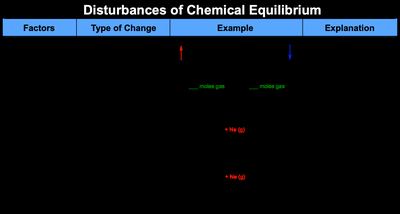
Le Chatelier’s Principle states that if a system at equilibrium is disturbed, it will shift in the direction that minimizes the disturbance and re-establishes equilibrium. Disturbances include changes in concentration, pressure, or temperature.
Adding or removing reactants/products: The system shifts to consume the added species or replace the removed one.
Changing pressure/volume: The system shifts toward the side with fewer or more moles of gas, depending on the change.
Adding an inert gas: No effect on equilibrium position if volume is constant.
Catalysts: Do not affect the position of equilibrium; they only speed up the attainment of equilibrium.
Temperature Changes and Equilibrium
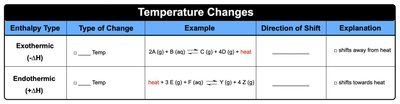
Temperature changes affect the equilibrium position depending on whether the reaction is exothermic or endothermic:
Exothermic Reaction (ΔH < 0): Increasing temperature shifts equilibrium to the left (toward reactants).
Endothermic Reaction (ΔH > 0): Increasing temperature shifts equilibrium to the right (toward products).
ICE Charts (Initial, Change, Equilibrium)
ICE charts are used to organize and solve equilibrium problems when some equilibrium concentrations are unknown. The chart tracks the Initial amounts, the Change during the reaction, and the Equilibrium amounts.
Set up the ICE chart with initial values, changes (using variables like x), and equilibrium values.
Write the equilibrium constant expression and substitute the equilibrium values.
Solve for the unknowns, often using algebraic or quadratic methods.
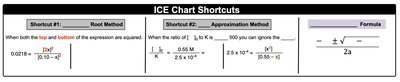
Shortcuts can be used if the change is small compared to the initial amount.
Reaction Quotient (Q)
The reaction quotient (Q) is calculated like K but with current (not necessarily equilibrium) concentrations. Comparing Q to K predicts the direction the reaction will shift to reach equilibrium:
Q < K: The reaction will shift right (toward products).
Q > K: The reaction will shift left (toward reactants).
Q = K: The system is at equilibrium.
Summary Table: Key Concepts in Chemical Equilibrium
Concept | Definition/Formula |
|---|---|
Equilibrium Constant (K) | |
Kp vs. Kc | |
ICE Chart | Tracks Initial, Change, and Equilibrium values |
Le Chatelier’s Principle | System shifts to minimize disturbance |
Reaction Quotient (Q) | Compare Q to K to predict shift |
