 Indietro
Quantum Mechanics, Atomic Structure, and Electron Configuration: General Chemistry Study Notes
Guida di studio - Note intelligenti
 Appunti personalizzati basati sui tuoi materiali, ampliati con definizioni chiave, esempi e contesto.
Quantum Mechanics and Atomic Structure
Key Physical Constants and Equations
Understanding the behavior of electrons in atoms requires several fundamental constants and equations from quantum mechanics and electromagnetic theory.
Speed of light (c): m/s
Planck’s constant (h): J·s
Ground-state energy of an electron (hydrogen): J
Essential Equations:
Speed of light:
Photon energy:
Bohr energy transition:
de Broglie wavelength:
Electromagnetic Spectrum
The electromagnetic spectrum encompasses all types of electromagnetic radiation, from radio waves to gamma rays. The visible spectrum is a small portion of this range, corresponding to wavelengths detectable by the human eye.
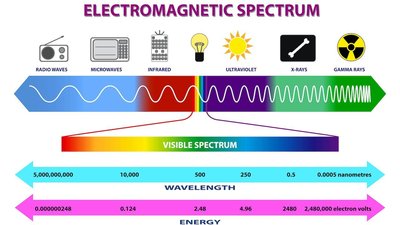
Wavelength (): Distance between successive peaks of a wave (measured in meters or nanometers).
Frequency (): Number of wave cycles per second (measured in Hz or s-1).
Energy: Increases as wavelength decreases and frequency increases.
Bohr Model of the Atom
The Bohr model describes electrons in hydrogen-like atoms as occupying specific orbits with quantized energies. This model explains atomic emission spectra and the stability of atoms.
Postulate 1: Electrons are only permitted in certain orbits with specific energies.
Postulate 2: Electrons in allowed orbits do not radiate energy and do not spiral into the nucleus.
Postulate 3: Electrons absorb or emit energy only when transitioning between orbits, with energy .
Applications: Explains black body radiation, the photoelectric effect, and atomic emission spectra.
Photoelectric Effect
The photoelectric effect is the emission of electrons from a metal surface when light of sufficient frequency strikes it. This phenomenon supports the particle nature of light and the quantization of energy.
Each metal has a minimum frequency (threshold frequency) required for electron emission.
Energy of emitted electrons depends on the frequency, not the intensity, of the light.
de Broglie Hypothesis
All matter exhibits wave-like properties. The wavelength of a particle is inversely proportional to its mass and velocity.
de Broglie wavelength:
Quantum Numbers and Atomic Orbitals
Quantum Numbers
Quantum numbers describe the properties of atomic orbitals and the electrons within them.
Number | Symbol | Possible Values |
|---|---|---|
Principal Quantum Number | n | 1, 2, 3, 4, ... |
Angular Momentum Quantum Number | l | 0, 1, 2, 3, ..., (n-1) |
Magnetic Quantum Number | m_l | -l, ..., 0, ..., +l |
Spin Quantum Number | m_s | +1/2, -1/2 |
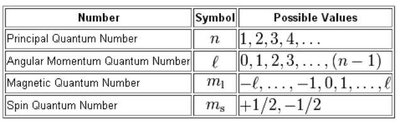
n (Principal): Energy level (shell)
l (Angular momentum): Shape of the orbital (0 = s, 1 = p, 2 = d, 3 = f)
ml (Magnetic): Orientation of the orbital
ms (Spin): Electron spin direction (+1/2 or -1/2)
Shapes of Atomic Orbitals
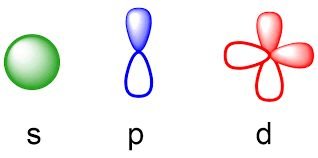
Atomic orbitals have characteristic shapes depending on the angular momentum quantum number (l).
s orbital (l = 0): Spherical shape
p orbital (l = 1): Dumbbell shape
d orbital (l = 2): Cloverleaf or complex shapes
Electron Configuration and the Periodic Table
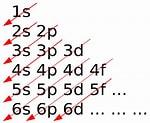
Electron configuration describes the arrangement of electrons in an atom’s orbitals. The periodic table reflects the filling order of these orbitals.
Electrons fill orbitals in order of increasing energy (Aufbau principle).
Each orbital can hold a maximum of two electrons (Pauli exclusion principle).
Electrons occupy degenerate orbitals singly before pairing (Hund’s rule).
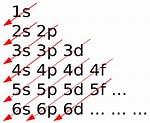
Rules and Principles
Pauli Exclusion Principle: No two electrons in the same atom can have the same set of four quantum numbers.
Hund’s Rule: For orbitals of equal energy, one electron enters each orbital until all are half-filled before pairing begins.
Heisenberg Uncertainty Principle: The more precisely the momentum of a particle is known, the less precisely its position is known, and vice versa.
Sample Calculations and Applications
Energy and Wavelength of Emitted Light
When an electron transitions between energy levels in a hydrogen atom, the energy and wavelength of the emitted photon can be calculated using the Bohr equation and Planck’s relation.
Energy change:
Wavelength:
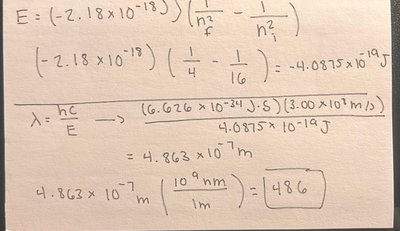
Example: An electron drops from n = 4 to n = 2 in hydrogen, emitting light with a wavelength of 486 nm (visible region).
Sample Multiple Choice Questions (Concept Review)
Which quantum number defines the shape of an orbital? Angular momentum quantum number (l)
What is the condensed electron configuration of argon (Z=18)? [Ne]3s23p6
What type of element has a partially filled d subshell? Transition metal
Which orbitals can hold two electrons? All orbitals (s, p, d, f) can hold a maximum of two electrons each.
Summary Table: Quantum Numbers
Quantum Number | Symbol | Meaning | Possible Values |
|---|---|---|---|
Principal | n | Energy level | 1, 2, 3, ... |
Angular Momentum | l | Orbital shape | 0 to n-1 |
Magnetic | ml | Orbital orientation | -l to +l |
Spin | ms | Electron spin | +1/2, -1/2 |
Additional info:
Black body radiation, the photoelectric effect, and emission spectra are foundational experiments that led to the development of quantum mechanics.
Electron configurations can be predicted using the periodic table and the Aufbau principle.
