 Indietro
Step-by-Step Guidance for Chemistry 1A Exam 1 Study Questions
Guida di studio - Note intelligenti
 Appunti personalizzati basati sui tuoi materiali, ampliati con definizioni chiave, esempi e contesto.
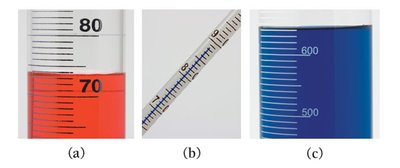
Q2. Read each measurement in the images below to the correct number of significant figures.
Background
Topic: Significant Figures and Measurement
This question tests your ability to correctly interpret laboratory measurements and report them with the appropriate number of significant figures, which is essential for accuracy and precision in scientific data.
Key Terms:
Significant Figures: The digits in a measurement that are known with certainty plus one digit that is estimated.
Graduated Cylinder, Thermometer, Beaker: Common laboratory glassware used for measuring volumes and temperatures.
Step-by-Step Guidance
Examine each image carefully and identify the smallest division or increment on the scale. This will help you determine the precision of the measurement.
For each instrument, estimate the value to one digit beyond the smallest marked increment. This estimated digit is considered significant.
Record the measurement, including all certain digits and the one uncertain digit, to reflect the correct number of significant figures.
Check that your answer for each measurement matches the precision allowed by the instrument's scale.
Try solving on your own before revealing the answer!
Final Answer:
a) 72.0 mL (3 significant figures)
b) 38.6 °C (3 significant figures)
c) 610 mL (2 significant figures)
Each answer reflects the correct number of significant figures based on the instrument's scale and the estimated digit.
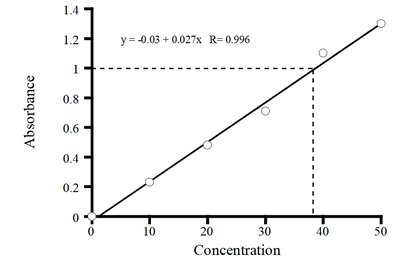
Q4. From the graph, estimate the concentration of the solution which shows an absorbance value of 0.4.
Background
Topic: Standard Curves and Data Analysis
This question tests your ability to use a standard curve to estimate the concentration of a solution based on its absorbance, a common technique in quantitative analysis.
Key Terms and Formula:
Standard Curve: A plot of absorbance versus concentration used to determine unknown concentrations.
Absorbance (A): The amount of light absorbed by a sample.
Equation of the Line: where is absorbance and is concentration.
Step-by-Step Guidance
Identify the absorbance value given in the question (0.4).
Locate this value on the y-axis of the graph and draw a horizontal line to intersect the standard curve.
From the intersection point, draw a vertical line down to the x-axis to estimate the corresponding concentration.
Alternatively, use the equation of the line to solve for concentration: set and solve for .
Try solving on your own before revealing the answer!
Final Answer:
Concentration ≈ 16 mg/dL
By plugging into the equation , you solve for and find the estimated concentration.
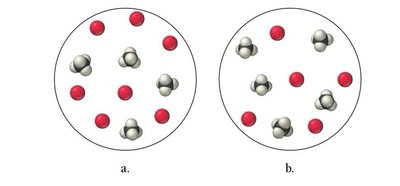
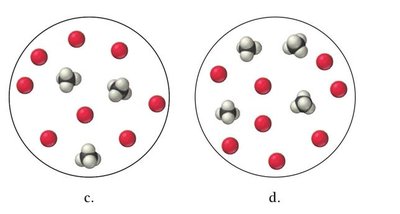
Q9. Gaseous methane reacts with oxygen to form carbon dioxide and water vapor. Write a balanced equation for the combustion reaction and determine which mixture in the figures below has neither reactant in excess.
Background
Topic: Chemical Reactions and Stoichiometry
This question tests your ability to write balanced chemical equations and use stoichiometric relationships to identify limiting and excess reactants in a mixture.
Key Terms and Formula:
Balanced Equation: Shows the reactants and products with correct stoichiometric coefficients.
Limiting Reactant: The reactant that is completely consumed in a reaction.
Stoichiometry: The calculation of reactant and product quantities based on the balanced equation.
Step-by-Step Guidance
Write the balanced equation for the combustion of methane: .
Examine each diagram and count the number of methane (CH4) and oxygen (O2) molecules present.
Compare the ratio of CH4 to O2 in each diagram to the stoichiometric ratio (1:2) required by the balanced equation.
Identify the diagram where the ratio matches exactly, meaning neither reactant is in excess.
Try solving on your own before revealing the answer!
Final Answer:
The mixture in diagram (b) has neither reactant in excess.
Diagram (b) shows the correct 1:2 ratio of CH4 to O2 molecules, matching the balanced equation.
