 Indietro
Stoichiometry and Chemical Reactions: Balancing, Types, and Calculations
Guida di studio - Note intelligenti
 Appunti personalizzati basati sui tuoi materiali, ampliati con definizioni chiave, esempi e contesto.
Stoichiometry
Law of Conservation of Mass
The Law of Conservation of Mass states that matter is neither created nor destroyed in a chemical reaction. This principle, established by Antoine Lavoisier, underpins all stoichiometric calculations and the balancing of chemical equations.
Chemical Equations
Chemical equations represent the transformation of reactants into products, showing the proportions of each substance involved. They are written to reflect the conservation of atoms for each element.
Reactants: Substances consumed during the reaction (left side of the equation).
Products: Substances formed during the reaction (right side of the equation).
States of Matter: Indicated in parentheses (s, l, g, aq).
Coefficients: Numbers placed before formulas to balance the equation.
Subscripts: Indicate the number of atoms of each element in a molecule.
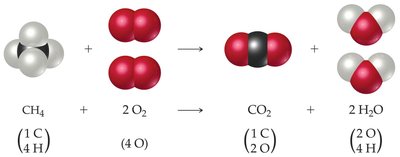
Balancing Chemical Equations
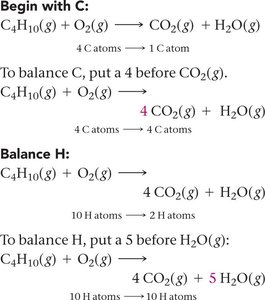
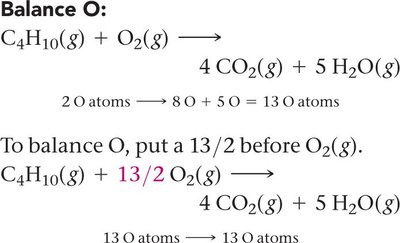
Balancing ensures the same number of each type of atom on both sides of the equation. The process involves:
Writing the skeletal equation with correct formulas.
Balancing atoms in complex substances first, then free elements.
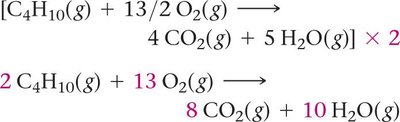
Clearing fractional coefficients by multiplying through by the denominator.
Checking that all atoms are balanced.
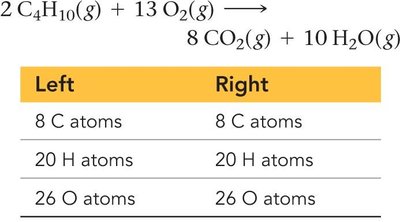
Types of Chemical Reactions
Combination (Synthesis) Reactions: Two or more substances form one product.
Decomposition Reactions: One substance breaks down into two or more products.
Combustion Reactions: Rapid reactions with oxygen producing heat and light, typically forming CO2 and H2O.
Double Displacement (Metathesis) Reactions: Ions in two compounds exchange partners.
Precipitation Reactions: Formation of an insoluble solid from two aqueous solutions.
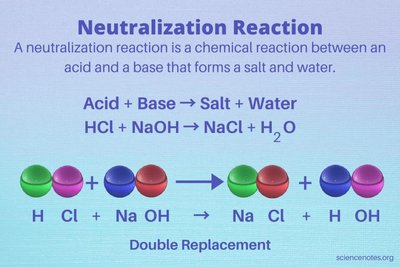
Acid-Base (Neutralization) Reactions: Acid reacts with base to form water and a salt.
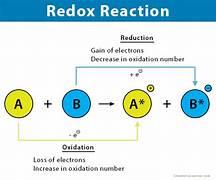
Redox (Oxidation-Reduction) Reactions: Transfer of electrons between species.
Precipitation and Solubility Rules
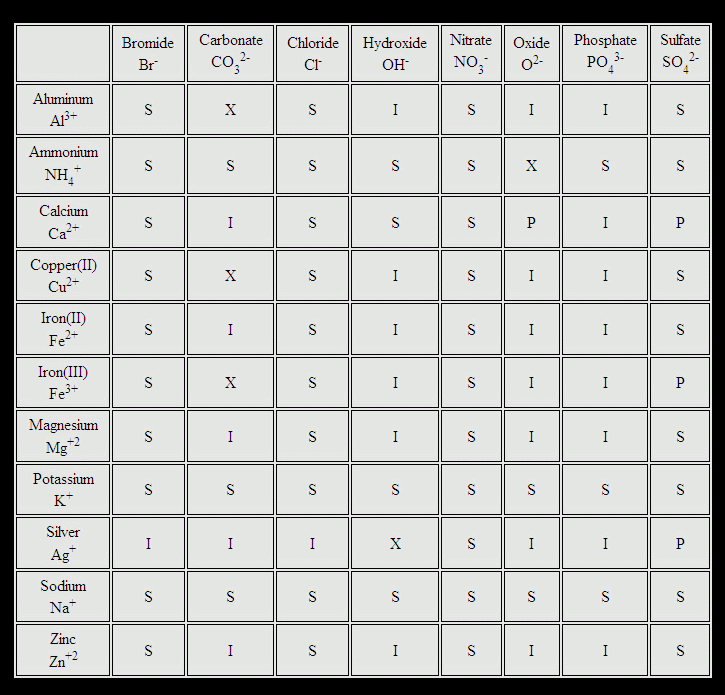
Precipitation reactions depend on the solubility of ionic compounds. Solubility rules help predict whether a precipitate will form.
Ion | Solubility | Exceptions |
|---|---|---|
NO3- | Soluble | None |
Cl-, I- | Soluble | Pb2+, Ag+, Hg22+ |
SO42- | Soluble | Ca2+, Ba2+, Sr2+, Pb2+, Ag+, Hg2+ |
CO32-, PO43- | Insoluble | Group IA, NH4+ |
OH- | Insoluble | Group IA, Ca2+, Ba2+, Sr2+ |
Acids and Bases
Acids are substances that increase H+ concentration in water (Arrhenius) or donate protons (Brønsted-Lowry). Bases increase OH- concentration or accept protons.
Strong acids: HCl, HBr, HI, HNO3, H2SO4, HClO3, HClO4
Strong bases: Alkali and some alkaline earth metal hydroxides (e.g., NaOH, KOH, Ca(OH)2)
Neutralization Reactions
When an acid reacts with a base, the products are a salt and water. The net ionic equation for a strong acid and strong base is:
Redox Reactions and Oxidation Numbers
Redox reactions involve the transfer of electrons. Oxidation is the loss of electrons, and reduction is the gain of electrons. Oxidation numbers help track electron transfer.
Elements in their standard state: 0
Monatomic ions: charge of the ion
Oxygen: usually -2 (except peroxides: -1)
Hydrogen: +1 (with nonmetals), -1 (with metals)
Fluorine: always -1
Sum of oxidation numbers in a compound: 0; in a polyatomic ion: equals the ion's charge
Formula Weights and Moles
The formula weight is the sum of atomic weights in a chemical formula (amu). The molecular weight is the sum for a molecule. The mole is a counting unit: particles (Avogadro's number).
The molar mass (g/mol) numerically equals the formula weight (amu).
Percent Composition
The percent by mass of an element in a compound is:
Empirical and Molecular Formulas
The empirical formula gives the simplest whole-number ratio of atoms in a compound. The molecular formula is a multiple of the empirical formula, determined by the compound's molar mass.
Stoichiometric Calculations
Stoichiometry uses balanced equations to relate quantities of reactants and products. The coefficients indicate mole ratios, which are used to convert between masses, moles, and numbers of particles.
Limiting Reactant, Theoretical Yield, and Percent Yield
Limiting Reactant: The reactant that is completely consumed first, limiting the amount of product formed.
Theoretical Yield: The maximum amount of product possible, calculated from the limiting reactant.
Percent Yield:
Solution Concentration: Molarity
Molarity (M) is the number of moles of solute per liter of solution:
Summary Table: Balancing Chemical Equations
Step | Description |
|---|---|
1 | Write skeletal equation |
2 | Balance atoms in complex substances |
3 | Balance free elements last |
4 | Clear fractions by multiplying through |
5 | Check atom balance |
