 Indietro
Thermochemistry and Energy in Chemical Systems: Study Notes
Guida di studio - Note intelligenti
 Appunti personalizzati basati sui tuoi materiali, ampliati con definizioni chiave, esempi e contesto.
Review of Chemical Reactions and Stoichiometry
Precipitation Reactions and Ionic Equations
Chemical reactions in aqueous solutions often involve the formation of a precipitate, which is an insoluble solid formed from the reaction of two soluble salts. Writing balanced equations for these reactions is essential for understanding stoichiometry and the conservation of mass.
Complete Ionic Equation: Shows all soluble ionic substances dissociated into ions.
Net Ionic Equation: Includes only the ions and molecules directly involved in the reaction, omitting spectator ions.
Example: When magnesium chloride reacts with potassium carbonate, magnesium carbonate precipitates:
Net Ionic Equation:
Redox Check: This is not a redox reaction; the oxidation numbers of all elements remain unchanged.
Stoichiometric Calculations: The amount of precipitate can be used to determine the concentration of ions in solution.
Example Calculation: 21 g of MgCO3 (molar mass 84.3 g/mol) corresponds to 0.25 mol, so the original solution contained 0.25 mol MgCl2 in 0.500 L, or 0.50 M.
Oxidation Numbers
Oxidation numbers are used to keep track of electron transfer in chemical reactions. They are assigned based on a set of rules and help identify redox processes.
Key Assignments:
Br in BrO3−: +5; O: -2
K in K2CO3: +1; C: +4; O: -2
N in NH3: -3; H: +1
O in O2 and O3: 0
Mn in MnO4−: +7; O: -2
P in P2O5: +5; O: -2
N in NO: +2; O: -2
Ca in CaTiO3: +2; Ti: +4; O: -2
Ca in CaH2: +2; H: -1
Thermochemistry: Energy, Heat, and Work
Nature of Energy
Thermochemistry is the study of the relationships between chemistry and energy, especially heat. Energy is the ability to do work or transfer heat. Work is energy transfer not as heat, often involving a force acting over a distance. Heat is the flow of energy caused by a temperature difference.
Types of Energy
Kinetic Energy (Ek): Energy of motion.
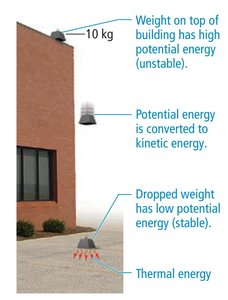
Potential Energy: Energy due to position or composition. In chemistry, electrostatic potential energy is most important:
Thermal Energy: Energy associated with temperature, arising from the motion of atoms or molecules (a type of kinetic energy).
Units of Energy
Joule (J): SI unit of energy.
Calorie (cal): (note: food "Calorie" is 1 kcal)
Work
Work is the action of a force through a distance. It can be converted to heat, kinetic energy, or potential energy.
Formula:

Potential Energy in Chemistry
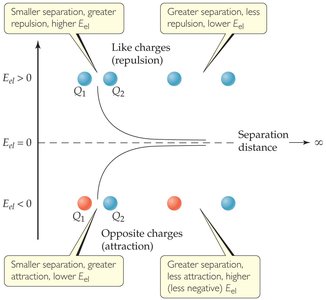
Potential energy in molecules is primarily electrostatic, arising from interactions between charged particles.
Electrostatic Potential Energy: , where and are charges, is separation, and is a proportionality constant.
System and Surroundings
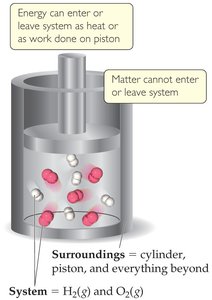
In thermochemistry, the system is the part of the universe we study (e.g., reactants and products), and the surroundings are everything else.
Heat
Heat is energy transferred between systems or objects with different temperatures. It always flows from warmer to cooler objects.

Conversion of Energy
Energy can be converted from one form to another, such as potential to kinetic energy, or kinetic energy to heat (e.g., via friction).
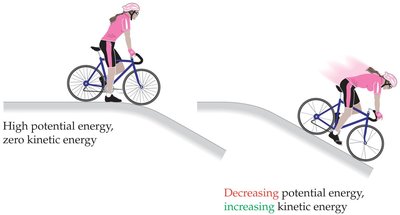
First Law of Thermodynamics and Internal Energy
First Law of Thermodynamics
The First Law of Thermodynamics states that energy is neither created nor destroyed. The total energy of the universe is constant; energy lost by the system is gained by the surroundings, and vice versa.
Internal Energy (E)
The internal energy of a system is the sum of all kinetic and potential energies of its components. It is a state function, meaning it depends only on the current state, not the path taken to reach it.
Change in Internal Energy:
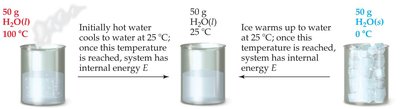
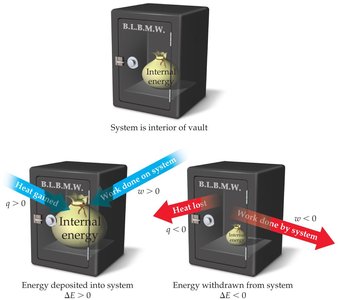
Visualizing Changes in Internal Energy
Energy is exchanged between system and surroundings as either heat (q) or work (w):
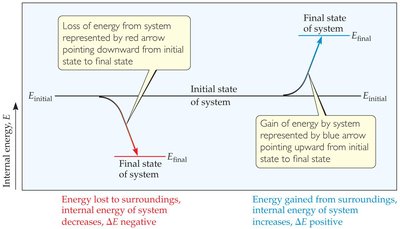
Signs of q, w, and ΔE
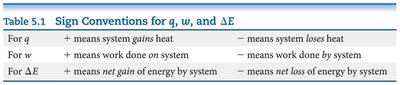
Quantity | Positive (+) | Negative (−) |
|---|---|---|
q (heat) | System gains heat | System loses heat |
w (work) | Work done on system | Work done by system |
ΔE (internal energy) | Net gain of energy by system | Net loss of energy by system |
State Functions vs. Path Functions
Internal energy (E) is a state function, but heat (q) and work (w) are not. The total change in energy depends only on the initial and final states, not on how the change occurs.
Enthalpy and Heat Flow at Constant Pressure
Definition of Enthalpy (H)
Enthalpy is a thermodynamic quantity defined as the internal energy plus the product of pressure and volume:
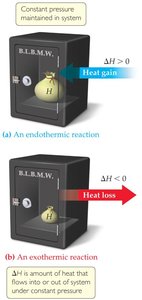
At constant pressure, the change in enthalpy () equals the heat exchanged:
Since and , then at constant pressure.
Endothermic and Exothermic Processes
Endothermic: ; system absorbs heat from surroundings.
Exothermic: ; system releases heat to surroundings.
Summary Table: Key Equations and Concepts
Concept | Equation | Description |
|---|---|---|
Kinetic Energy | Energy of motion | |
Electrostatic Potential Energy | Energy due to charge interactions | |
Work | Force acting over distance | |
PV Work | Work done by expanding gas | |
First Law | Change in internal energy | |
Enthalpy | Heat content at constant pressure | |
Change in Enthalpy | (at constant P) | Heat exchanged at constant pressure |
