Ch.1 - Introduction: Matter, Energy, and Measurement
Brown - Chemistry: The Central Science 14th Edition
Brown14th EditionChemistry: The Central ScienceISBN: 9780134414232Non è quello che usi tu?Cambia libro di testo
Capitolo 1, Problema 7a

(a) Three spheres of equal size are composed of aluminum (density = 2.70 g/cm3), silver (density = 10.49 g/cm3), and nickel (density = 8.90 g/cm3). List the spheres from lightest to heaviest.

Guida verificata passo dopo passo
1
Identify the formula for density: \( \text{Density} = \frac{\text{Mass}}{\text{Volume}} \).
Since the spheres are of equal size, they have the same volume.
To compare the masses, rearrange the density formula to \( \text{Mass} = \text{Density} \times \text{Volume} \).
Calculate the mass for each sphere using their respective densities and the same volume.
List the spheres in order of increasing mass based on their calculated masses: Aluminum, Nickel, Silver.

Risposta video verificata per un problema simile:

Questa soluzione video è stata consigliata dai nostri tutor come utile per risolvere questo problema.
Durata del video:
2m

Concetti chiave

Ecco i concetti essenziali che devi comprendere per rispondere correttamente alla domanda.

Density

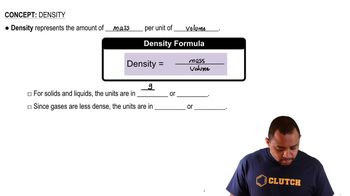
Density is defined as mass per unit volume, typically expressed in grams per cubic centimeter (g/cm³). It is a crucial property that helps determine how heavy an object is for a given size. In this question, the densities of aluminum, silver, and nickel are provided, allowing for a comparison of their weights based on equal volumes.
Video consigliato:
Percorso guidato
01:56
Density Concepts

Mass and Volume Relationship

The relationship between mass and volume is fundamental in understanding how density affects the weight of objects. For spheres of equal size, the mass of each sphere can be calculated by multiplying its density by its volume. This relationship allows us to rank the spheres based on their densities, as higher density indicates greater mass for the same volume.
Video consigliato:
Percorso guidato
01:09
Relationship of Volume and Moles Example

Comparative Analysis

Comparative analysis involves evaluating different items based on specific criteria—in this case, the densities of the metals. By comparing the densities of aluminum, silver, and nickel, we can determine their relative weights when the spheres are of equal size. This analysis is essential for accurately listing the spheres from lightest to heaviest.
Video consigliato:
Percorso guidato
06:11
Dimensional Analysis
Pratica correlata
Domanda del libro di testo

(a) What is the length of the pencil in the following figure if the ruler reads in centimeters? How many significant figures are there in this measurement?

919
views

Domanda del libro di testo

The three targets from a rifle range shown below were produced by: (A) the instructor firing a newly acquired target rifle; (B) the instructor firing his personal target rifle; and (C) a student who has fired his target rifle only a few times. (b) For the A and C results in the future to look like those in B, what needs to happen?

814
views
1
rank
Domanda del libro di testo
Identify each of the following as measurements of length, area, volume, mass, density, time, or temperature: (a) 25 ps, (b) 374.2 mg, (c) 77 K, (d) 100,000 km2, (e) 1.06 mm, (f) 16 nm2, (g) -78 °C, (h) 2.56 g>cm3, (i) 28 cm3.
1260
views
2
rank
4
comments
Domanda del libro di testo

(b) Three cubes of equal mass are composed of gold (density = 19.32 g/cm3), platinum (density = 21.45 g/cm3), and lead (density = 11.35 g/cm3). List the cubes from smallest to largest.

1059
views
Domanda del libro di testo

Consider the two spheres shown here, one made of silver and the other of aluminum. (d) If you release the spheres simultaneously, they will have the same velocity when they hit the ground. Will they have the same kinetic energy? If not, which sphere will have more kinetic energy?

400
views
Domanda del libro di testo

Is the separation method used in brewing a cup of coffee best described as distillation, filtration, or chromatography?

576
views