Ch.1 - Introduction: Matter, Energy, and Measurement
Brown - Chemistry: The Central Science 14th Edition
Brown14th EditionChemistry: The Central ScienceISBN: 9780134414232Non è quello che usi tu?Cambia libro di testo
Capitolo 1, Problema 72a,b,c,d

Give the derived SI units for each of the following quantities in base SI units: (a) acceleration = distance/time2 (b) force = mass × acceleration (c) work = force × distance (d) pressure = force/area

Guida verificata passo dopo passo
1
Identify the base SI units for distance and time: distance is measured in meters (m) and time is measured in seconds (s).
Write the formula for acceleration: acceleration = distance/time^2.
Substitute the base SI units into the formula: acceleration = meters/seconds^2.
Simplify the expression: acceleration = m/s^2.
Thus, the derived SI unit for acceleration is m/s^2.

Risposta video verificata per un problema simile:

Questa soluzione video è stata consigliata dai nostri tutor come utile per risolvere questo problema.
Durata del video:
41s

Concetti chiave

Ecco i concetti essenziali che devi comprendere per rispondere correttamente alla domanda.

SI Units

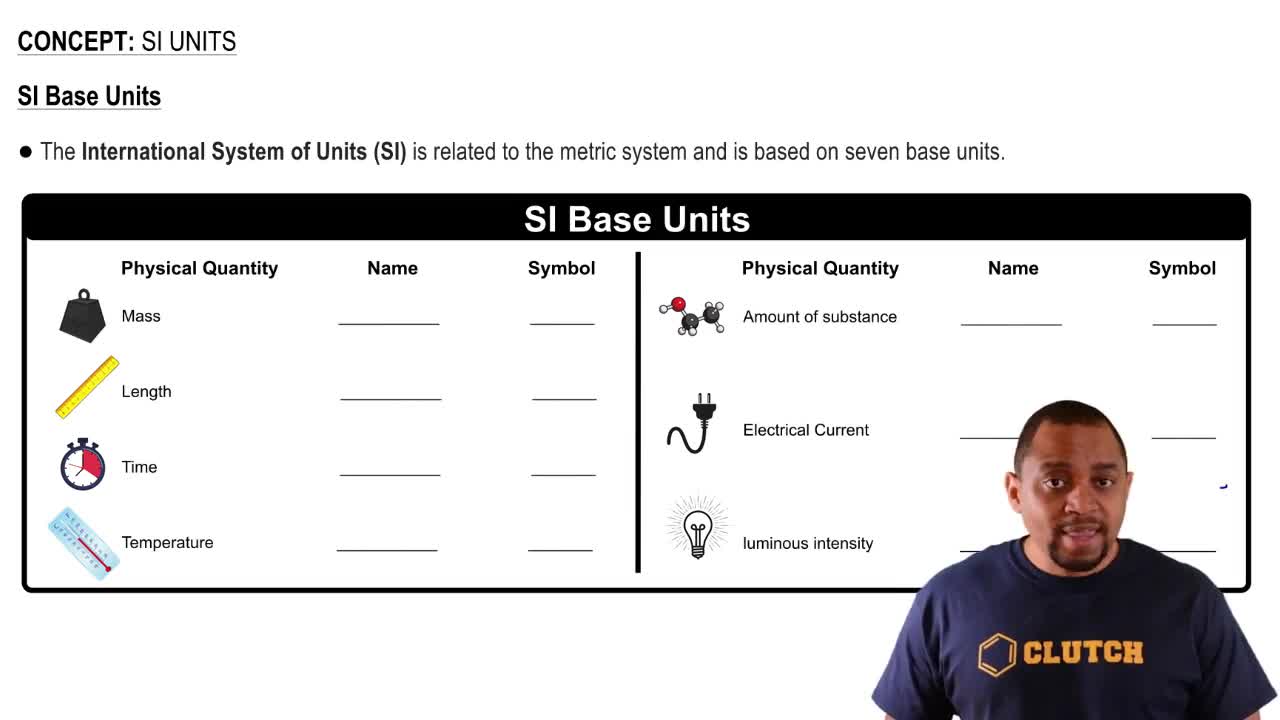
The International System of Units (SI) is the standard system of measurement used in science and engineering. It is based on seven base units, including meter (m) for distance, second (s) for time, and kilogram (kg) for mass. Derived units are formed from these base units to express other physical quantities, such as acceleration.
Video consigliato:

Acceleration

Acceleration is defined as the rate of change of velocity per unit time. In terms of SI units, it is expressed as meters per second squared (m/s²). This indicates how much the velocity of an object changes in meters for every second squared of time, making it a crucial concept in kinematics and dynamics.
Video consigliato:
Percorso guidato
01:59
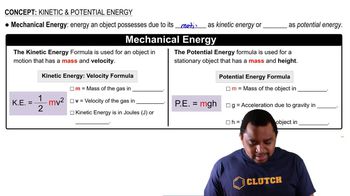
Kinetic & Potential Energy

Derived Units

Derived units are combinations of base SI units that describe other physical quantities. For example, acceleration is derived from the base units of distance (meters) and time (seconds). Understanding how to derive these units is essential for converting and manipulating measurements in physics and chemistry.
Video consigliato:
Percorso guidato
00:47
Ideal Gas Law Derivations