Ch.1 - Introduction: Matter, Energy, and Measurement
Brown - Chemistry: The Central Science 14th Edition
Brown14th EditionChemistry: The Central ScienceISBN: 9780134414232Non è quello che usi tu?Cambia libro di testo
Capitolo 1, Problema 39

If on a certain year, an estimated amount of 4 million metric tons (1 metric ton = 1000 kg) of nitrous oxide 1N2O2 was emitted worldwide due to agricultural activities, express this mass of N2O in grams without exponential notation, using an appropriate metric prefix.

Guida verificata passo dopo passo
1
Convert the mass from metric tons to kilograms by multiplying 4 million metric tons by 1000 kg/metric ton.
Convert the mass from kilograms to grams by multiplying the result by 1000 g/kg.
Determine the appropriate metric prefix for the mass in grams. Consider that 1,000,000,000 grams is equivalent to 1 gigagram (Gg).
Express the mass in grams using the metric prefix identified in the previous step.
Ensure the final expression of the mass is clear and does not use exponential notation.

Risposta video verificata per un problema simile:

Questa soluzione video è stata consigliata dai nostri tutor come utile per risolvere questo problema.
Durata del video:
3m

Concetti chiave

Ecco i concetti essenziali che devi comprendere per rispondere correttamente alla domanda.

Unit Conversion

Unit conversion is the process of converting a quantity expressed in one unit to another unit. In this case, we need to convert metric tons to grams. Since 1 metric ton equals 1000 kilograms and 1 kilogram equals 1000 grams, the conversion involves multiplying the number of metric tons by 1,000,000 to obtain the equivalent mass in grams.
Video consigliato:
Percorso guidato
01:56
Conversion Factors

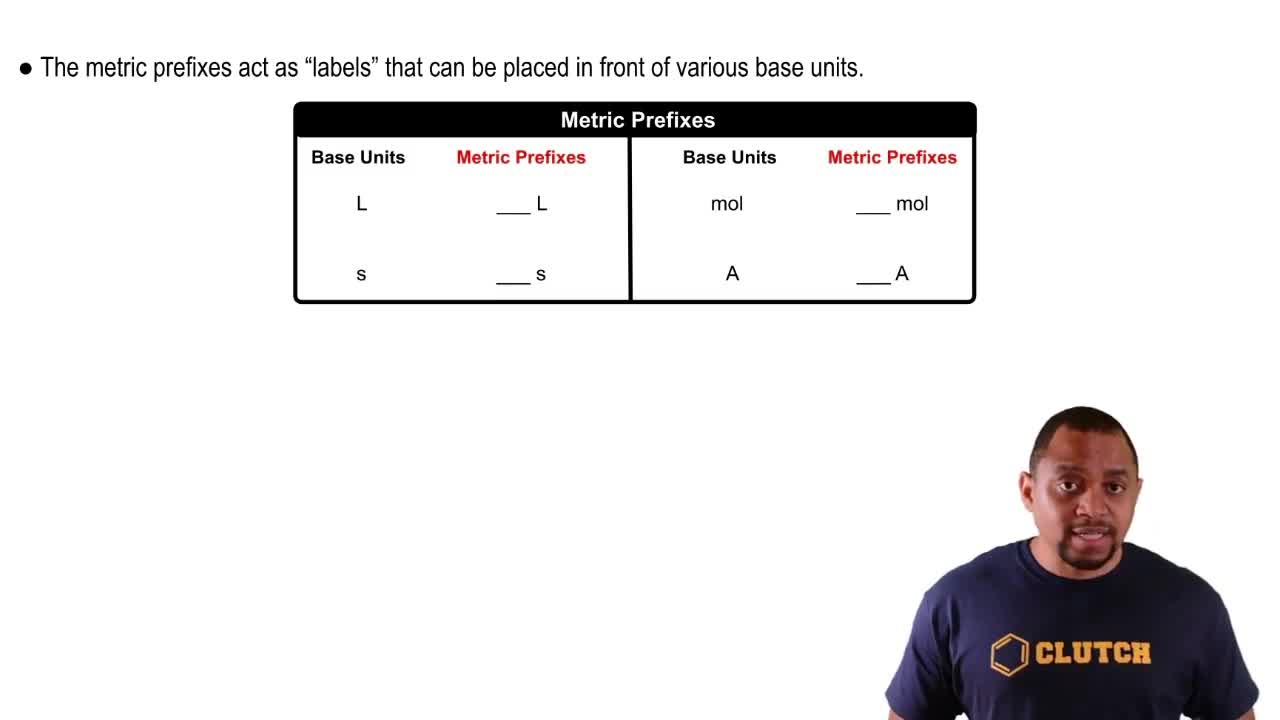
Metric Prefixes

Metric prefixes are used to denote multiples or fractions of a unit in the metric system. For example, 'kilo-' represents a factor of 1,000, while 'mega-' represents a factor of 1,000,000. Understanding these prefixes helps in expressing large or small quantities in a more manageable form, such as using 'megagrams' instead of grams for large masses.
Video consigliato:
Percorso guidato
01:16
Metric Prefixes Usage

Mass of Nitrous Oxide (N2O)

Nitrous oxide (N2O) is a compound consisting of two nitrogen atoms and one oxygen atom. When discussing its mass, it is important to recognize that the mass of the compound can be calculated based on the number of moles and the molar mass. However, in this question, we focus on the total mass emitted, which is given in metric tons and needs to be converted to grams.
Video consigliato:
Percorso guidato
00:58
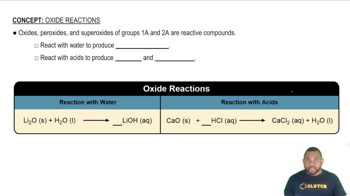
Oxide Reactions
Pratica correlata
Domanda del libro di testo

A watt is a measure of power (the rate of energy change) equal to 1 J/s. (a) Calculate the number of joules in a kilowatt-hour.

Domanda del libro di testo

(c) A spherical ball of lead has a diameter of 5.0 cm. What is the mass of the sphere if lead has a density of 11.34 g>cm3? (The volume of a sphere is 14>32pr3, where r is the radius.)

737
views
Domanda del libro di testo

A watt is a measure of power (the rate of energy change) equal to 1 J/s. (b) An adult person radiates heat to the surroundings at about the same rate as a 100-watt electric incandescent light bulb. What is the total amount of energy in kcal radiated to the surroundings by an adult over a 24 h period?

1155
views
Domanda del libro di testo

Use of the British thermal unit (Btu) is common in some types of engineering work. A Btu is the amount of heat required to raise the temperature of 1 lb of water by 1°F. Calculate the number of joules in a Btu.

884
views
Domanda del libro di testo

(a) After the label fell off a bottle containing a clear liquid believed to be benzene, a chemist measured the density of the liquid to verify its identity. A 25.0-mL portion of the liquid had a mass of 21.95 g. A chemistry handbook lists the density of benzene at 15 °C as 0.8787 g/mL. Is the calculated density in agreement with the tabulated value?

850
views
Domanda del libro di testo

(b) An experiment requires 15.0 g of cyclohexane, whose density at 25 C is 0.7781 g>mL. What volume of cyclohexane should be used?

570
views