Ch.1 - Introduction: Matter, Energy, and Measurement
Brown - Chemistry: The Central Science 14th Edition
Brown14th EditionChemistry: The Central ScienceISBN: 9780134414232Non è quello che usi tu?Cambia libro di testo
Capitolo 1, Problema 38a

(a) After the label fell off a bottle containing a clear liquid believed to be benzene, a chemist measured the density of the liquid to verify its identity. A 25.0-mL portion of the liquid had a mass of 21.95 g. A chemistry handbook lists the density of benzene at 15 °C as 0.8787 g/mL. Is the calculated density in agreement with the tabulated value?

Guida verificata passo dopo passo
1
Calculate the density of the liquid using the formula: \( \text{Density} = \frac{\text{Mass}}{\text{Volume}} \).
Substitute the given values into the formula: Mass = 21.95 g and Volume = 25.0 mL.
Perform the division to find the density of the liquid in g/mL.
Compare the calculated density with the tabulated density of benzene, which is 0.8787 g/mL.
Determine if the calculated density is close enough to the tabulated value to confirm the identity of the liquid as benzene.

Risposta video verificata per un problema simile:

Questa soluzione video è stata consigliata dai nostri tutor come utile per risolvere questo problema.
Durata del video:
1m

Concetti chiave

Ecco i concetti essenziali che devi comprendere per rispondere correttamente alla domanda.

Density

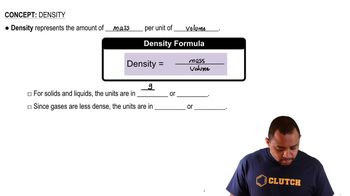
Density is defined as the mass of a substance divided by its volume, typically expressed in grams per milliliter (g/mL) for liquids. It is a physical property that can help identify substances, as different materials have characteristic densities. In this case, the density of the liquid is calculated to determine if it matches the known density of benzene.
Video consigliato:
Percorso guidato
01:56
Density Concepts

Measurement and Calculation

Accurate measurement is crucial in chemistry, as it directly affects the results of calculations. In this scenario, the chemist measures the mass of the liquid and its volume to compute the density. The formula used is density = mass/volume, where mass is given in grams and volume in milliliters, leading to a calculated density that can be compared to the standard value.
Video consigliato:
Percorso guidato
02:52
Units of Radiation Measurement

Comparison with Standard Values

Comparing calculated values with standard or tabulated values is a common practice in chemistry to verify the identity of substances. In this case, the calculated density of the liquid is compared to the known density of benzene at a specific temperature. If the values are close, it suggests that the liquid is likely benzene; significant differences may indicate a different substance.
Video consigliato:
Percorso guidato
01:10
Standard Reduction Potentials