Ch.1 - Introduction: Matter, Energy, and Measurement
Brown - Chemistry: The Central Science 14th Edition
Brown14th EditionChemistry: The Central ScienceISBN: 9780134414232Non è quello che usi tu?Cambia libro di testo
Capitolo 1, Problema 92i

Judge the following statements as true or false. If you believe a statement to be false, provide a corrected version. (i) Compounds always contain at least two different elements.

Guida verificata passo dopo passo
1
Understand the statement: "Compounds always contain at least two different elements." This is a definition-related statement in chemistry.
Recall the definition of a compound: A compound is a substance formed when two or more different elements chemically combine in fixed proportions.
Analyze the statement based on the definition: Since compounds are made of different elements, the statement that compounds always contain at least two different elements is true.
Consider exceptions or related terms: Elements themselves consist of only one type of atom, so they are not compounds. Also, mixtures are not compounds because their components are not chemically bonded.
Conclude that the statement is true and no correction is needed.

Risposta video verificata per un problema simile:

Questa soluzione video è stata consigliata dai nostri tutor come utile per risolvere questo problema.
Durata del video:
3m

Concetti chiave

Ecco i concetti essenziali che devi comprendere per rispondere correttamente alla domanda.

Definition of a Compound

A compound is a substance formed when two or more different elements chemically bond together in fixed proportions. It always contains atoms of at least two different elements, distinguishing it from pure elements or mixtures.
Video consigliato:
Percorso guidato
02:48
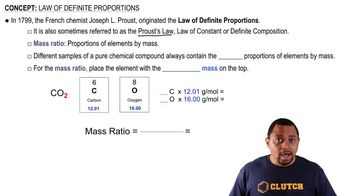
Law of Definite Proportions

Difference Between Elements and Compounds

Elements consist of only one type of atom and cannot be broken down chemically into simpler substances. Compounds, however, are made of two or more different elements chemically combined, which gives them distinct properties from their constituent elements.
Video consigliato:
Percorso guidato
02:35
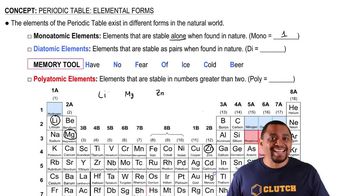
Elemental Forms of Elements

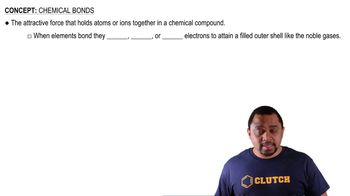
Chemical Bonding and Composition

Chemical bonds, such as covalent or ionic bonds, hold atoms together in compounds. The nature of these bonds and the specific elements involved determine the compound's properties and composition, always involving at least two different elements.
Video consigliato:
Pratica correlata
Domanda del libro di testo

Judge the following statements as true or false. If you believe a statement to be false, provide a corrected version. (g) The number 0.0033 has more significant figures than 0.033.

394
views

Domanda del libro di testo

In 2009, a team from Northwestern University and Western Washington University reported the preparation of a new 'spongy' material composed of nickel, molybdenum, and sulfur that excels at removing mercury from water. The density of this new material is 0.20 g/cm3, and its surface area is 1242 m2 per gram of material. (b) Calculate the surface area for a 10.0-mg sample of this material.

696
views
Domanda del libro di testo

Judge the following statements as true or false. If you believe a statement to be false, provide a corrected version. (d) Elements can exist in any of the three states of matter.

331
views
Domanda del libro di testo

You are assigned the task of separating a desired granular material with a density of 3.62 g/cm3 from an undesired granular material that has a density of 2.04 g/cm3. You want to do this by shaking the mixture in a liquid in which the heavier material will fall to the bottom and the lighter material will float. A solid will float on any liquid that is more dense. Using an Internet-based source or a handbook of chemistry, find the densities of the following substances: carbon tetrachloride, hexane, benzene, and diiodomethane. Which of these liquids will serve your purpose, assuming no chemical interaction takes place between the liquid and the solids?

724
views
Domanda del libro di testo

Judge the following statements as true or false. If you believe a statement to be false, provide a corrected version. (f) A hypothesis is more weakly supported by experimental evidence than a theory.

524
views