Ch.1 - Introduction: Matter, Energy, and Measurement
Brown - Chemistry: The Central Science 14th Edition
Brown14th EditionChemistry: The Central ScienceISBN: 9780134414232Non è quello che usi tu?Cambia libro di testo
Capitolo 1, Problema 93

You are assigned the task of separating a desired granular material with a density of 3.62 g/cm3 from an undesired granular material that has a density of 2.04 g/cm3. You want to do this by shaking the mixture in a liquid in which the heavier material will fall to the bottom and the lighter material will float. A solid will float on any liquid that is more dense. Using an Internet-based source or a handbook of chemistry, find the densities of the following substances: carbon tetrachloride, hexane, benzene, and diiodomethane. Which of these liquids will serve your purpose, assuming no chemical interaction takes place between the liquid and the solids?

Guida verificata passo dopo passo
1
Identify the densities of the given liquids: carbon tetrachloride, hexane, benzene, and diiodomethane.
Compare the density of each liquid to the densities of the granular materials: 3.62 g/cm^3 (desired) and 2.04 g/cm^3 (undesired).
Determine which liquid has a density greater than 2.04 g/cm^3 but less than 3.62 g/cm^3.
The liquid with a density in this range will allow the undesired material to float and the desired material to sink.
Select the liquid that meets these criteria for effective separation of the materials.

Risposta video verificata per un problema simile:

Questa soluzione video è stata consigliata dai nostri tutor come utile per risolvere questo problema.
Durata del video:
1m

Concetti chiave

Ecco i concetti essenziali che devi comprendere per rispondere correttamente alla domanda.

Density

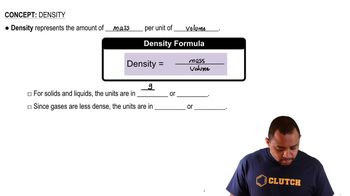
Density is defined as mass per unit volume, typically expressed in grams per cubic centimeter (g/cm³). It is a crucial property that determines whether an object will float or sink in a fluid. An object will float in a liquid if its density is less than that of the liquid. In this scenario, understanding the densities of the granular materials and the liquids is essential for effective separation.
Video consigliato:
Percorso guidato
01:56
Density Concepts

Buoyancy

Buoyancy is the upward force exerted by a fluid that opposes the weight of an object immersed in it. This principle explains why objects with lower density than the fluid will float, while those with higher density will sink. In the context of the question, selecting a liquid with a density lower than the desired material (3.62 g/cm³) but higher than the undesired material (2.04 g/cm³) is key to achieving separation through buoyancy.

Separation Techniques

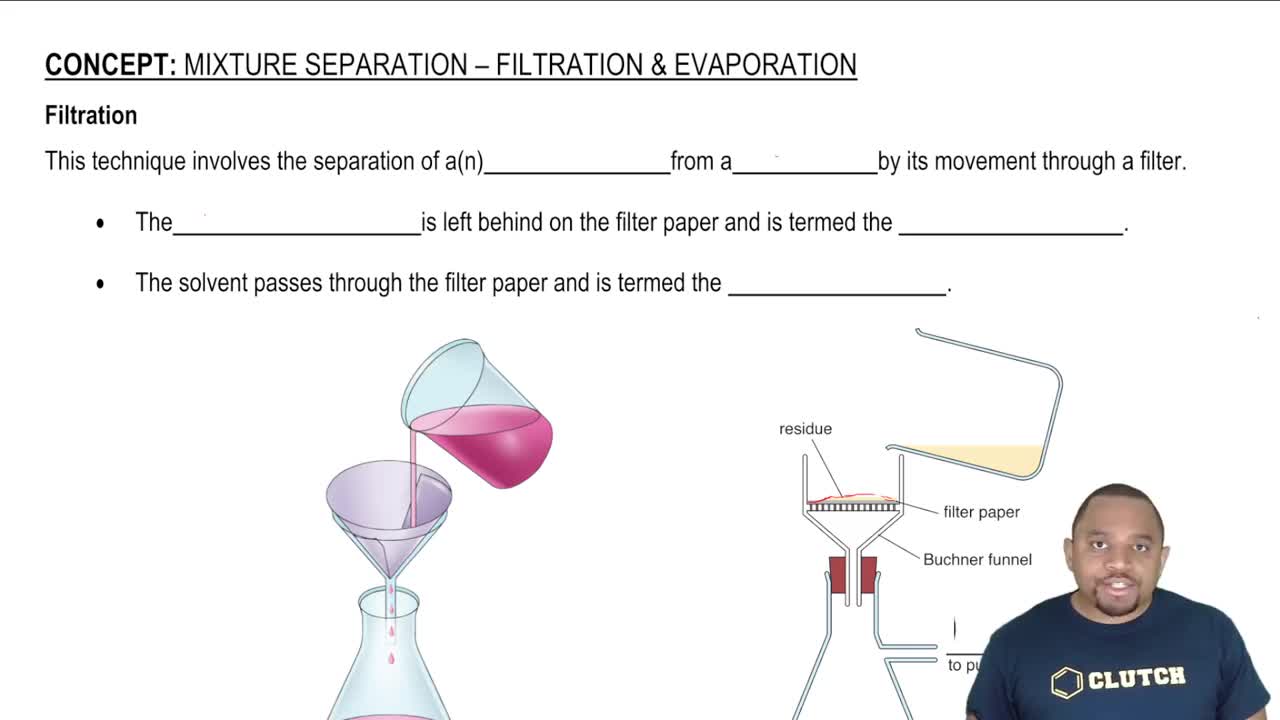
Separation techniques in chemistry involve methods used to isolate specific components from a mixture based on their physical properties. In this case, the technique of density-based separation is employed, where shaking the mixture in a suitable liquid allows for the separation of materials based on their differing densities. Understanding various separation methods is important for selecting the most effective approach for the task at hand.
Video consigliato:
Percorso guidato
04:50
Filtration and Evaporation