
Ch.10 - Gases
Brown - Chemistry: The Central Science 14th Edition
Brown14th EditionChemistry: The Central ScienceISBN: 9780134414232Non è quello che usi tu?Cambia libro di testo
Capitolo 10, Problema 41

A 50.0 g sample of solid CO2 (dry ice) is added at -100 °C to an evacuated (all of the gas removed) container with a volume of 5.0 L. If the container is sealed and then allowed to warm to room temperature 125 °C2 so that the entire solid CO2 is converted to a gas, what is the pressure inside the container?

Guida verificata passo dopo passo
1
Identify the initial and final conditions of the system. Initially, you have solid CO2 at -100 °C, and finally, you have gaseous CO2 at 25 °C in a 5.0 L container.
Convert the mass of CO2 to moles using the molar mass of CO2 (44.01 g/mol). This will help you determine the amount of gas present.
Use the Ideal Gas Law, \( PV = nRT \), to find the pressure. Here, \( P \) is the pressure, \( V \) is the volume (5.0 L), \( n \) is the number of moles of CO2, \( R \) is the ideal gas constant (0.0821 L·atm/mol·K), and \( T \) is the temperature in Kelvin.
Convert the final temperature from Celsius to Kelvin by adding 273.15 to the Celsius temperature (25 °C).
Substitute the values for \( n \), \( V \), \( R \), and \( T \) into the Ideal Gas Law equation and solve for \( P \), the pressure inside the container.

Risposta video verificata per un problema simile:

Questa soluzione video è stata consigliata dai nostri tutor come utile per risolvere questo problema.
Durata del video:
4m

Concetti chiave

Ecco i concetti essenziali che devi comprendere per rispondere correttamente alla domanda.

Ideal Gas Law

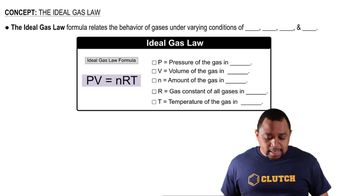
The Ideal Gas Law is a fundamental equation in chemistry that relates the pressure, volume, temperature, and number of moles of a gas. It is expressed as PV = nRT, where P is pressure, V is volume, n is the number of moles, R is the ideal gas constant, and T is temperature in Kelvin. This law is essential for calculating the pressure of gases under varying conditions.
Video consigliato:
Percorso guidato
01:15
Ideal Gas Law Formula

Molar Mass and Moles

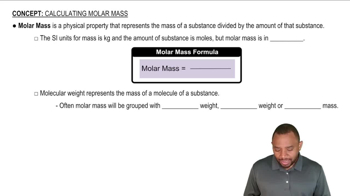
Molar mass is the mass of one mole of a substance, typically expressed in grams per mole (g/mol). To find the number of moles of a substance, you can use the formula n = mass (g) / molar mass (g/mol). In this question, knowing the molar mass of CO2 allows us to convert the mass of dry ice into moles, which is necessary for applying the Ideal Gas Law.
Video consigliato:
Percorso guidato
02:11
Molar Mass Concept

Phase Changes and Temperature Effects

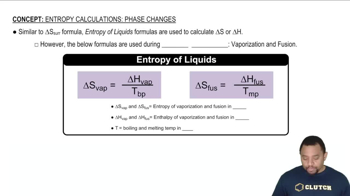
Phase changes refer to the transitions between solid, liquid, and gas states of matter, which are influenced by temperature and pressure. In this scenario, solid CO2 (dry ice) sublimates directly into gas as it warms up. Understanding how temperature affects the state of a substance is crucial for predicting the behavior of CO2 in the container as it transitions from solid to gas.
Video consigliato:
Percorso guidato
01:46
Entropy in Phase Changes