Ch.10 - Gases
Brown - Chemistry: The Central Science 14th Edition
Brown14th EditionChemistry: The Central ScienceISBN: 9780134414232Non è quello che usi tu?Cambia libro di testo
Capitolo 10, Problema 27a

(a) Amonton's law expresses the relationship between pressure and temperature. Use Charles's law and Boyle's law to derive the proportionality relationship between P and T.

Guida verificata passo dopo passo
1
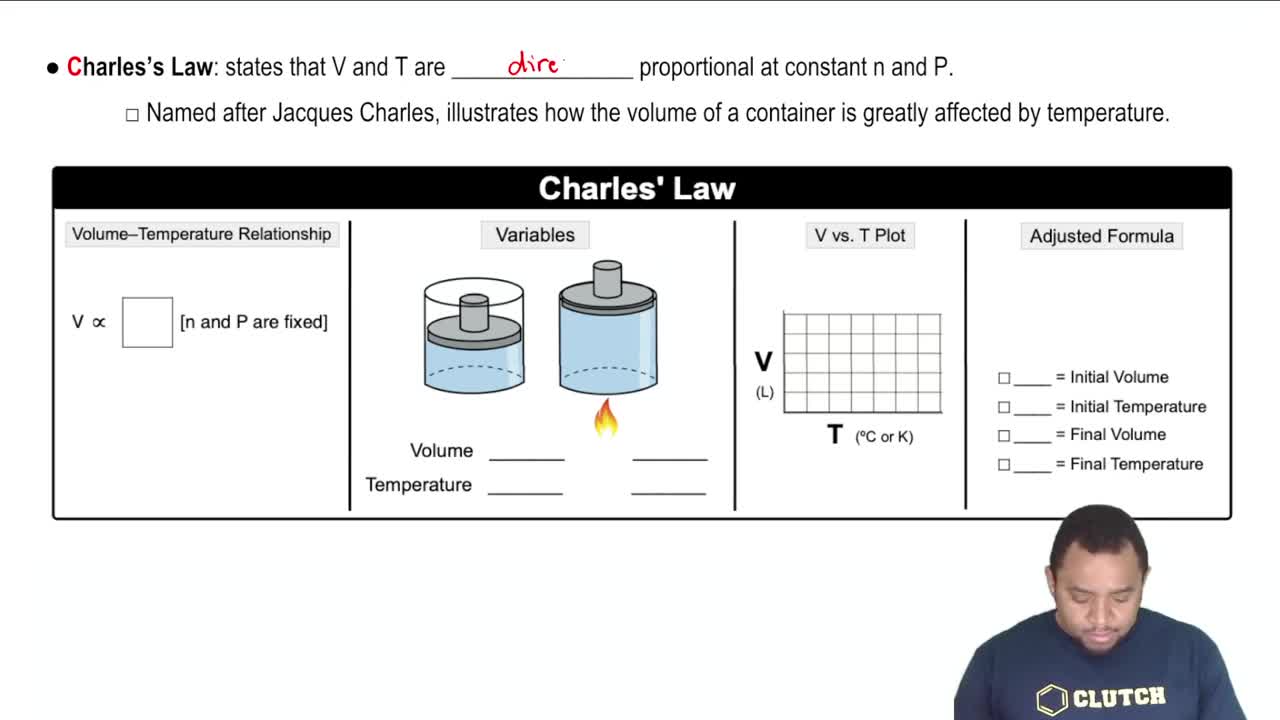
Start by recalling Charles's Law, which states that the volume of a gas is directly proportional to its temperature at constant pressure: \( V \propto T \) or \( V = kT \), where \( k \) is a constant.
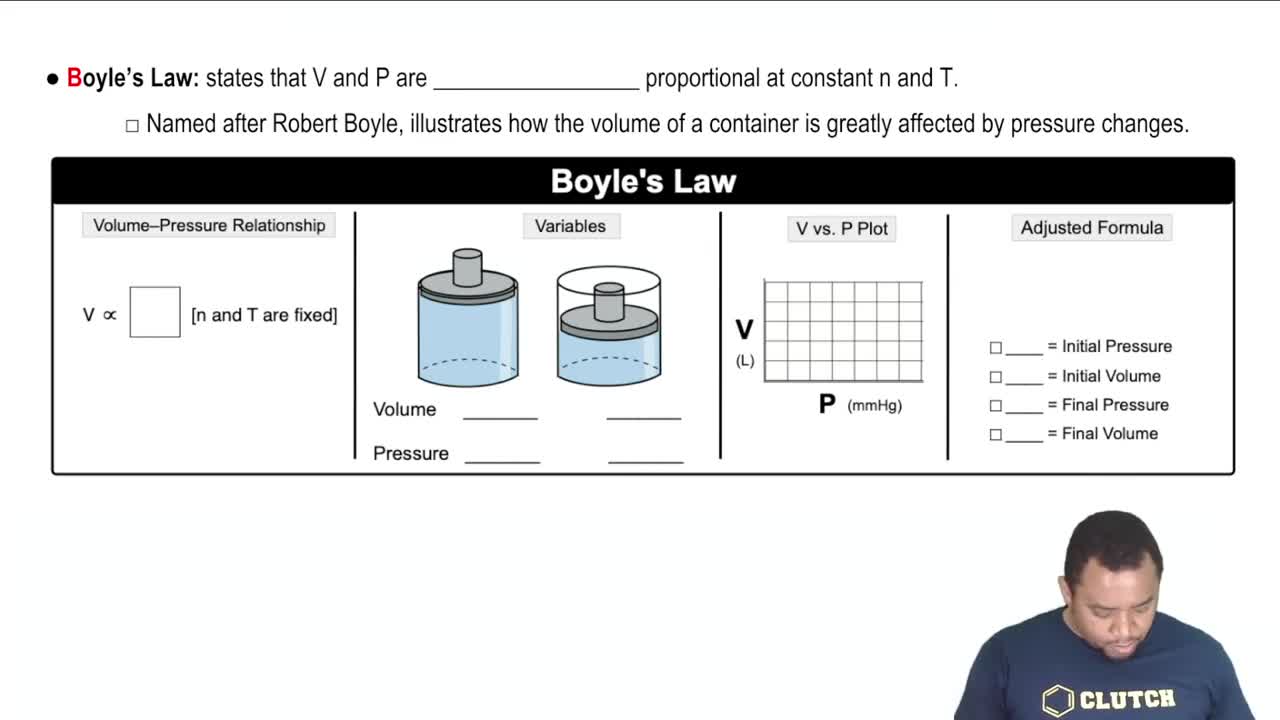
Recall Boyle's Law, which states that the pressure of a gas is inversely proportional to its volume at constant temperature: \( P \propto \frac{1}{V} \) or \( PV = k' \), where \( k' \) is a constant.
Combine the two laws by substituting the expression for \( V \) from Charles's Law into Boyle's Law: \( P(kT) = k' \).
Simplify the equation to express the relationship between pressure and temperature: \( P \propto T \) or \( P = k''T \), where \( k'' \) is a new constant.
Conclude that Amonton's Law, which is also known as Gay-Lussac's Law, states that the pressure of a gas is directly proportional to its temperature when volume is held constant.

Risposta video verificata per un problema simile:

Questa soluzione video è stata consigliata dai nostri tutor come utile per risolvere questo problema.
Durata del video:
3m

Concetti chiave

Ecco i concetti essenziali che devi comprendere per rispondere correttamente alla domanda.

Amonton's Law

Amonton's Law, also known as the pressure-temperature law, states that the pressure of a gas is directly proportional to its absolute temperature when the volume is held constant. This relationship implies that as the temperature increases, the kinetic energy of gas molecules increases, leading to higher pressure if the volume does not change.
Video consigliato:

Charles's Law

Charles's Law describes how the volume of a gas is directly proportional to its absolute temperature when pressure is held constant. This means that if the temperature of a gas increases, its volume will also increase, provided the pressure remains unchanged. This law is essential for understanding how temperature affects gas behavior.
Video consigliato:

Boyle's Law

Boyle's Law states that the pressure of a gas is inversely proportional to its volume when the temperature is held constant. This means that if the volume of a gas decreases, its pressure increases, assuming the temperature remains constant. This law is crucial for analyzing the relationships between pressure, volume, and temperature in gas systems.
Video consigliato: