
Ch.10 - Gases
Brown - Chemistry: The Central Science 14th Edition
Brown14th EditionChemistry: The Central ScienceISBN: 9780134414232Non è quello che usi tu?Cambia libro di testo
Capitolo 10, Problema 64

A deep-sea diver uses a gas cylinder with a volume of 10.0 L and a content of 51.2 g of O2 and 32.6 g of He. Calculate the partial pressure of each gas and the total pressure if the temperature of the gas is 19 °C.

Guida verificata passo dopo passo
1
Step 1: Convert the temperature from Celsius to Kelvin by adding 273.15 to the Celsius temperature. This is necessary because gas law calculations require temperature in Kelvin.
Step 2: Calculate the number of moles of each gas using the formula \( n = \frac{m}{M} \), where \( n \) is the number of moles, \( m \) is the mass of the gas, and \( M \) is the molar mass of the gas. Use the molar mass of O2 (32.00 g/mol) and He (4.00 g/mol).
Step 3: Use the ideal gas law \( PV = nRT \) to calculate the partial pressure of each gas. Rearrange the formula to \( P = \frac{nRT}{V} \), where \( P \) is the pressure, \( n \) is the number of moles, \( R \) is the ideal gas constant (0.0821 L·atm/mol·K), \( T \) is the temperature in Kelvin, and \( V \) is the volume in liters.
Step 4: Calculate the partial pressure of O2 by substituting the number of moles of O2, the ideal gas constant, the temperature in Kelvin, and the volume of the cylinder into the rearranged ideal gas law equation.
Step 5: Calculate the partial pressure of He using the same method as in Step 4, substituting the number of moles of He. Then, add the partial pressures of O2 and He to find the total pressure in the gas cylinder.

Concetti chiave

Ecco i concetti essenziali che devi comprendere per rispondere correttamente alla domanda.

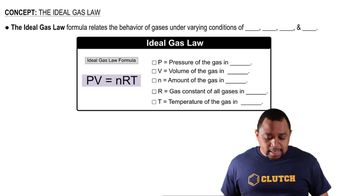
Ideal Gas Law

The Ideal Gas Law relates the pressure, volume, temperature, and number of moles of a gas through the equation PV = nRT. This law is essential for calculating the behavior of gases under various conditions, allowing us to determine the pressure exerted by a gas in a given volume at a specific temperature.
Video consigliato:
Percorso guidato
01:15
Ideal Gas Law Formula

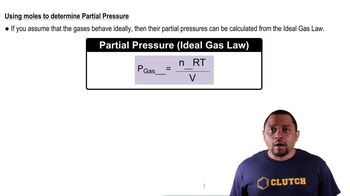
Partial Pressure

Partial pressure is the pressure that a single gas in a mixture would exert if it occupied the entire volume alone. According to Dalton's Law of Partial Pressures, the total pressure of a gas mixture is the sum of the partial pressures of each individual gas, which is crucial for solving the problem at hand.
Video consigliato:
Percorso guidato
00:48
Partial Pressure Calculation

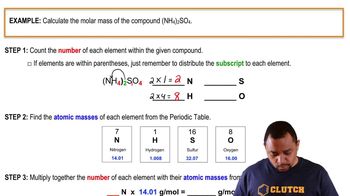
Molar Mass and Moles Calculation

To calculate the partial pressures, it is necessary to convert the mass of each gas into moles using their respective molar masses. This conversion is vital for applying the Ideal Gas Law, as the number of moles (n) directly influences the pressure calculation for each gas in the mixture.
Video consigliato:
Percorso guidato
03:12
Molar Mass Calculation Example
Pratica correlata
Domanda del libro di testo
A piece of dry ice (solid carbon dioxide) with a mass of 20.0 g is placed in a 25.0-L vessel that already contains air at 50.66 kPa and 25 °C. After the carbon dioxide has totally sublimed, what is the partial pressure of the resultant CO2 gas, and the total pressure in the container at 25 °C?
1245
views
Domanda del libro di testo

Consider the apparatus shown in the following drawing. (a) When the valve between the two containers is opened and the gases are allowed to mix, what is the partial pressure of N2 after mixing?

1135
views
Domanda del libro di testo

Consider a mixture of two gases, A and B, confined in a closed vessel. A quantity of a third gas, C, is added to the same vessel at the same temperature. How does the addition of gas C affect the following: (a) the partial pressure of gas A?

835
views
Domanda del libro di testo

The atmospheric concentration of CO2 gas is presently 407 ppm (parts per million, by volume; that is, 407 L of every 106 L of the atmosphere are CO2). What is the mole fraction of CO2 in the atmosphere?.

1953
views
Domanda del libro di testo
A plasma-screen TV contains thousands of tiny cells filled with a mixture of Xe, Ne, and He gases that emits light of specific wavelengths when a voltage is applied. A particular plasma cell, 0.900 mm * 0.300 mm * 10.0 mm, contains 4% Xe in a 1:1 Ne:He mixture at a total pressure of 66.66 kPa. Calculate the number of Ne atoms in the cell and state the assumptions you need to make in your calculation.
864
views