
Ch.10 - Gases
Brown - Chemistry: The Central Science 14th Edition
Brown14th EditionChemistry: The Central ScienceISBN: 9780134414232Non è quello che usi tu?Cambia libro di testo
Capitolo 10, Problema 87

Arsenic(III) sulfide sublimes readily, even below its melting point of 320 °C. The molecules of the vapor phase are found to effuse through a tiny hole at 0.52 times the rate of effusion of Xe atoms under the same conditions of temperature and pressure. What is the molecular formula of arsenic(III) sulfide in the gas phase?

Guida verificata passo dopo passo
1
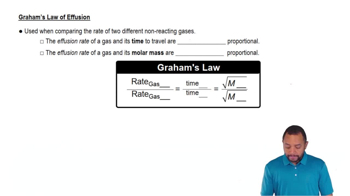
Use Graham's law of effusion, which states that the rate of effusion of a gas is inversely proportional to the square root of its molar mass: \( \frac{\text{Rate}_1}{\text{Rate}_2} = \sqrt{\frac{M_2}{M_1}} \).
Identify the given rates of effusion: the rate of effusion of arsenic(III) sulfide is 0.52 times that of xenon (Xe).
Set up the equation using Graham's law: \( 0.52 = \sqrt{\frac{M_{\text{Xe}}}{M_{\text{As}_x\text{S}_y}}} \), where \( M_{\text{Xe}} \) is the molar mass of xenon.
Square both sides of the equation to solve for the molar mass of arsenic(III) sulfide: \( 0.52^2 = \frac{M_{\text{Xe}}}{M_{\text{As}_x\text{S}_y}} \).
Calculate the molar mass of arsenic(III) sulfide using the known molar mass of xenon (131.29 g/mol) and determine the molecular formula by comparing the calculated molar mass to possible combinations of arsenic and sulfur atoms.

Risposta video verificata per un problema simile:

Questa soluzione video è stata consigliata dai nostri tutor come utile per risolvere questo problema.
Durata del video:
6m

Concetti chiave

Ecco i concetti essenziali che devi comprendere per rispondere correttamente alla domanda.

Effusion and Graham's Law

Effusion is the process by which gas molecules escape through a tiny hole into a vacuum. Graham's Law states that the rate of effusion of a gas is inversely proportional to the square root of its molar mass. This means that lighter gases effuse faster than heavier gases, allowing us to compare the effusion rates of different substances to deduce their molar masses.
Video consigliato:
Percorso guidato
2:03
Graham's Law of Effusion

Molecular Formula

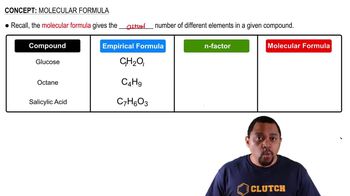
The molecular formula of a compound indicates the number and type of atoms present in a molecule. For arsenic(III) sulfide, the formula can be derived from the stoichiometry of the elements involved. Understanding how to determine the molecular formula from empirical data, such as effusion rates, is crucial for identifying the compound in question.
Video consigliato:
Percorso guidato
02:08
Determining Molecular Formulas

Molar Mass Calculation

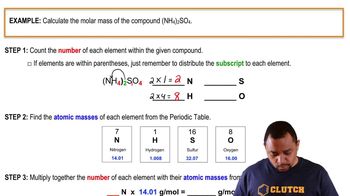
To find the molecular formula of arsenic(III) sulfide, we need to calculate its molar mass based on the effusion rate compared to xenon (Xe). By using the known molar mass of xenon and the ratio of effusion rates, we can derive the molar mass of arsenic(III) sulfide, which will help us confirm its molecular formula in the gas phase.
Video consigliato:
Percorso guidato
03:12
Molar Mass Calculation Example
Pratica correlata
Domanda del libro di testo

A gas of unknown molecular mass was allowed to effuse through a small opening under constant-pressure conditions. It required 105 s for 1.0 L of the gas to effuse. Under identical experimental conditions it required 31 s for 1.0 L of O2 gas to effuse. Calculate the molar mass of the unknown gas. (Remember that the faster the rate of effusion, the shorter the time required for effusion of 1.0 L; in other words, rate is the amount that diffuses over the time it takes to diffuse.)

1825
views
Domanda del libro di testo

The planet Jupiter has a surface temperature of 140 K and a mass 318 times that of Earth. Mercury (the planet) has a surface temperature between 600 K and 700 K and a mass 0.05 times that of Earth. On which planet is the atmosphere more likely to obey the ideal-gas law? Explain.

1231
views
Domanda del libro di testo

(b) List two reasons why the gases deviate from ideal behavior.

746
views
1
rank
Domanda del libro di testo

Hydrogen has two naturally occurring isotopes, 1H and 2H. Chlorine also has two naturally occurring isotopes, 35Cl and 37Cl. Thus, hydrogen chloride gas consists of four distinct types of molecules: 1H35Cl, 1H37Cl, 2H35Cl, and 2H37Cl. Place these four molecules in order of increasing rate of effusion.

1412
views
Domanda del libro di testo

At constant pressure, the mean free path 1l2 of a gas molecule is directly proportional to temperature. At constant temperature, l is inversely proportional to pressure. If you compare two different gas molecules at the same temperature and pressure, l is inversely proportional to the square of the diameter of the gas molecules. Put these facts together to create a formula for the mean free path of a gas molecule with a proportionality constant (call it Rmfp, like the ideal-gas constant) and define units for Rmfp.

951
views