
Ch.10 - Gases
Brown - Chemistry: The Central Science 14th Edition
Brown14th EditionChemistry: The Central ScienceISBN: 9780134414232Non è quello che usi tu?Cambia libro di testo
Capitolo 10, Problema 89

(b) List two reasons why the gases deviate from ideal behavior.

Guida verificata passo dopo passo
1
1. Real gases deviate from ideal behavior because the ideal gas law assumes that gas particles are point particles, meaning they occupy no volume. However, in reality, gas particles do have a finite volume. When the pressure of a gas is very high, or the volume is very low, the volume of the gas particles becomes significant compared to the total volume in which the gas is contained. This causes the gas to deviate from ideal behavior.
2. The ideal gas law also assumes that there are no intermolecular attractions or repulsions between gas particles. But in reality, gas particles do experience intermolecular forces. When a gas is at a low temperature or high pressure, these forces become significant, causing the gas to deviate from ideal behavior.

Risposta video verificata per un problema simile:

Questa soluzione video è stata consigliata dai nostri tutor come utile per risolvere questo problema.
Durata del video:
5m

Concetti chiave

Ecco i concetti essenziali che devi comprendere per rispondere correttamente alla domanda.

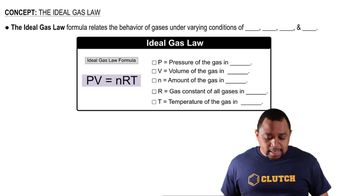
Ideal Gas Law

The Ideal Gas Law describes the behavior of an ideal gas through the equation PV=nRT, where P is pressure, V is volume, n is the number of moles, R is the ideal gas constant, and T is temperature. Ideal gases are assumed to have no intermolecular forces and occupy no volume. However, real gases deviate from this behavior under certain conditions, particularly at high pressures and low temperatures.
Video consigliato:
Percorso guidato
01:15
Ideal Gas Law Formula

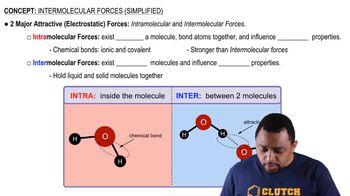
Intermolecular Forces

Intermolecular forces are the attractive forces between molecules that can affect their behavior in a gas phase. In ideal gas behavior, these forces are negligible, but in real gases, they can lead to deviations from ideality. For example, stronger intermolecular forces can cause gases to condense into liquids, especially at lower temperatures, leading to lower pressures than predicted by the Ideal Gas Law.
Video consigliato:
Percorso guidato
01:59
Intermolecular vs Intramolecular Forces

Molecular Volume

Molecular volume refers to the actual space occupied by gas molecules. In the Ideal Gas Law, it is assumed that gas molecules have no volume, but in reality, they do occupy space. At high pressures, the volume of the gas molecules becomes significant compared to the volume of the container, causing deviations from ideal behavior as the gas cannot be compressed indefinitely.
Video consigliato:
Percorso guidato
02:35
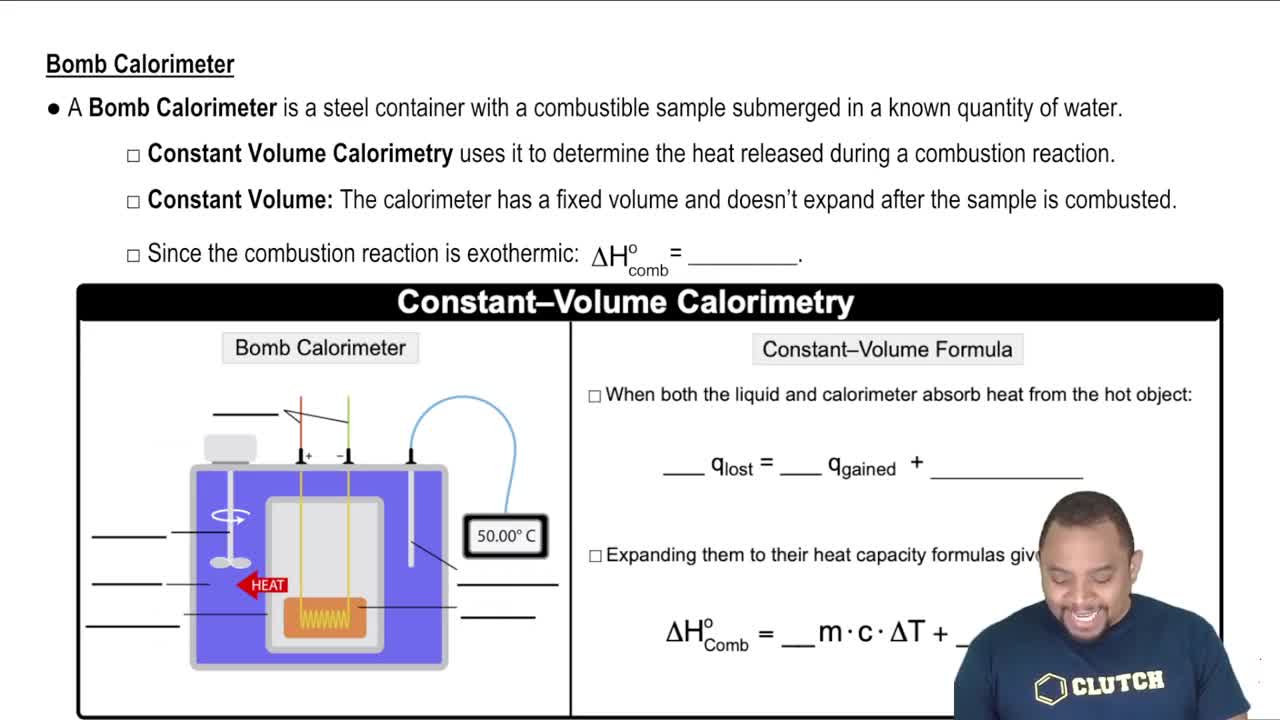
Constant-Volume Calorimetry
Pratica correlata
Domanda del libro di testo

A gas of unknown molecular mass was allowed to effuse through a small opening under constant-pressure conditions. It required 105 s for 1.0 L of the gas to effuse. Under identical experimental conditions it required 31 s for 1.0 L of O2 gas to effuse. Calculate the molar mass of the unknown gas. (Remember that the faster the rate of effusion, the shorter the time required for effusion of 1.0 L; in other words, rate is the amount that diffuses over the time it takes to diffuse.)

1825
views
Domanda del libro di testo

The planet Jupiter has a surface temperature of 140 K and a mass 318 times that of Earth. Mercury (the planet) has a surface temperature between 600 K and 700 K and a mass 0.05 times that of Earth. On which planet is the atmosphere more likely to obey the ideal-gas law? Explain.

1231
views
Domanda del libro di testo

Arsenic(III) sulfide sublimes readily, even below its melting point of 320 °C. The molecules of the vapor phase are found to effuse through a tiny hole at 0.52 times the rate of effusion of Xe atoms under the same conditions of temperature and pressure. What is the molecular formula of arsenic(III) sulfide in the gas phase?

1628
views
Domanda del libro di testo
Based on their respective van der Waals constants ( Table 10.3), is Ar or CO2 expected to behave more nearly like an ideal gas at high pressures?
993
views
Domanda del libro di testo

Which statement concerning the van der Waals constants a and b is true? (a) The magnitude of a relates to molecular volume, whereas b relates to attractions between molecules. (b) The magnitude of a relates to attractions between molecules, whereas b relates to molecular volume. (c) The magnitudes of a and b depend on pressure. (d) The magnitudes of a and b depend on temperature.

1795
views