
A sample of 3.00 g of SO2(g) originally in a 5.00-L vessel at 21 °C is transferred to a 10.0-L vessel at 26 °C. A sample of 2.35 g of N2(g) originally in a 2.50-L vessel at 20 °C is transferred to this same 10.0-L vessel. (c) What is the total pressure in the vessel?
Ch.10 - Gases
Brown14th EditionChemistry: The Central ScienceISBN: 9780134414232Non è quello che usi tu?Cambia libro di testo
Capitolo 10, Problema 72b
(b) What is the partial pressure in atm of each component of this mixture if its held in a 15.50-L vessel at 15 °C?
Guida verificata passo dopo passo1
Step 1: Begin by identifying the components of the gas mixture. You will need the number of moles of each gas present in the mixture.
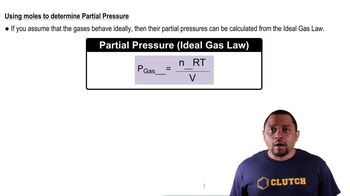
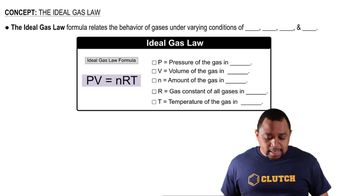
Step 2: Use the Ideal Gas Law, which is expressed as , where is the pressure, is the volume, is the number of moles, is the ideal gas constant, and is the temperature in Kelvin.
Step 3: Convert the temperature from Celsius to Kelvin using the formula . For 15 °C, calculate the temperature in Kelvin.
Step 4: Calculate the partial pressure of each gas using the Ideal Gas Law. Rearrange the formula to solve for pressure: . Substitute the values for each gas component.
Step 5: Ensure that the units are consistent, particularly for the ideal gas constant , which is typically L atm/mol K. Calculate the partial pressure for each component in atm.

Risposta video verificata per un problema simile:
Questa soluzione video è stata consigliata dai nostri tutor come utile per risolvere questo problema.
Durata del video:
6mConcetti chiave
Ecco i concetti essenziali che devi comprendere per rispondere correttamente alla domanda.
Partial Pressure
Partial pressure is the pressure exerted by a single component of a gas mixture. According to Dalton's Law of Partial Pressures, the total pressure of a gas mixture is equal to the sum of the partial pressures of its individual components. This concept is crucial for calculating the contribution of each gas in a mixture to the overall pressure in a confined space.
Video consigliato:
Percorso guidato
Partial Pressure Calculation
Ideal Gas Law
The Ideal Gas Law relates the pressure, volume, temperature, and number of moles of a gas through the equation PV = nRT. This law is essential for determining the behavior of gases under various conditions. In this context, it can be used to calculate the partial pressures of each gas in the mixture when the total volume and temperature are known.
Video consigliato:
Percorso guidato
Ideal Gas Law Formula
Gas Mixtures
Gas mixtures consist of two or more gases that occupy the same volume and exert pressure independently. The behavior of each gas in a mixture can be analyzed separately, allowing for the application of the Ideal Gas Law to each component. Understanding how to treat gas mixtures is vital for accurately calculating the partial pressures of each gas in a given volume and temperature.
Video consigliato:
Percorso guidato
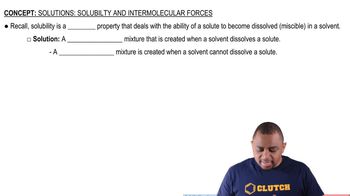
Solubility and Mixtures
Pratica correlata
Domanda del libro di testo
(a) What are the mole fractions of H2 in a mixture of 15.08 g of O2, 8.17 g of N2, and 2.64 g of H2?
774
views
Domanda del libro di testo
A sample of 3.00 g of SO2(g) originally in a 5.00-L vessel at 21 °C is transferred to a 10.0-L vessel at 26 °C. A sample of 2.35 g of N2(g) originally in a 2.50-L vessel at 20 °C is transferred to this same 10.0-L vessel. (a) What is the partial pressure of SO2(g) in the larger container? (b) What is the partial pressure of N2(g) in this vessel?
491
views
Domanda del libro di testo
(a) What are the mole fractions of N2 in a mixture of 15.08 g of O2, 8.17 g of N2, and 2.64 g of H2?
884
views
Domanda del libro di testo
A quantity of N2 gas originally held at 531.96 kPa pressure
in a 1.00-L container at 26 °C is transferred to a 12.5-L container
at 20 °C. A quantity of O2 gas originally at 531.96 kPa
and 26 °C in a 5.00-L container is transferred to this same
container. What is the total pressure in the new container?
802
views
Domanda del libro di testo
(a) What are the mole fractions of O2 in a mixture of 15.08 g of O2, 8.17 g of N2, and 2.64 g of H2?
917
views
